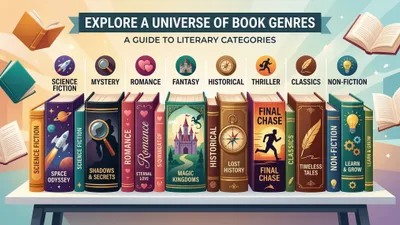
A nonfiction book is a written work based on facts, real events, real people, or real ideas — not invented stories. Nonfiction books inform, instruct, persuade, or document reality, covering everything from biographies and history to self-help, business, and how-to guides.
If you’re researching nonfiction because you want to read more of it, write your own, or just settle a debate about which shelf a book belongs on — this guide gives you the definition, the categories, and clear examples.
In this guide, you’ll learn:
- The exact definition of a nonfiction book
- The main types of nonfiction (with examples)
- How nonfiction differs from fiction
- Whether memoirs, essays, and journalism count as nonfiction
Here’s everything you need to know.
What Is a Nonfiction Book?
A nonfiction book is any book whose content is presented as factually true. The author commits to accuracy: real people are named, real events are described, and real ideas are explained. Nonfiction includes biographies, histories, self-help, science, business, cookbooks, and instructional guides — anything not invented for storytelling alone.
The word literally means “not fiction.” If a book is based on real events, real research, or real expertise — and the author isn’t making things up — it’s nonfiction.
The Main Types of Nonfiction Books
Nonfiction is a huge category. Most nonfiction books fall into one of these subgenres:
| Type | What It Is | Example |
|---|---|---|
| Biography | The story of a real person’s life, written by someone else | Steve Jobs by Walter Isaacson |
| Autobiography / Memoir | A person’s story written by themselves | Becoming by Michelle Obama |
| Self-Help | Practical advice for personal improvement | Atomic Habits by James Clear |
| History | Account of past events and eras | Sapiens by Yuval Noah Harari |
| Business | Strategy, leadership, entrepreneurship | Good to Great by Jim Collins |
| How-To / Instructional | Step-by-step guidance for a skill | On Writing by Stephen King |
| Science & Nature | Explains scientific concepts or the natural world | A Brief History of Time by Stephen Hawking |
| True Crime | Real criminal cases and investigations | In Cold Blood by Truman Capote |
| Travel | Real journeys, places, and cultures | Eat, Pray, Love by Elizabeth Gilbert |
| Religion & Spirituality | Faith, philosophy, and spiritual practice | The Power of Now by Eckhart Tolle |
| Cookbooks | Recipes and culinary instruction | Salt, Fat, Acid, Heat by Samin Nosrat |
| Reference | Dictionaries, encyclopedias, almanacs | Merriam-Webster Dictionary |
| Academic / Textbook | Scholarly work for study and research | College textbooks, journal anthologies |
| Essay Collections | Curated nonfiction essays by one or more authors | Bad Feminist by Roxane Gay |
That’s the short list — the Library of Congress catalogs dozens more nonfiction subcategories.
Nonfiction vs. Fiction: What’s the Difference?
The simplest test is this: fiction is invented; nonfiction is true. A novel about a wizard school is fiction. A biography of J.K. Rowling is nonfiction.
Here’s the difference at a glance:
| Fiction | Nonfiction | |
|---|---|---|
| Source | Invented by the author | Based on facts and real events |
| Purpose | Entertain, explore emotions, tell a story | Inform, instruct, persuade, document |
| Characters | Made up (or fictionalized) | Real people |
| Structure | Plot-driven (rising action, climax) | Argument-driven or topic-driven |
| Truth standard | None — anything goes | Accuracy expected |
Some books blur the line. Creative nonfiction uses storytelling techniques (scenes, dialogue, character) to tell true stories — memoirs and literary journalism live here. They’re still nonfiction because the events actually happened.
Is a Memoir Nonfiction?
Yes — a memoir is nonfiction. A memoir is a first-person account of real experiences from the author’s own life. It uses narrative techniques to tell a true story, but the events, people, and emotions are real. Memoirs sit inside the broader category of autobiography.
Is an Essay Collection Nonfiction?
Yes — most essay collections are nonfiction. An essay is a short piece of prose that explores a real topic, idea, or experience from the author’s perspective. Famous essayists like Joan Didion, James Baldwin, and Roxane Gay all wrote nonfiction essays. (Fiction does occasionally appear in “essay” form, but it’s rare and usually labeled as such.)
What About Journalism and True Crime?
Both are nonfiction. Journalism is reporting on real events, people, and issues. True crime is a nonfiction subgenre that investigates real criminal cases. Books like In Cold Blood and The Devil in the White City use novelistic prose, but the underlying facts are real and researched — making them nonfiction.
Common Nonfiction Book Lengths
Nonfiction books vary widely in length depending on subgenre. Here’s a rough guide:
- Self-help / Business: 40,000–60,000 words
- Memoir: 70,000–90,000 words
- History / Biography: 80,000–120,000+ words
- How-To Guides: 25,000–50,000 words
- Cookbooks: Word count varies — recipes drive the length
For more detail on book length by category, see our guide to how many words are in a book.
How Are Nonfiction Books Written?
Nonfiction writing usually starts with research, expertise, or personal experience — then moves through outlining, drafting, fact-checking, and editing. Modern authors often use AI writing tools to speed up the research and drafting phases without sacrificing accuracy.
Our Pick — Chapter
Chapter is built specifically for nonfiction authors. It helps you outline, research, and draft a full-length nonfiction book using AI, then refine each chapter with your own voice and expertise. Over 2,147 authors have used it to create more than 5,000 books.
Best for: Nonfiction authors writing self-help, business, how-to, and expert-led books Pricing: $97 one-time Why we built it: Most AI tools are built for fiction. Nonfiction authors needed something that respected accuracy, structure, and authority — so we made it.
Related Resources
- How to Write a Nonfiction Book in 30 Days
- Nonfiction Book Outline Template
- Best AI Writing Software for Nonfiction Authors
FAQ
What is a nonfiction book in simple terms?
A nonfiction book is a book based on real facts, real people, or real events — not invented stories. It informs, instructs, or documents reality, and includes categories like biography, self-help, history, business, science, and how-to guides.
What are the 5 most popular types of nonfiction books?
The five most popular nonfiction categories are self-help, biography/memoir, business, history, and how-to/instructional books. According to Publishers Weekly, self-help and memoir consistently dominate adult nonfiction bestseller lists year after year.
Is a textbook a nonfiction book?
Yes, a textbook is a nonfiction book. Textbooks present factual information for educational purposes — math, science, history, language, and more. They’re one of the oldest and most widely produced forms of nonfiction.
Can a nonfiction book include opinions?
Yes — nonfiction books can include opinions, arguments, and analysis, as long as the underlying facts are accurate. Op-eds, essays, business books, and persuasive nonfiction all combine factual information with the author’s perspective. The line is honesty, not neutrality.
Is the Bible a fiction or nonfiction book?
The Bible is typically classified as nonfiction by libraries and bookstores, usually shelved under religion or spirituality. Whether you read it as historical, theological, or literary text, it’s catalogued alongside other religious and philosophical works rather than with novels.