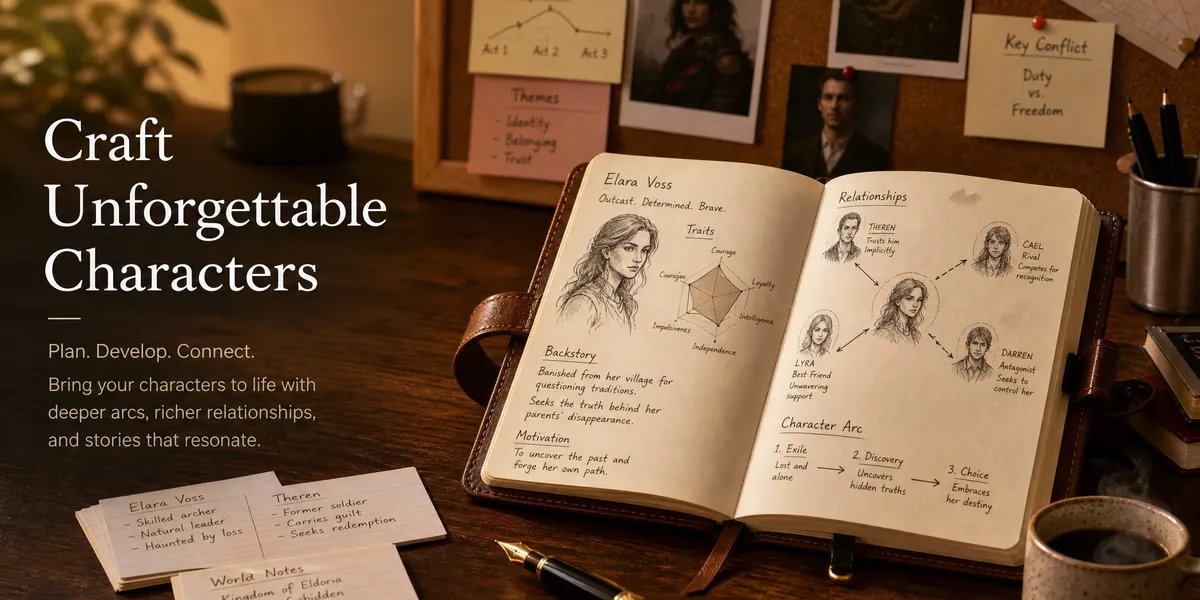
A character development template is a structured framework that walks you through building a fictional character from the inside out — covering identity, psychology, backstory, goals, flaws, and how they change across your story.
In this guide, you’ll learn:
- The 7 sections every character development template needs (with a free copy-paste version)
- How to map your character’s internal arc alongside your plot
- The “Want vs. Need” framework that professional authors use to create tension
- How to adapt your template for protagonists, antagonists, and side characters
Here’s the complete template, plus how to use each section.
What Is a Character Development Template?
A character development template is a planning document that helps you design fictional characters with psychological depth, clear motivation, and a believable transformation arc. Unlike a basic character profile template — which focuses on surface details like appearance, demographics, and backstory facts — a development template tracks how your character changes over the course of your story.
Think of it this way. A profile tells you who your character is on page one. A development template tells you who they become by the final chapter — and maps every turning point in between.
The best character development templates combine two things: a snapshot of who the character is at the start (their identity, psychology, and worldview) and a progression map showing how events force them to grow, break, or transform.
Why You Need a Character Development Template
Pantsing your way through a novel works for some writers — until your protagonist starts making decisions that contradict everything you established about them in chapter two. A character development template prevents that.
Here’s what it gives you:
- Consistency — Your character’s voice, decisions, and reactions stay true to who they are, even across a 90,000-word manuscript
- Built-in conflict — When you define a character’s Want (external goal) and Need (internal truth), every scene becomes a tug-of-war between them
- Faster drafting — Writers who plan characters upfront spend less time stuck in the middle of their draft wondering “what would this person actually do here?”
Over 10,000 authors have used Chapter to plan and write their books, and the ones who develop characters before drafting consistently finish faster. The platform’s AI-assisted workflow encourages you to build character foundations first — so your draft has direction from page one.
The Complete Character Development Template (Free & Copy-Paste)
Below is a full character development template you can copy directly into your writing tool, notebook, or book outline. Each section builds on the last, moving from external identity to internal psychology to story-level transformation.
Section 1: Core Identity
This is the foundation. Start with the facts that anchor your character in a specific world.
- Full name (including nicknames, aliases, or titles)
- Age and life stage (teenager finding identity? Midlife crisis? Elder with regrets?)
- Role in the story (protagonist, antagonist, mentor, love interest, foil)
- Occupation (what they do for money — and whether they love or hate it)
- One-sentence summary (e.g., “A burned-out ER nurse who stopped believing she could save anyone”)
The one-sentence summary is the most important line on this template. If you can distill your character into a single sentence that contains both a fact and an emotional wound, you have a character worth writing.
Section 2: Psychology and Personality
This is where your character stops being a name on a page and starts feeling like a person. Dig into how they think, what they value, and where they break.
- Dominant character traits (pick 3-5 that define their default behavior)
- Core belief (the worldview they operate from — “people always leave,” “hard work fixes everything,” “love makes you weak”). The Enneagram personality system is one useful framework for identifying core beliefs and fear patterns.
- Emotional default (how they respond to stress — anger? Withdrawal? Humor? Control?)
- Communication style (blunt? Evasive? Charming? Formal?)
- What makes them laugh (humor reveals character faster than almost anything else)
- What they’d never admit (the secret even they don’t want to look at)
A strong psychological profile creates consistency in your writing. When you know your character’s core belief is “I don’t deserve good things,” you’ll instinctively write them sabotaging their own happiness — and readers will recognize the pattern even before the character does. The Myers-Briggs framework is another starting point for thinking about how different personality types process conflict.
Section 3: Backstory and Wound
Every compelling character carries a wound from their past — an event or pattern that shaped their current worldview and created the flaw holding them back. As writing coach K.M. Weiland explains, the “Lie Your Character Believes” is the foundation of every meaningful character arc.
- Defining childhood moment (the memory they’d describe in therapy)
- The wound (what happened that broke something in them)
- The lie (the false belief they built from that wound — e.g., “If I’m perfect, no one will leave me”)
- How the wound manifests today (self-sabotage, avoidance, overcompensation, mistrust)
- Relationship with family (close? Estranged? Complicated? Dead?)
- Key formative relationships (the person who shaped them most, for better or worse)
You don’t need to include all of this backstory in your novel. Most of it stays invisible. But you need to know it, because it drives every choice your character makes.
Section 4: Want vs. Need (The Engine of Your Story)
This is the single most important section of any character development template. The tension between Want and Need is what generates your entire character arc.
- The Want (external, concrete goal — “find the murderer,” “win the competition,” “get the promotion”)
- The Need (internal truth they must learn — “vulnerability isn’t weakness,” “I’m worthy of love,” “revenge won’t bring peace”)
- Why they can’t see the Need yet (their lie and wound block them)
- What happens if they get the Want but not the Need (empty victory, hollow success)
- What happens if they get the Need but not the Want (bittersweet growth, meaningful loss)
In The Great Gatsby, Gatsby’s Want is to win Daisy back. His Need is to stop living in the past. He gets neither — and that’s the tragedy. In a romance, your heroine might Want to land the promotion (external) while Needing to learn she’s more than her productivity (internal).
This framework works for every genre. If you’re writing genre fiction, Chapter’s AI writing tools can help you brainstorm Want vs. Need combinations that fit your story’s structure.
Section 5: Character Arc Map
This is what separates a character development template from a static character profile. You’re mapping how your character transforms across your story’s structure.
| Story Beat | Character State | Key Moment |
|---|---|---|
| Opening | Defined by their lie/wound. Pursuing the Want. | Show them in their “normal world” — flawed but functioning |
| Inciting incident | Forced out of comfort zone. The Want becomes urgent. | The event that makes standing still impossible |
| Rising action | Testing the lie. Small cracks appear. | Scenes where the old approach starts failing |
| Midpoint shift | Glimpse of the Need. A moment of partial truth. | The scene where they almost change but pull back |
| Dark moment | The lie collapses. Rock bottom. | Everything they’ve been avoiding catches up |
| Climax | Choose: cling to the lie or embrace the Need. | The decision that defines their arc |
| Resolution | Transformed (or broken, if negative arc). | Show the “new normal” — how they’ve changed |
Fill in specific scenes from your story for each beat. This becomes your character arc roadmap.
Not every character follows a positive arc. Antagonists often follow a negative arc (doubling down on the lie) or a flat arc (they already have the truth and change the world around them). The template works for all three — just adjust the climax outcome.
Section 6: Relationships and Dynamics
Characters don’t exist in isolation. The people around them reveal different sides of who they are — and often drive the transformation you mapped in Section 5.
For each major relationship, define:
- Character name and role (best friend, rival, love interest, mentor)
- What this person represents (a mirror, a foil, a temptation, a truth-teller)
- The dynamic (who has power? Who needs whom? What’s the unspoken tension?)
- How this relationship changes (does it deepen? Break? Reverse?)
- One scene that defines the relationship (the moment readers will remember)
Pay special attention to your character foils — characters who reflect your protagonist’s traits back at them, often in opposite ways. A reckless protagonist paired with a cautious best friend creates natural tension in every scene they share.
Section 7: Voice and Signature Details
This final section brings your character off the page and into the reader’s senses. These are the details that make a character feel alive rather than documented.
- Speech pattern (short sentences? Academic vocabulary? Slang? Sarcasm as default?)
- Physical habit when nervous (cracks knuckles, touches their hair, goes completely still)
- Object they always carry (a watch, a specific pen, a photo, a lucky coin)
- Sensory anchor (what smell, sound, or taste transports them to a memory?)
- Contradiction (one thing about them that surprises people — the tough guy who bakes, the introvert who karaokes)
These micro-details are where showing rather than telling lives. You won’t describe your character’s anxiety — you’ll show them pressing their thumbnail into their palm under the table during a meeting.
How to Use This Template for Different Character Types
You don’t need the same depth for every character. Here’s how to scale the template.
Protagonist: Fill out all 7 sections in full. This is the character your reader spends the entire book with — they need the deepest development.
Antagonist: Focus on Sections 2, 3, and 4. A great villain needs a clear psychology, a wound that explains (but doesn’t excuse) their actions, and a Want/Need structure. Read more on writing compelling antagonists.
Major supporting characters: Sections 1, 2, 4, and 6. They need personality, motivation, and a clear relationship dynamic with your protagonist.
Minor characters: Section 1 and one line from Section 7 (their signature detail). A taxi driver who whistles the same tune in every scene is more memorable than one with a full backstory you never use.
How to Fill Out a Character Development Template With AI
If you’re staring at a blank template, AI writing tools can help you brainstorm and iterate faster than working alone.
Here’s a workflow that works:
- Start with Section 4 (Want vs. Need) — this is the hardest part. Ask your AI tool to generate five Want/Need combinations for your genre and premise.
- Work backward to Section 3 — Once you know the Need, ask: “What wound would make a person unable to see this truth?” That’s your backstory.
- Build forward to Section 5 — Use the character arc map to plot specific scenes where the lie cracks.
- Fill in Sections 1, 2, 6, and 7 last — these are easier once you know the internal structure.
Chapter is built for this workflow. Over, and its AI assists you through character development as part of the outlining process — not as an afterthought. You feed it your character’s core conflict, and it helps you brainstorm scenes, dialogue, and arcs that stay consistent.
If you want more prompt-based approaches, check out our guide to AI prompts for character development.
Character Development Template Examples by Genre
The core template stays the same across genres, but the emphasis shifts.
Fantasy/Sci-Fi: Lean heavily into Section 3 (backstory/wound) and Section 6 (relationships). Worldbuilding means your character’s wound is often tied to the magic system, political structure, or species dynamics. The character archetypes common in fantasy — such as those described in Christopher Vogler’s The Writer’s Journey — are starting points. The template helps you push past the archetype into specificity.
Romance: Section 4 (Want vs. Need) is everything. Both love interests need their own completed template, and their Wants and Needs should interlock. Her Need should challenge his Lie, and vice versa. The relationship itself is the mechanism of transformation. Romance Writers of America emphasizes that the central relationship must drive both characters’ growth arcs.
Thriller/Mystery: Focus on Sections 2 and 4 for your protagonist, and Section 3 for your antagonist. Thriller characters are often defined by what they’re hiding — from others and from themselves. The Want is usually urgent (solve the case, survive the threat), while the Need is personal (confront the past, trust someone).
Literary Fiction: Every section matters equally. Literary fiction lives or dies on character interiority, so spend extra time on Section 2 (psychology) and Section 7 (voice). As MasterClass’s guide to character development notes, the most memorable literary characters feel like contradictions held in tension. Your character’s speech pattern and internal conflicts are your most powerful tools.
Common Mistakes When Using a Character Development Template
Even with a solid template in front of you, writers fall into predictable traps.
- Filling every field for every character — Minor characters don’t need seven-section templates. Over-developing side characters pulls focus from your protagonist and slows your drafting.
- Treating the template as scripture — Characters evolve during drafting. If your protagonist does something surprising that contradicts the template, follow the story. Update the template afterward.
- Skipping the Want vs. Need section — This is the section most writers rush through, and it’s the one that matters most. Without tension between Want and Need, your character has no arc.
- Writing backstory instead of story — The template is a planning tool, not content. Your reader doesn’t need to know your character’s wound directly — they need to see its effects in how the character behaves.
- Making the wound too simple — “Her parents divorced” isn’t a wound. “She learned to make herself small so neither parent would use her as a weapon in their fights” is a wound. Specificity creates depth.
What Is the Difference Between a Character Profile and a Character Development Template?
A character profile is a snapshot — it documents who your character is at a single point in time. It covers demographics, appearance, personality traits, likes, dislikes, and backstory details. It’s a reference sheet you consult while writing. Check out our full character profile template for that approach.
A character development template is a progression map. It includes profile-level information plus the character’s internal arc, Want vs. Need tension, transformation beats, and relationship dynamics. It answers not just “who is this person?” but “who do they become, and why?”
Use a profile for quick reference during drafting. Use a development template when you’re planning the story and need to ensure your character’s arc is structurally sound.
Can You Use a Character Development Template for Nonfiction?
Yes — and more authors should. Memoir writers and narrative nonfiction authors benefit from treating real people (including themselves) as characters with arcs.
If you’re writing a memoir, fill out Sections 3, 4, and 5 for your past self as the protagonist. What was your wound? What did you Want vs. what did you Need to learn? How did events force the transformation?
The template gives your true story the structural backbone that keeps readers engaged. Over 10,000 authors on Chapter have used this kind of structured approach for both fiction and nonfiction — and the nonfiction authors who outline their character arcs first write books that read like novels.
How Long Should It Take to Complete a Character Development Template?
Completing a character development template takes 30 minutes to 2 hours for your protagonist, depending on how complex your story is. You’re aiming for depth, not length — a template filled with specific, honest answers is more useful than one padded with details you’ll never use.
Here’s a realistic timeline:
- Protagonist: 1-2 hours (all 7 sections)
- Antagonist: 30-60 minutes (Sections 2, 3, 4, 5)
- Major supporting characters: 20-30 minutes each (Sections 1, 2, 4, 6)
- Minor characters: 5-10 minutes each (Section 1 + one signature detail)
Don’t try to complete every character’s template before you start writing. Do your protagonist and antagonist first, then develop supporting characters as they appear in your draft.
FAQ
What is a character development template?
A character development template is a structured framework that guides you through building a fictional character’s identity, psychology, motivation, and transformation arc. Unlike basic character sheets, it maps how your character changes across your story — tracking the tension between what they want and what they need to grow.
How do you write a character development sheet?
You write a character development sheet by working through seven core sections: identity, psychology, backstory/wound, Want vs. Need, arc map, relationships, and voice details. Start with the Want vs. Need section first — it determines your character’s entire arc. Then work backward to the wound that created the internal conflict, and forward to the scenes where transformation happens.
What should be included in a character template?
A complete character template should include core identity, personality traits, backstory wound, the Want vs. Need framework, a character arc map tied to plot beats, key relationship dynamics, and signature voice details. The most important element is the tension between the character’s external goal (Want) and internal truth they must learn (Need).
Can AI help with character development?
Yes — AI writing tools can accelerate character development by brainstorming Want vs. Need combinations, generating backstory options, and stress-testing your character’s consistency across scenes. Chapter integrates AI character development into the book planning process, helping over 5,000 authors build deeper characters before they start drafting.
What is the difference between a flat and a round character?
A flat character stays the same throughout a story, serving a specific narrative function without undergoing internal change. A round character has psychological complexity, internal contradictions, and transforms through the story’s events. Your protagonist should almost always be a round character — and a character development template is designed to ensure that depth.