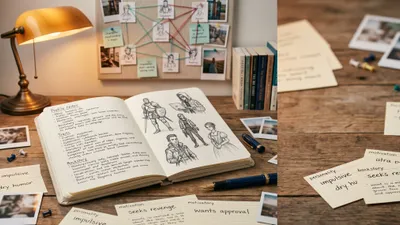
Character development writing prompts help you discover who your characters really are — their fears, contradictions, secrets, and the moments that shaped them — before you ever write chapter one.
In this guide, you’ll find:
- 50+ prompts organized by what they reveal about your character
- Exercises for backstory, motivation, flaws, relationships, and transformation
- A method for turning prompt responses into scenes that belong in your book
Pick a category, grab a prompt, and start writing.
What Are Character Development Writing Prompts?
Character development writing prompts are targeted questions or scenario-based exercises that push you to explore who your character is beneath the surface. Unlike general creative writing prompts that spark story ideas, these dig into a single character’s psychology, history, and behavior.
They work because they force specificity. You can say your character is “brave.” A prompt that asks you to write the moment your character chose to stay when everyone else ran gives you something far more useful — a scene you understand in your bones.
The best character development prompts don’t ask you to fill in a worksheet. They ask you to write. The difference matters. A character profile template tells you facts. A prompt reveals how your character acts, speaks, and thinks under pressure.
Backstory Prompts
Backstory is the raw material of personality. These prompts help you excavate the events and environments that made your character who they are today.
-
Write the memory your character would delete if they could. Not their worst memory — the one they’d most want gone. Why that one?
-
Your character is ten years old. Describe the room they sleep in. What’s on the walls? What’s hidden under the bed?
-
Write the conversation your character overheard as a child that changed how they saw one of their parents.
-
Your character gets a package in the mail from someone they haven’t spoken to in fifteen years. What’s inside? Do they open it immediately or let it sit?
-
Describe the first time your character was genuinely afraid. Not startled — afraid in a way that stayed with them.
-
Write the moment your character realized they were good at something. Who noticed first — them or someone else?
-
Your character’s family has a tradition they never explain to outsiders. What is it, and what does your character feel about it?
-
Write about the teacher, coach, or mentor who either built your character up or broke them down. What did they say that stuck?
These prompts work best when you write in your character’s voice. First person, present tense, as if they’re telling you the story themselves. You’ll learn their speech patterns, their evasions, and the things they emphasize or leave out.
Motivation and Desire Prompts
Character motivation is the engine of your story. These prompts reveal what your character wants, what they need, and why they can’t stop chasing it.
-
Your character is offered exactly what they’ve always wanted — but accepting it means betraying someone they love. Write the sixty seconds of silence before they answer.
-
Write the lie your character tells themselves about why they’re pursuing their goal. They believe it completely. The reader shouldn’t.
-
Your character writes a letter they’ll never send. Who’s it to, and what do they finally say?
-
Describe what your character does on a day when nothing is required of them. No obligations, no crises. Where do they go? What draws them there?
-
Your character achieves their goal. Write the scene five minutes after. What do they feel? Is it what they expected?
-
Write the thing your character would never admit they want — not even to themselves.
-
Your character is asked a simple question at a dinner party: “What do you do?” Write three versions of their answer — one for a stranger, one for someone they’re trying to impress, and one that’s actually true.
-
Describe what your character fights for that has nothing to do with the main plot. Their private cause, the thing they protect without being asked.
The gap between what a character wants and what they need drives the most compelling character arcs. If a prompt reveals a contradiction between desire and need, you’ve found your story’s emotional spine.
Flaw and Vulnerability Prompts
Character flaws make fictional people feel real. These prompts expose the cracks, blind spots, and defense mechanisms your character uses to get through the day.
-
Write the worst version of your character. Not evil — just their ugliest moment. The time they were petty, selfish, or cowardly in a way they’d never want anyone to see.
-
Your character is wrong about something and refuses to admit it. What is it, and what happens when someone pushes back?
-
Describe your character’s defense mechanism. Do they deflect with humor? Go silent? Attack first? Write a scene where the mechanism activates.
-
Your character gives advice they absolutely do not follow themselves. What is it?
-
Write the apology your character owes but hasn’t given. Why are they holding onto it?
-
Your character sees someone they admire doing something dishonest. Describe their internal reaction — and what they actually do about it.
-
Describe the habit your character has that quietly drives the people closest to them crazy. Your character either doesn’t notice or doesn’t care.
-
Write the moment your character realizes they’ve become the person they swore they’d never be.
Vulnerability prompts are where you find the emotional truth of your character. If you’re uncomfortable writing the response, you’re probably onto something real. The prompts that make you squirm tend to produce the scenes readers remember.
Relationship and Dialogue Prompts
Characters reveal themselves most clearly through how they interact with other people. These prompts put your character in conversation, conflict, and connection.
-
Write a scene where your character has to ask for help from someone they don’t respect.
-
Your character and their closest friend disagree about something that matters. Write the argument — not the resolution.
-
Describe how your character acts in the first five minutes of meeting someone new. What impression do they try to create? What impression do they actually give?
-
Write the text message conversation between your character and someone they’re lying to. Include the messages they type and delete.
-
Your character is at a funeral. They didn’t particularly like the person who died. Write their internal monologue during the eulogy.
-
Two of your characters are trapped in an elevator for two hours. Write the conversation that starts awkward, goes somewhere unexpected, and reveals something neither planned to share.
-
Your character receives a compliment that makes them genuinely uncomfortable. What is it? Who said it? Why does it land wrong?
-
Write the thing your character says to the person they love that they mean as kindness but actually causes harm.
Dialogue is one of the fastest ways to test whether you know your character. If you can write a page of conversation between two characters and the reader can tell who’s speaking without dialogue tags, your character development work is paying off.
Voice and Identity Prompts
These prompts help you find your character’s unique way of seeing and expressing the world — the details they notice, the metaphors they reach for, the cadence of their thoughts.
-
Your character walks into a room they’ve never been in before. Describe it through their eyes only — what they notice first reveals who they are.
-
Write your character’s internal monologue during a boring meeting. Where does their mind wander?
-
Your character has to describe their life to a stranger using only five words. What do they say?
-
Write a scene in your character’s voice where they describe something beautiful. Then rewrite it where they describe something they hate. The voice should sound like the same person.
-
Your character tells a joke. What kind? Is it actually funny? Who’s the audience?
-
Describe how your character explains a complicated idea to a child. What does their teaching style reveal about their patience, intelligence, or emotional awareness?
-
Write a grocery list for your character. Not just items — include the crossed-out things, the notes in the margins, and what it reveals about their life right now.
-
Your character writes a one-star review of something. What is it, and what bothers them enough to write about it?
Voice prompts are especially useful when you’re writing in first person or deep third person. The character’s perspective isn’t just what they see — it’s how they interpret, judge, and filter every moment on the page.
Transformation and Arc Prompts
Character arcs track how your character changes from the opening page to the last. These prompts explore the before, during, and after of that transformation.
-
Write two versions of the same scene: your character at the beginning of the story and the same character at the end. Same situation, different person.
-
Describe the moment your character realizes their worldview is wrong. Not when someone tells them — when they feel it.
-
Your character looks in the mirror at the start of the story and again at the end. What do they see differently?
-
Write the scene where your character does something they never could have done in chapter one. Make it small — a sentence they say, a door they walk through, a call they finally make.
-
Your character writes a letter to their past self. What do they warn about? What do they promise? What do they forgive?
-
Describe the person who changed your character the most — and whether your character knows it.
-
Write the last line of your character’s story before you’ve written the first. Knowing where they end up changes how you build them.
-
Your character faces the same choice they faced at the beginning of the story. This time, they choose differently. Write both moments.
Transformation prompts help you reverse-engineer a satisfying arc. If you know who your character becomes, you can work backward to figure out who they need to be at the start — and what has to break along the way.
Prompts for Specific Genres
Different genres demand different character work. Use these prompts alongside genre-specific exercises for deeper results.
Romance Character Prompts
-
Write the moment your character realizes they’re attracted to someone they told themselves they’d never fall for. What gives them away?
-
Your character has a dealbreaker in relationships — something non-negotiable. Write the scene where the love interest accidentally crosses it.
-
Describe your character’s worst date. What went wrong tells you what they value.
Fantasy and Sci-Fi Character Prompts
-
Your character has a power or ability they’ve never told anyone about. Write the moment they almost reveal it — and why they stop.
-
Write a scene where your character encounters an aspect of their world that most people accept without question — but your character secretly doubts.
-
Describe the object your character carries everywhere. It has no magical properties. It matters anyway.
For more genre prompts, explore our fantasy writing prompts, horror writing prompts, and dystopian writing prompts.
Literary and Contemporary Character Prompts
-
Write a scene where nothing happens externally but everything changes internally. Your character is sitting still. Their world is shifting.
-
Your character revisits a place that meant something to them ten years ago. Describe what’s changed — in the place and in them.
-
Write the conversation your character has with themselves at 3 AM when they can’t sleep.
How to Turn Prompt Responses Into Real Scenes
Writing prompts are only useful if the material makes it into your book. Here’s how to bridge the gap between exercise and manuscript.
Mine for contradictions. The most interesting discoveries are the ones that surprise you. If your “tough” character cried in a backstory prompt, that tension between surface and interior is your story’s emotional fuel.
Steal the voice. When you write in your character’s perspective during prompts, you’re developing their narrative voice. Copy the sentence patterns, the vocabulary, the rhythm directly into your draft.
Identify the wound. Look across all your prompt responses for a single thread — the event or belief that connects their flaw, their desire, and their fear. That wound is your character’s emotional core, and it should drive every major decision they make.
Keep a character journal. Store all prompt responses in one place. When you get stuck mid-draft and need to know how your character would react to a scene, the answers are already there.
If you’re building an entire cast, run the same five or six prompts for every major character. The differences in their responses will naturally create the friction, chemistry, and contrast that make ensemble stories work.
Using AI to Accelerate Character Development
Tools like Chapter can help you generate prompt responses faster and explore character possibilities you might not reach on your own.
Our Pick — Chapter
Chapter’s AI writing assistant lets you brainstorm character backstories, test dialogue between characters, and explore “what if” scenarios — all within a single workspace designed for book-length projects.
Best for: Fiction and nonfiction authors building complex characters for full-length books Pricing: $97 one time, 2 books included (fiction or nonfiction), 30-day money-back guarantee Why we built it: Over 2,147 authors have used Chapter to write more than 5,000 books — and strong character work is where every good book starts.
You can feed character development prompts directly into Chapter’s AI and get responses in your character’s voice. It’s not a replacement for doing the deep thinking yourself — but it’s a powerful brainstorming partner when you’re stuck on backstory details or need to test how a character would react in a scenario you hadn’t considered.
For more AI-assisted character work, check out our guide to AI character generators and AI prompts for character development.
Common Mistakes With Character Development Prompts
-
Treating prompts as questionnaires. Writing “my character is afraid of failure” is a fact. Writing the scene where they sabotage their own success because winning would prove their father wrong — that’s character development.
-
Only exploring positive traits. The prompts that build the most interesting characters are the ones that make you uncomfortable. Lean into flaws, contradictions, and ugly moments.
-
Doing prompts once and forgetting them. Return to key prompts at different points in your drafting process. Your understanding of the character deepens as you write, and prompt responses at chapter twenty will be richer than responses before chapter one.
-
Developing every character equally. Your protagonist and antagonist need deep exploration. Supporting characters need enough to be distinct — not a full psychological profile. Spend your prompt time where it matters most.
-
Ignoring the body. Character isn’t only psychology. Use prompts that explore how your character moves, what they do with their hands when nervous, how they occupy space. Physical behavior reveals as much as inner monologue.
How Many Prompts Should You Use Per Character?
How many character development writing prompts you need depends on the character’s role in your story. For protagonists and major viewpoint characters, work through 10-15 prompts across different categories — backstory, motivation, flaws, voice, and relationships.
For secondary characters, 5-7 prompts focused on motivation and their relationship to the protagonist will give you enough depth. For minor characters, 2-3 prompts covering their core trait and their function in the story are sufficient.
The goal isn’t completion — it’s discovery. Stop when you know something about your character that surprises you. That surprise is usually the detail that makes them feel real to readers.
Can Writing Prompts Replace a Character Outline?
Writing prompts and character outlines serve different purposes, and the strongest character work uses both. A profile template gives you the facts — age, appearance, occupation, goals. Prompts give you the behavior — how your character acts when those facts collide with real situations.
Think of the template as your character’s resume and the prompts as their job interview. The resume tells you what they’ve done. The interview tells you who they are.
Most experienced writers start with a basic profile, then use 5-10 development prompts to stress-test and deepen what they’ve outlined. The prompts often reveal that their initial profile was too neat — real characters are messier, more contradictory, and more interesting than any template can capture.
FAQ
What are character development writing prompts?
Character development writing prompts are exercises that help you explore a fictional character’s psychology, backstory, and behavior. Unlike story prompts that generate plot ideas, development prompts focus on building depth within a single character. They push you to write scenes and responses that reveal who your character really is beneath the surface.
How do you develop a character quickly?
You develop a character quickly by choosing 3-5 targeted prompts that cover backstory, motivation, and a key flaw, then writing 200-300 word responses for each in the character’s own voice. This focused approach — spending 30-60 minutes total — gives you enough depth to write with confidence. Tools like Chapter can help you brainstorm faster.
What is the best way to make characters feel real?
The best way to make characters feel real is to give them contradictions. A brave character who avoids one specific conversation. A generous person with one selfish habit. Real people are inconsistent, and fictional characters feel authentic when they contain the same kind of tension. Use prompts that explore flaws and vulnerability to find those contradictions.
Should you do character development before or during writing?
You should do character development both before and during writing. Pre-writing prompts help you establish a foundation — backstory, voice, core motivation. But characters evolve as you draft, so returning to prompts mid-manuscript reveals deeper layers you couldn’t access before the story existed. The two-phase approach builds the most fully realized characters.
How many characters should you fully develop?
You should fully develop 2-4 characters per novel — your protagonist, antagonist, and 1-2 key supporting characters. Full development means running 10-15 prompts across multiple categories. Every other character needs only enough work to serve their story function. Over-developing minor characters wastes time and can bloat your narrative with unnecessary backstory.