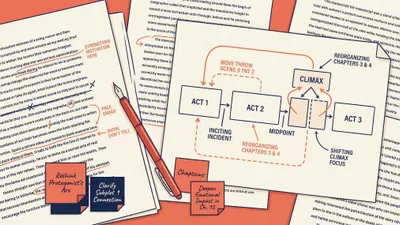
An AI revision assistant helps you revise your manuscript faster by catching structural problems, tightening prose, and flagging inconsistencies that your tired eyes miss after the tenth read-through.
In this guide, you’ll learn:
- The three-layer revision framework that professional editors use (and how AI handles each layer)
- Exactly which prompts produce useful feedback vs. generic fluff
- How to revise a full manuscript without losing your voice
Here’s how to revise your book with AI, step by step.
What Is an AI Revision Assistant?
AI revision assistant — A software tool that uses artificial intelligence to analyze your manuscript and suggest improvements at the structural, sentence, and proofreading levels.
Unlike basic grammar checkers, an AI revision assistant can evaluate your entire book’s pacing, flag character inconsistencies across chapters, and identify passages where your prose goes flat. Think of it as a first-pass editor that works at 3 AM without complaining.
The best AI revision tools — like Chapter — go beyond sentence-level fixes. They help you restructure scenes, tighten dialogue, and spot plot holes before a human editor ever sees your draft.
Why Revising With AI Is Different From Editing With AI
Revision and editing are not the same thing — and the distinction matters when you’re choosing AI tools.
Revision means re-seeing your manuscript. You’re asking big questions: Does the structure work? Is the pacing right? Does chapter 12 actually need to exist?
Editing means fixing what’s already there. Grammar, word choice, consistency, formatting.
Most authors jump straight to editing. That’s a mistake. Polishing sentences in a chapter you’ll later cut is wasted effort. AI revision assistants let you work top-down — structural problems first, sentence-level polish last.
This layered approach comes from professional editing workflows, where developmental editing always precedes copy editing and proofreading. AI just makes each layer faster.
The Three-Layer AI Revision Framework
Professional editors break revision into three distinct passes. Your AI revision assistant should follow the same hierarchy.
Layer 1: Developmental Revision (Structure and Story)
This is the big-picture pass. You’re evaluating whether your book works as a whole.
Feed your AI assistant full chapters or detailed chapter summaries. Ask it to evaluate:
- Plot structure: Are your story beats hitting at the right moments? Does the midpoint actually shift the narrative?
- Character arcs: Does your protagonist change believably from chapter 1 to the final page?
- Pacing: Which sections drag? Where does tension drop off?
- Redundancy: Are you making the same argument in chapters 4 and 7?
For nonfiction, developmental revision focuses on logical flow, argument structure, and whether each chapter earns its place in the table of contents.
Prompt example for developmental revision:
“Read this chapter and evaluate the pacing. Identify any sections where tension drops, any information that repeats from earlier chapters, and any character behavior that contradicts what was established in the first three chapters. Be specific — quote the passages that need attention.”
The key is specificity. Vague prompts like “make this better” produce generic advice. Directed prompts produce actionable feedback.
If you want a deeper dive into this layer, our guide to AI for developmental editing covers the full workflow.
Layer 2: Line-Level Revision (Prose and Voice)
Once your structure is solid, zoom in to the paragraph and sentence level.
This is where AI revision assistants excel at catching:
- Passive voice overuse — “The door was opened by Sarah” vs. “Sarah opened the door”
- Adverb clutter — flagging every “really,” “very,” and “extremely”
- Show vs. tell violations — “She was angry” vs. showing anger through action and dialogue
- Repetitive sentence structure — five paragraphs in a row starting with “She” or “The”
- Voice drift — sections where your writing style shifts noticeably
Prompt example for line-level revision:
“Review this chapter for prose quality. Flag passive voice, unnecessary adverbs, telling instead of showing, and repetitive sentence openers. For each issue, suggest a specific revision that maintains my conversational, first-person voice.”
This layer is where you’re most at risk of losing your voice. Always specify your style in the prompt. Tell the AI what your voice sounds like, or better yet, give it a sample passage that nails your tone and say “match this energy.”
Our AI co-writing process guide covers voice-matching techniques in more detail.
Layer 3: Proofreading and Consistency
The final pass catches the small stuff that derails reader trust.
AI is genuinely excellent at:
- Spelling and grammar — including contextual errors that spell-check misses (e.g., “there” vs. “their”)
- Consistency checking — Is it “grey” in chapter 2 and “gray” in chapter 14? Is your character’s eye color consistent?
- Timeline errors — Does your character arrive in Paris on Tuesday but reference “yesterday’s Monday meeting” on Thursday?
- Formatting inconsistencies — chapter heading styles, scene break markers, dialogue tag conventions
Prompt example for proofreading:
“Proofread this chapter for spelling, grammar, and internal consistency. Cross-reference character names, locations, and timeline details against this summary: [paste your story bible or character sheet]. Flag any discrepancies.”
For a complete copy editing workflow, check out our AI for copy editing books guide.
How to Set Up Your AI Revision Workflow
Here’s the practical, step-by-step process for revising a full manuscript with AI.
Step 1: Let Your Draft Rest
Put your manuscript away for at least 48 hours after finishing the draft. Fresh eyes — even AI-assisted ones — catch more when you’re not still in drafting mode.
Step 2: Create Your Revision Brief
Before touching any AI tool, write a one-page document that includes:
- Your book’s genre and target reader
- Your voice and tone (include a 200-word sample passage that nails it)
- Known weak spots you want the AI to focus on
- A character/setting reference sheet for consistency checking
This brief becomes context for every AI prompt you’ll use. It prevents the AI from giving generic, one-size-fits-all feedback.
Step 3: Run the Developmental Pass
Work through your manuscript chapter by chapter. Feed each chapter (plus relevant context from surrounding chapters) into your AI tool.
Use the Layer 1 prompts above. Collect all the structural feedback before making any changes. You want the full picture before you start cutting and rearranging.
Step 4: Make Structural Changes Yourself
This is critical: read the AI’s feedback, then make the changes yourself. Don’t ask the AI to rewrite your chapters based on its own feedback.
Why? Because revision is decision-making. The AI identifies problems. You decide how to solve them based on your creative vision. Skipping this step is how manuscripts end up sounding like AI wrote them.
Step 5: Run the Line-Level Pass
After structural changes are locked, run your revised chapters through Layer 2 prompts. Focus on prose quality, voice consistency, and sentence-level craft.
Use a diff comparison tool to see exactly what the AI changed. This prevents blindly accepting AI output — you stay in control of every word.
Step 6: Final Proofreading Pass
Run the clean manuscript through Layer 3 for spelling, grammar, and consistency. This pass should be the fastest — if you did Layers 1 and 2 well, you’re just catching typos and formatting issues here.
Step 7: Human Eyes Last
After all three AI passes, have at least one human read your manuscript. A beta reader, writing partner, or professional editor catches emotional beats, humor that falls flat, and story flow issues that no AI reliably detects yet.
Best AI Revision Assistant Tools for Authors
Not every AI tool handles revision well. Here are the ones that actually work for book-length manuscripts.
Our Pick — Chapter
Chapter is purpose-built for book writing and revision. Unlike general-purpose AI tools, it understands manuscript structure, maintains context across chapters, and keeps your voice consistent throughout the revision process.
Best for: Authors who want an all-in-one writing and revision platform Pricing: $97 one time, 2 books included (fiction or nonfiction), 30-day money-back guarantee Why we built it: Over 2,147 authors have used Chapter to write 5,000+ books — and revision is where most of them say AI saves the most time.
Other tools worth knowing:
- Claude — Strong for developmental feedback on long passages. Handles nuance better than most AI models.
- ChatGPT — Good for brainstorming revision approaches and getting quick structural feedback.
- ProWritingAid — Best for Layer 2 and Layer 3 work. Excellent at catching style issues and repetitive patterns.
- Grammarly — Solid Layer 3 proofreading tool, but limited for developmental or line-level revision.
The best approach is often combining tools: Chapter or Claude for developmental revision, ProWritingAid for line-level craft, and a final Grammarly pass for proofreading.
Common AI Revision Mistakes to Avoid
Even with the right tools, these mistakes can derail your revision:
- Accepting all AI suggestions blindly. AI doesn’t know your creative intent. It will “fix” deliberate rule-breaking, dialect, and stylistic choices. Review every suggestion.
- Starting with proofreading. Always work top-down. Developmental first, then line edits, then proofreading. Polishing a paragraph you’ll delete wastes time.
- Using vague prompts. “Make this chapter better” gives you nothing useful. Be specific about what you want evaluated and what your standards are.
- Feeding the AI your entire manuscript at once. Even with large context windows, chapter-by-chapter revision produces more focused, actionable feedback.
- Skipping the human read. AI misses emotional resonance, humor timing, and the subjective experience of reading your story. A human reader is still essential.
How Long Does AI-Assisted Revision Take?
AI-assisted revision typically takes 2-4 weeks for a full-length book (60,000-80,000 words), compared to 6-12 weeks for purely manual revision.
Here’s a realistic timeline:
| Revision Layer | Time Without AI | Time With AI |
|---|---|---|
| Developmental (structure) | 2-4 weeks | 3-7 days |
| Line edits (prose) | 2-4 weeks | 3-5 days |
| Proofreading | 1-2 weeks | 1-2 days |
| Total | 5-10 weeks | 1-3 weeks |
The time savings compound because AI catches issues you’d discover in your third or fourth manual pass on the first try. Authors on Chapter report finishing revision in under two weeks — some in as few as five days for a complete nonfiction book.
Can an AI Revision Assistant Replace a Human Editor?
An AI revision assistant cannot fully replace a human editor — but it can dramatically reduce how much human editing you need.
Here’s what AI handles well:
- Consistency checking — AI is better than humans at catching spelling variations, timeline errors, and factual contradictions across 300 pages.
- Grammar and mechanics — AI rarely misses a comma splice or subject-verb disagreement.
- Pattern recognition — AI spots overused words, repetitive sentence structures, and passive voice faster than any human.
Here’s what AI still struggles with:
- Emotional resonance — Does this scene make you feel something? AI can’t reliably answer that.
- Cultural sensitivity — AI may miss context-dependent nuances in representation.
- Creative judgment — “Should I cut this subplot?” requires understanding your book’s artistic goals, not just its structure.
The smartest approach: use AI for the heavy lifting (Layers 1-3 above), then hire a human editor for a final developmental review. You’ll spend less on editing because your manuscript arrives cleaner, and your editor can focus on the high-value creative feedback that only humans provide.
For more on this balance, read our deep dive on AI writing quality and what makes AI-assisted books publishable.
AI Revision Prompts That Actually Work
Here are ready-to-use prompts for each revision layer. Copy, customize, and paste into your AI tool.
Developmental revision prompts:
- “Analyze the pacing of chapters 1-5. Where does momentum stall? Which scenes could be cut or combined without losing essential plot information?”
- “Compare my protagonist’s behavior in chapter 3 vs. chapter 15. Does the character arc feel earned, or are there gaps in their development?”
- “Evaluate this chapter’s argument structure. Is the logic sound? Are there claims that need more evidence or examples?”
Line-level revision prompts:
- “Rewrite the first paragraph of each section to hook the reader faster. Keep my voice — here’s a sample of my best writing: [paste sample].”
- “Find every instance of telling instead of showing in this chapter. For each, suggest a revision that shows the emotion through action or dialogue.”
- “Identify my five most overused words or phrases in this chapter. Suggest alternatives that match my style.”
Proofreading prompts:
- “Check this chapter against my style guide: [paste guide]. Flag any deviations in spelling, hyphenation, capitalization, or number formatting.”
- “Verify all character names, locations, and dates against this reference sheet: [paste reference]. List any inconsistencies.”
How to Keep Your Voice During AI Revision
The biggest fear authors have about AI revision is losing their voice. Here’s how to prevent it.
Always provide voice context. Before any revision prompt, include a paragraph that defines your style. “My writing voice is conversational, slightly irreverent, with short sentences and frequent one-line paragraphs. I use contractions. I avoid formal language.”
Use the AI as a highlighter, not a rewriter. Ask it to identify problems, not fix them. You do the rewriting. This keeps every word in your voice.
Compare before and after. Run AI-revised text through a diff tool. If more than 30% of a passage changed, the AI probably overwrote your voice. Revert and try a more specific prompt.
Revise in your own words last. After every AI pass, read the chapter aloud. If anything sounds “off” — not quite like you — rewrite it manually. Your ear is the final authority.
For more on maintaining your voice while using AI, our guide to the AI co-writing process walks through voice-preserving techniques step by step.
FAQ
What is the best AI revision assistant for books?
The best AI revision assistant for books is Chapter, which is purpose-built for book-length manuscript revision. It maintains context across chapters, preserves your voice, and supports all three revision layers — developmental, line-level, and proofreading. Over 2,147 authors have used it to revise and publish books.
Can AI revise a book without changing my writing style?
Yes, AI can revise a book without changing your writing style if you provide voice context in every prompt and use the AI as a problem-identifier rather than a rewriter. Include a sample of your best writing, specify your tone, and always review AI suggestions before accepting them. The key is treating AI as a highlighter, not an auto-corrector.
How much does AI revision cost compared to a human editor?
AI revision tools typically cost $0-$97 for unlimited use, while human editors charge $500-$5,000+ for a full manuscript edit. Most authors find the best value in using AI for initial revision passes, then hiring a human editor for final developmental feedback — reducing total editing costs by 40-60%.
Is AI revision good enough for self-publishing?
AI revision is good enough for self-publishing when combined with at least one human read-through. AI excels at catching grammar errors, consistency issues, and structural problems. For the highest quality results, use the three-layer framework — developmental, line-level, and proofreading — then have a beta reader or editor review the final draft.
How long does it take to revise a book with AI?
Revising a book with AI typically takes 1-3 weeks for a full-length manuscript (60,000-80,000 words), compared to 5-10 weeks for manual revision alone. The developmental pass takes 3-7 days, line editing takes 3-5 days, and proofreading takes 1-2 days. Authors using Chapter report finishing complete revisions in as few as five days.