You can use AI to developmental edit your manuscript — catching plot holes, weak character arcs, and pacing problems — before you spend thousands on a human editor. The trick is knowing what AI handles well and where you still need human judgment.
In this guide, you’ll learn:
- The 6-step AI developmental editing workflow that covers structure, characters, pacing, and theme
- Which AI tools actually analyze full manuscripts (not just sentences)
- How to combine AI and human editing for the best results
- The exact prompts that surface the feedback you need
Here’s how to use AI for developmental editing without sacrificing the depth your book deserves.
What Is AI Developmental Editing?
AI developmental editing is the process of using artificial intelligence tools to analyze and improve the big-picture elements of your manuscript — plot structure, character arcs, pacing, theme, and narrative coherence. Unlike copy editing, which fixes grammar and sentence-level issues, developmental editing asks whether your book works as a story.
Traditional developmental editing costs $2,000 to $10,000 for a full manuscript. AI tools can do a meaningful first pass in minutes for a fraction of that cost. They won’t replace a skilled human editor entirely, but they’ll catch structural problems early — saving you revision cycles and giving you a stronger manuscript to hand off when you do hire one.
How AI Developmental Editing Differs From Copy Editing
Before you start, make sure you’re solving the right problem. Copy editing and developmental editing fix different things, and using the wrong type first wastes time.
| What It Fixes | Developmental Editing | Copy Editing |
|---|---|---|
| Plot holes and logic gaps | Yes | No |
| Character consistency | Yes | No |
| Pacing and tension | Yes | No |
| Scene order and structure | Yes | No |
| Grammar and punctuation | No | Yes |
| Sentence clarity | No | Yes |
| Factual accuracy | Sometimes | Yes |
Always do developmental editing first. There’s no point polishing sentences in a chapter you end up cutting. Fix the bones of the story, then worry about the prose.
Step 1: Upload Your Full Manuscript to an AI Tool
The first step is getting your entire manuscript into a tool that can analyze it holistically. Most general-purpose AI tools (like ChatGPT or Claude) have context limits that force you to work chapter by chapter. That’s fine for line editing, but developmental editing requires seeing the whole picture.
Tools that handle full manuscripts:
Our Pick — Chapter
Chapter analyzes your complete manuscript as part of its writing and editing workflow. You get structural feedback, character tracking, and pacing analysis built into the same platform where you write.
Best for: Authors who want writing and developmental editing in one tool Pricing: $97 one time, 2 books included (fiction or nonfiction), 30-day money-back guarantee Why we built it: Most AI writing tools stop at generation. Chapter continues through revision and structural editing because that’s where books actually get good.
Other options that analyze full manuscripts include Marlowe by Authors A.I. (fiction-focused pacing and genre analysis), AutoCrit (genre benchmarking and manuscript scoring), and ProWritingAid (25+ structural and style reports). Each approaches developmental feedback differently, so your choice depends on what kind of feedback matters most for your book.
Step 2: Run a Structural Analysis First
Start with the biggest problems. A structural analysis looks at your manuscript’s overall shape — does the narrative arc work? Does the story escalate tension properly? Is the climax in the right place?
What to look for in the AI’s structural report:
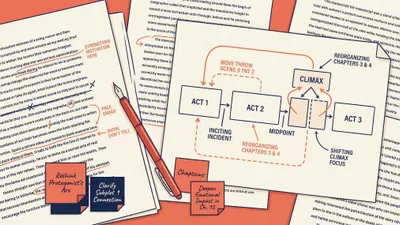
- Act structure. Does your book follow a clear three-act structure or appropriate narrative framework? Does the midpoint shift the story’s direction?
- Scene sequencing. Are scenes in an order that builds tension? Could any be rearranged for stronger impact?
- Subplot tracking. Does every subplot resolve? Are any introduced too late or dropped without payoff?
- Chapter length consistency. Wildly uneven chapters often signal structural imbalances — one section is doing too much work while another isn’t doing enough.
If you’re using a general AI tool like Claude or ChatGPT, feed it your full outline first, then ask: “Analyze this book’s structure. Identify any plot threads that don’t resolve, scenes that could be reordered for stronger pacing, and sections where tension drops.”
The key is asking for specific structural elements rather than vague “feedback on my book.”
Step 3: Analyze Character Arcs and Consistency
Character problems are among the most common issues developmental editors flag — and among the hardest for authors to see in their own work. You know your characters so well that you fill in gaps the reader never sees.
Run these character-focused checks:
- Arc completion. Does every major character change from page one to the final chapter? If a character ends the book the same person they started as, you have a flat arc — which works only if it’s intentional.
- Motivation clarity. At every major decision point, can the reader understand why this character chose this action? Unmotivated decisions are the most common cause of “I just didn’t buy it” reviews.
- Voice distinctiveness. Cover the dialogue tags. Can you tell who’s speaking from the dialogue alone? If all your characters sound the same, AI can flag the specific passages where voices blur.
- Consistency tracking. Eye colors, backstory details, relationship dynamics, and established personality traits. AI is excellent at catching these continuity errors across a 70,000-word manuscript because it doesn’t forget what happened in chapter three by the time it reaches chapter thirty.
The prompt that works best: “Track [character name] through every scene they appear in. Note any inconsistencies in their personality, backstory details, stated goals versus actions, and identify the arc from their first appearance to their last.”
Step 4: Evaluate Pacing and Tension
Pacing problems kill more manuscripts than bad prose. A sagging middle, a rushed climax, or twenty pages of exposition before anything happens — these are the issues that make readers abandon books.
AI tools can map your manuscript’s tension curve by analyzing scene-level conflict, chapter endings, and the balance between action, dialogue, and narration.
What good pacing analysis reveals:
- The “saggy middle” problem. Most first drafts lose momentum between the 25% and 50% marks. AI can identify exactly which chapters slow down and why — usually because conflict pauses or the protagonist stops making active choices.
- Chapter ending hooks. Every chapter should end with a reason to turn the page. AI can flag chapters that end on resolution rather than tension.
- Scene-level balance. A ratio of roughly 40% action, 30% dialogue, and 30% narration keeps most genres moving. Heavy skews in any direction usually signal pacing issues.
- Information dumps. Passages where you stop the story to explain worldbuilding, backstory, or technical details. AI excels at finding these because the pattern (long paragraphs with no dialogue or action) is easy to detect.
If you’re working with a general-purpose AI, paste a few chapters at a time and ask: “Rate the pacing of each scene on a scale of 1-5 for tension. Identify any scenes where conflict drops below a 2 and suggest what’s causing the slowdown.”
Step 5: Check Theme and Thematic Consistency
Theme is the element most authors handle intuitively — and the one that most often becomes muddy in revision. When you cut scenes, reorder chapters, and rewrite character motivations, your theme can drift without you noticing.
AI can help you identify:
- Thematic statements. What is your book actually saying? Sometimes the theme you intended and the theme the text supports are different. AI can identify the recurring ideas across your manuscript and tell you what argument your book is making.
- Contradictions. Characters or plot events that undermine your central theme. A book about the importance of community where the protagonist solves every problem alone, for example.
- Heavy-handedness. Passages where theme becomes sermon. If your characters are explicitly stating the book’s message, AI can flag those moments so you can dramatize them instead.
The prompt: “What are the three strongest thematic threads in this manuscript? Are there any scenes or character actions that contradict or undermine these themes?”
Step 6: Compile and Prioritize Your Revision Plan
The biggest mistake authors make with AI developmental feedback is trying to fix everything at once. AI tools generate a lot of feedback — not all of it equally important.
Prioritize revisions in this order:
- Plot-breaking problems. Unresolved plot threads, logic gaps, missing motivations for key plot events. Fix these first because they affect everything else.
- Character arc issues. Incomplete arcs, inconsistent characterization, flat protagonists. These are harder to fix than plot issues because changes ripple through every scene the character appears in.
- Structural rearrangement. Scenes or chapters that need to move. Do this before fine-tuning pacing because moving scenes changes the rhythm.
- Pacing adjustments. Cutting slow sections, expanding rushed climaxes, adding tension to sagging middles.
- Thematic refinement. Strengthening or clarifying your theme through small additions and cuts. This comes last because fixing the items above often resolves thematic issues automatically.
Save a copy of your manuscript before you start revising. You’ll want to compare the before and after, and sometimes an “improvement” introduces new problems.
Best AI Tools for Developmental Editing in 2026
Not every tool is built for big-picture manuscript analysis. Here’s what actually works for developmental editing specifically.
| Tool | Best For | Full Manuscript? | Pricing |
|---|---|---|---|
| Chapter ★ | Writing + structural editing workflow | Yes | $97 one-time |
| Marlowe | Fiction pacing and genre fit | Yes | Per-report |
| AutoCrit | Genre benchmarking | Yes | $30/mo+ |
| ProWritingAid | Style + structure reports | Yes (with premium) | Free-$30/mo |
| Claude / ChatGPT | Flexible chapter-by-chapter analysis | Chapter-level | Free-$20/mo |
| Sudowrite | Scene-level prose editing | Scene-level | $10-$59/mo |
For a deeper comparison of all these options, see our full breakdown of the best AI book editor tools.
What AI Can and Cannot Do for Developmental Editing
Being honest about AI’s limitations helps you use it better. Here’s where it excels and where you still need a human.
AI handles well:
- Consistency tracking across long manuscripts (names, dates, physical descriptions, timeline errors)
- Identifying missing subplot resolutions
- Detecting pacing drops and information dumps
- Comparing your structure against genre conventions
- Generating revision checklists from its analysis
AI struggles with:
- Reader emotional response (will this scene make someone cry?)
- Market positioning (is this concept fresh or overdone?)
- Voice and tone — AI can detect inconsistency but can’t tell you if your voice is compelling
- Cultural sensitivity and representation
- The “it just doesn’t feel right” instinct that experienced editors develop over thousands of manuscripts
The best approach: Use AI for the analytical first pass, then hire a human developmental editor for the subjective, nuanced feedback that makes a good book great. You’ll get more value from that human editor because you’ve already fixed the structural issues AI caught, letting them focus on the higher-level craft questions only a human can answer.
Common Mistakes When Using AI for Developmental Editing
- Editing sentence by sentence instead of structurally. Developmental editing is about the forest, not the trees. If you’re using AI to fix paragraphs, you’re copy editing, not developmental editing.
- Accepting all AI suggestions without critical evaluation. AI might suggest cutting a “slow” chapter that’s actually doing essential emotional groundwork. You know your story better than the tool does.
- Skipping the full-manuscript view. Feeding AI one chapter at a time misses the connections between chapters that are the whole point of developmental editing.
- Forgetting to re-check after revisions. Fixing one plot hole can create another. Run the AI analysis again after major revisions to catch cascading issues.
- Using AI as a replacement for beta readers. AI tells you what’s structurally wrong. Beta readers tell you how the book feels to read. You need both.
How Long Does AI Developmental Editing Take?
AI developmental editing takes 1 to 3 days for a complete manuscript analysis and revision plan, compared to 4 to 8 weeks for a traditional human developmental edit. The AI analysis itself runs in minutes. The time investment is in reviewing the feedback, prioritizing issues, and planning your revision approach.
Here’s a realistic timeline for the full AI-assisted developmental editing process:
- Day 1: Upload manuscript, run full analysis, review structural and character reports
- Day 2: Compile revision priorities, map out which scenes need rewriting, cutting, or rearranging
- Day 3: Begin revisions on the highest-priority issues
The actual revision work still takes weeks — AI accelerates the diagnosis, not the surgery. But starting with a clear, prioritized revision plan instead of vague “something feels off” saves most authors multiple revision cycles.
How Much Does AI Developmental Editing Cost?
AI developmental editing costs between $0 and $97 depending on your tool choice, compared to $2,000 to $10,000 for a professional human developmental editor. That’s a 95%+ cost reduction for the analysis phase.
Here’s how the costs break down:
- Free options: ChatGPT (free tier) or Claude can handle chapter-by-chapter analysis at no cost, though you’ll work harder to get structured feedback
- Mid-range ($10-$30/month): ProWritingAid, AutoCrit, and Sudowrite offer monthly subscriptions with manuscript-level analysis
- One-time investment ($97): Chapter includes developmental editing features alongside the full writing workflow, with no recurring fees
- Per-report pricing: Marlowe charges per manuscript analysis, making it affordable for occasional use
Most authors get the best value by combining AI analysis ($0-$97) with a focused human developmental edit ($1,500-$3,000) where the editor addresses the nuanced issues AI surfaced but couldn’t resolve. That hybrid approach delivers better results than either method alone.
Can AI Replace a Human Developmental Editor?
AI cannot fully replace a human developmental editor — but it can handle 60-70% of the analytical work a developmental editor does. The remaining 30-40% requires human judgment, genre expertise, and the ability to understand how a reader will emotionally respond to your story.
What AI replaces: the first-pass read-through, consistency checking, structure mapping, and pacing analysis. A human editor would spend 10-15 hours on these tasks. AI does them in minutes.
What AI can’t replace: the editorial letter that says “your protagonist’s grief feels performative in chapter twelve because you haven’t earned it yet — here’s why and here’s how to fix it.” That level of emotional intelligence and craft knowledge still requires a human who has edited hundreds of books.
The smartest workflow for most authors: run AI analysis first, fix the structural issues it catches, then send the improved manuscript to a human editor who can focus entirely on the craft-level feedback that justifies their fee.
FAQ
What is AI developmental editing?
AI developmental editing is the process of using artificial intelligence tools to analyze your manuscript’s big-picture elements — plot structure, character arcs, pacing, and thematic consistency. Unlike copy editing, which fixes grammar, developmental editing evaluates whether your story works as a whole and identifies structural problems that need revision.
Can AI find plot holes in my book?
Yes, AI can find plot holes in your book by tracking story events, character knowledge, and timeline consistency across your full manuscript. AI excels at catching contradictions, unresolved subplots, and logic gaps that human readers miss because they forget details from earlier chapters. Tools like Chapter and Marlowe specifically analyze plot coherence.
Should I use AI editing before hiring a human editor?
You should use AI editing before hiring a human editor because it catches structural and consistency issues that would otherwise consume your editor’s time on mechanical problems. Running AI analysis first means your human editor can focus on craft, voice, and emotional resonance — the high-value feedback that justifies professional editing costs.
How much does developmental editing cost with AI vs. a human editor?
AI developmental editing costs $0 to $97 depending on the tool, while human developmental editors charge $2,000 to $10,000 per manuscript. Most authors get the best results from a hybrid approach — using AI for the analytical first pass ($0-$97) and a human editor for nuanced craft feedback ($1,500-$3,000).
What are the best AI tools for developmental editing?
The best AI tools for developmental editing are Chapter for an integrated writing and editing workflow, Marlowe for fiction-specific pacing and genre analysis, ProWritingAid for structural reports, and AutoCrit for genre benchmarking. General AI tools like Claude and ChatGPT also work for chapter-by-chapter developmental analysis.