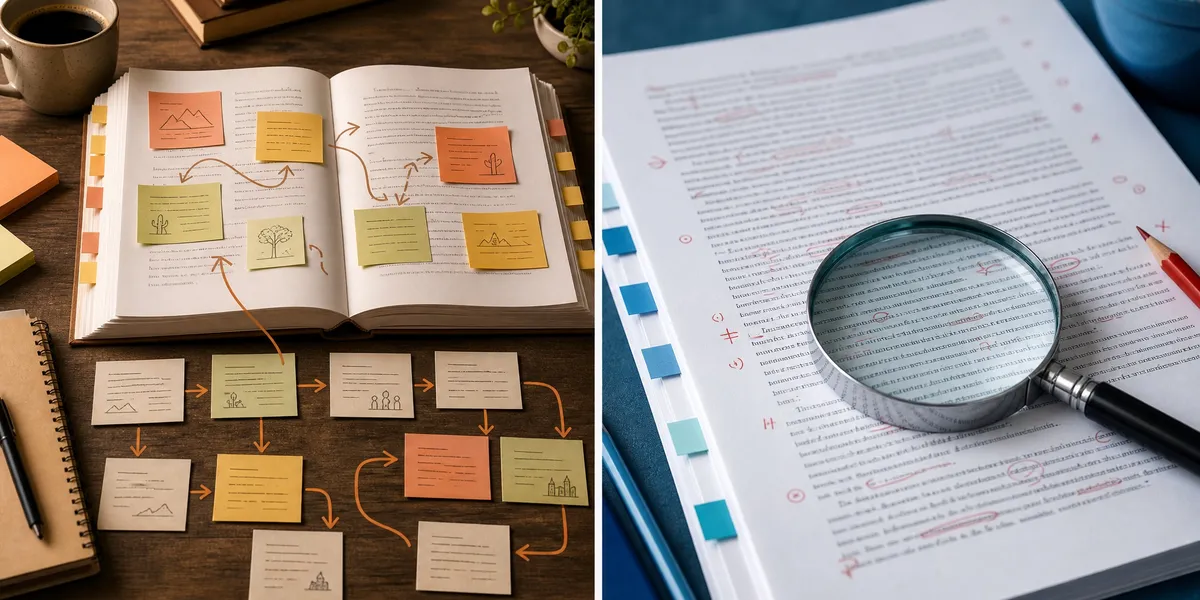
The difference between developmental and copy editing is scope. Developmental editing fixes what your book is about — structure, argument, character, pacing. Copy editing fixes how the sentences are written — grammar, punctuation, consistency, and house style. One rebuilds. The other polishes.
In this guide, you’ll learn:
- What each editor actually changes, with side-by-side examples of the same passage
- A three-question diagnostic for which edit your manuscript needs right now
- Why doing them in the wrong order costs you roughly a third of your editing budget
- What each stage costs in 2026 and where AI genuinely helps
Here’s the full breakdown.
What Is Developmental Editing?
Developmental editing — a big-picture edit that evaluates whether your book works as a whole, addressing structure, argument, character, pacing, and reader experience before any sentence-level work begins.
A developmental editor reads your entire manuscript before commenting on anything. They’re building a model of your book in their head and testing it against what you said you were trying to do.
Their deliverable is usually an editorial letter — 5 to 20 pages of analysis — plus in-manuscript notes. They rarely rewrite your prose. They tell you what to rewrite and why.
For fiction, that means plot structure, character arcs, point of view consistency, scene order, and whether your midpoint actually turns the story. For nonfiction, it means argument sequence, chapter logic, evidence gaps, and whether chapter four is secretly chapter two.
Our longer developmental editing guide walks through the full process and how to brief an editor.
What Is Copy Editing?
Copy editing — a line-by-line pass that corrects grammar, spelling, punctuation, syntax, and internal consistency, and applies a single style standard across the whole manuscript.
A copy editor works inside your document, usually with tracked changes. They fix the comma splice in paragraph three. They notice your protagonist’s eyes were green in chapter two and hazel in chapter nine.
They also enforce a style guide. Most trade and self-published books in the US follow the Chicago Manual of Style, which settles questions like serial commas, number formatting, and how you treat internal thought.
Copy editors build a style sheet as they go — a running document of every decision made about your book, from character names to whether you write “email” or “e-mail.” That style sheet then goes to your proofreader. Our copy editing guide covers the three-pass system you can run yourself first.
Developmental vs Copy Editing at a Glance
| Developmental Editing | Copy Editing | |
|---|---|---|
| Fixes | Structure, argument, character, pacing | Grammar, punctuation, consistency, style |
| Unit of work | Chapters and scenes | Sentences and words |
| When | After your first complete draft | After revisions are locked |
| Deliverable | Editorial letter plus margin notes | Tracked changes plus style sheet |
| You will | Rewrite substantially | Accept or reject line edits |
| Typical cost, 80k words | $2,400 to $6,400 | $1,600 to $3,200 |
| Turnaround | 3 to 6 weeks | 2 to 4 weeks |
| Can AI help? | Partially — good at diagnosis, weak on taste | Substantially — strong on mechanics |
The row that matters most is “you will.” Developmental editing creates work. Copy editing removes it. That single distinction drives the ordering rule in the next section.
The Same Paragraph, Edited Both Ways
Here’s a passage from a hypothetical thriller draft:
Sarah walked into the office and she felt nervous. The office was on the fourth floor and had been renovated in 2019. Her boss, Mark, looked up from his desk. “We need to talk about the Henderson account” he said. Sarah had worked at the firm for six years and had never been in trouble before.
The copy editor’s version:
Sarah walked into the office and felt nervous. The office was on the fourth floor and had been renovated in 2019. Her boss, Mark, looked up from his desk. “We need to talk about the Henderson account,” he said. Sarah had worked at the firm for six years and had never been in trouble.
Three fixes: a redundant pronoun, a missing comma inside the dialogue tag, a wordy phrase trimmed. The paragraph is now correct.
The developmental editor’s note:
This is your inciting incident and it’s told, not dramatized. We’re informed Sarah is nervous rather than shown it. The renovation date and her six-year tenure are backstory placed exactly where tension should be. Consider opening mid-confrontation and seeding her history across the next three chapters.
Notice that the developmental note doesn’t dispute a single word of the copy editor’s work. It says the paragraph shouldn’t exist in this form at all.
That’s the difference between developmental and copy editing in one example — and it’s also the reason order matters so much.
Which Order Should You Do Them In?
Developmental editing always comes first, then copy editing. Developmental work rewrites, cuts, and reorders whole chapters, so any copy editing done beforehand gets deleted along with the text it polished. Editing in the wrong order means paying twice for the same pages.
Run the math on a typical 80,000-word manuscript.
A copy edit at $0.025 per word costs about $2,000. A developmental edit on that same manuscript commonly triggers a 20 to 35 percent rewrite — chapters cut, scenes merged, sections rebuilt.
If you copy edited first, you paid roughly $400 to $700 to perfect text that no longer exists, and the rewritten material now needs a fresh copy edit. Most editors won’t discount a second pass much, because they’re reading the whole book again either way.
The correct sequence for a full editorial process looks like this:
- Self-revision — your own structural pass before anyone sees it
- Beta readers — cheap, early signal on where readers disengage
- Developmental edit — the big structural intervention
- Your revision — 4 to 12 weeks, often the longest stage
- Line edit (optional) — style and rhythm, covered in our copy editing vs line editing comparison
- Copy edit — mechanics, consistency, style guide
- Proofread — final typo catch after formatting, explained in proofreading vs editing
Most self-published authors skip steps 5 and sometimes 2. Almost nobody should skip 3 and 6 on a debut.
How Do You Know Which Edit Your Manuscript Needs?
Answer these three questions honestly. Each one maps to a specific edit.
1. Can you summarize your book in two sentences without using the word “and then”?
If you can’t, you have a structure problem. “And then” chaining means your chapters are sequential rather than causal — events happen in order rather than because of each other. That’s a developmental issue.
2. Have three readers stopped at roughly the same page?
If beta readers consistently drift at chapter seven, chapter seven isn’t a comma problem. Clustered drop-off is the single most reliable structural signal you can get for free.
3. Are your notes about individual sentences or whole sections?
Read your own margin notes from your last self-revision. If they say “clunky” and “wordy,” you’re ready for a copy edit. If they say “does this chapter earn its place,” you’re not.
Two or more structural answers means you need developmental editing first. If all three point to sentence-level issues, book the copy editor.
There’s a fourth signal worth naming: if you’re an experienced author on book five in a series with a locked structure, you may genuinely only need a copy edit. First books almost never qualify.
What Does Each Type of Editing Cost in 2026?
Rates vary by genre, manuscript condition, and editor experience. The Editorial Freelancers Association publishes member-reported ranges that most of the industry treats as a benchmark.
| Service | Per-word range | 80,000-word book |
|---|---|---|
| Developmental editing (fiction) | $0.03 to $0.08 | $2,400 to $6,400 |
| Developmental editing (nonfiction) | $0.035 to $0.09 | $2,800 to $7,200 |
| Manuscript critique (lighter alternative) | $0.01 to $0.025 | $800 to $2,000 |
| Copy editing | $0.02 to $0.04 | $1,600 to $3,200 |
| Proofreading | $0.01 to $0.02 | $800 to $1,600 |
Three things move these numbers more than anything else.
Manuscript condition. A clean draft copy edits faster. Editors quote from a sample, and a messy sample raises your rate.
Genre. Technical nonfiction, academic work, and anything requiring fact-checking sits at the top of the range. Commercial fiction sits lower.
Editor experience. A former Big Five editor charges what a former Big Five editor charges. Sometimes that’s worth it. Often a strong mid-career freelancer gives you 90 percent of the value.
If a full developmental edit is out of reach, a manuscript critique is the highest-value substitute. You get the editorial letter without the in-manuscript notes, usually at a third of the price. Our book editor cost breakdown goes deeper on budgeting.
Can One Editor Do Both?
Yes, and many freelancers offer both services — but doing both on the same manuscript back-to-back has a real drawback worth understanding before you book it.
A developmental editor who has read your book four times stops seeing it fresh. Copy editing depends on catching what the writer’s brain auto-corrects, and by pass four your editor’s brain auto-corrects the same way yours does.
Publishers use different people for exactly this reason. The developmental editor shapes the book; a separate copy editor comes in cold.
If budget forces one editor to do both, insist on a gap of at least three weeks between passes. Distance restores some of the fresh-eyes advantage.
The exception is a genuine “full edit” package where the editor does one structural pass, you revise, and then they copy edit months later. That’s fine — the calendar gap does the work.
Can AI Handle Developmental or Copy Editing?
AI handles copy editing substantially better than developmental editing, because copy editing is rule-governed and developmental editing is judgment-governed. Language models are strong at consistent application of mechanical rules and weak at knowing whether a slow chapter is a flaw or a deliberate breath.
Here’s the honest split.
Where AI performs well:
- Grammar, punctuation, and syntax correction across a full manuscript
- Consistency tracking — character details, timelines, terminology, capitalization
- Style guide enforcement once you specify Chicago, AP, or a house style
- Flagging repetition, filter words, and crutch phrases at scale
- Generating a first-draft style sheet for a human copy editor to refine
Where AI still falls short:
- Deciding whether a subplot earns its word count
- Recognizing intentional rule-breaking as voice rather than error
- Judging emotional payoff against setup
- Genre convention nuance — what romance readers expect versus what literary readers tolerate
- Anything requiring a defensible opinion it will hold under pushback
The practical workflow that works: use AI to run diagnostics and clean mechanics, then spend your human editing budget where judgment is required. An AI developmental editor is genuinely useful for structural diagnosis — pacing maps, scene inventories, chapter-by-chapter summaries that reveal where your throughline breaks. It’s much less useful as the final word on what to cut.
For mechanics, AI copy editing tools can clear the obvious 80 percent before a human ever opens the file, which shortens the paid pass. Our best AI book editor roundup compares the current options.
Our Pick — Chapter
Chapter is built for the part of this process that comes before either edit: getting a structurally sound draft out of your head and onto the page. It works from your outline, keeps chapter logic consistent, and produces manuscripts that need less structural surgery later.
Best for: authors who want fewer developmental problems to pay for Pricing: $97 one time, 2 books included (fiction or nonfiction), 30-day money-back guarantee Why we built it: 2,147+ authors have written books on Chapter and 5,000+ books have been created on the platform — the pattern we kept seeing was structure problems that started at the outline stage.
Chapter is a drafting tool, not an editor. You’ll still want human eyes on the finished manuscript.
Do You Need Both Edits, or Can You Skip One?
You can skip a developmental edit if your structure has already been validated — by beta readers, an agent, a critique group, or four previous books in the same series. You should almost never skip a copy edit, because mechanical errors are the ones readers punish publicly in reviews.
That asymmetry is worth sitting with.
Structural weakness makes a book mediocre. Readers say it dragged. Copy errors make a book look unprofessional, and reviewers name them specifically. The Alliance of Independent Authors treats professional copy editing as a baseline quality standard for indie publishing.
If your total budget is $2,000, spend it on a manuscript critique plus a copy edit rather than a full developmental edit alone. You’ll get structural guidance you implement yourself and a clean final book.
If your budget is $500, buy the copy edit and use free structural feedback from beta readers and writing groups.
How Long Does Each Edit Take?
Developmental editing typically takes three to six weeks for an 80,000-word manuscript, and copy editing takes two to four weeks. The bigger time cost is yours — revising after a developmental edit commonly takes four to twelve weeks, which is longer than both professional passes combined.
Build your publication timeline backward from that number. A book you want out in June needs its developmental edit started in December, not April.
Editors also book out. Good freelancers are frequently scheduled two to four months ahead, and the best ones longer. Contact editors before your draft is finished so you can hold a slot. Our guide on how to hire a book editor covers what to send in that first email.
Common Mistakes to Avoid
- Copy editing before revising. The single most expensive error in this article. Polished prose you delete later is money burned.
- Hiring a developmental editor for a first draft you haven’t self-revised. You’ll pay a professional to find problems you’d have caught on your own second read.
- Assuming “editing” means one thing. Ask any editor to define their service in writing before you pay. ACES, the Society for Editing and the UK’s CIEP both publish standard definitions worth referencing in your brief.
- Skipping the sample edit. Any editor worth hiring will edit 1,000 to 2,000 words free or cheaply. It tells you more than any portfolio.
- Treating the editorial letter as optional reading. Authors regularly implement the easy notes and quietly ignore the hard one that mattered most.
- Expecting a copy editor to fix structure. They won’t, and it isn’t their job. Understanding what a book editor does at each stage prevents this mismatch.
FAQ
What is the difference between developmental and copy editing?
The difference between developmental and copy editing is scope and timing. Developmental editing addresses structure, argument, character, and pacing across whole chapters after your first draft. Copy editing corrects grammar, punctuation, and consistency sentence by sentence once revisions are complete.
Which comes first, developmental editing or copy editing?
Developmental editing always comes first. It triggers substantial rewrites — commonly 20 to 35 percent of a manuscript — that would destroy any copy editing already done. Copy editing comes near the end, after your structural revisions are locked and before proofreading.
Is developmental editing more expensive than copy editing?
Yes. Developmental editing typically costs $0.03 to $0.08 per word versus $0.02 to $0.04 for copy editing, according to Editorial Freelancers Association ranges. On an 80,000-word book that’s roughly $2,400 to $6,400 compared with $1,600 to $3,200.
Can I skip developmental editing if I use AI to write my book?
No — and AI-drafted manuscripts often need more structural attention, not less. AI tools maintain local coherence well but can produce chapters that repeat, drift, or fail to escalate. A structural pass or manuscript critique is still worth budgeting for.
Do developmental editors fix grammar?
Developmental editors generally do not fix grammar. They may flag persistent errors in the editorial letter, but line-level correction is outside their scope and outside your quote. Expect structural notes, not tracked changes, from a developmental edit.
Is copy editing the same as proofreading?
No. Copy editing is a substantive mechanical pass on the manuscript, applying a style guide and building a style sheet. Proofreading is a final check on formatted pages for typos, bad line breaks, and layout errors. Publications like Copyediting treat them as separate professional roles.
Where to Go From Here
The decision comes down to one question: does your book have the right shape yet?
If you’re unsure, that uncertainty is itself the answer — book the structural work first. If you’re confident in the shape and just want it clean, hire the copy editor and skip ahead.
For a wider view of the whole editorial pipeline, Reedsy’s book editing guide maps the stages, and our own copy editing and developmental editing guides go deeper on each one individually.