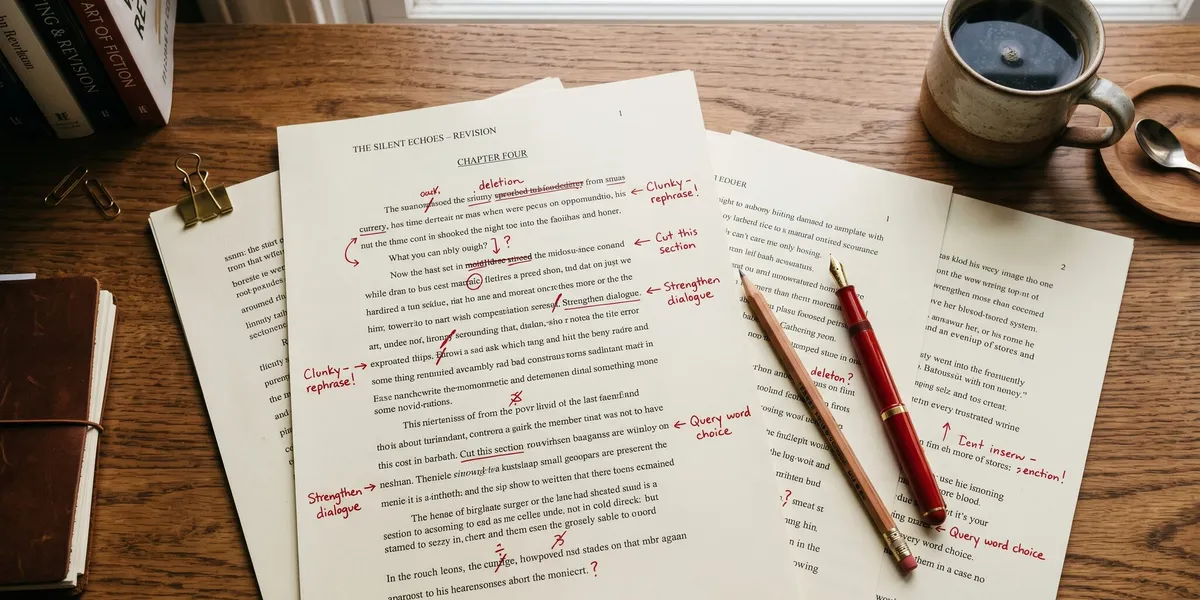
Every novel manuscript has mistakes — even the ones that become bestsellers. The difference between a published author and a frustrated one is knowing which mistakes to look for and how to fix them.
In this guide, you’ll learn:
- The 15 most common writing mistakes that kill novels before they reach readers
- Before-and-after examples so you can spot each mistake in your own work
- A revision triage system that helps you fix the biggest problems first
Here are the mistakes — organized from structural (fix these first) to line-level (polish last).
What Are the Most Common Writing Mistakes in Novels?
The most common writing mistakes in novels are structural problems like weak openings and pacing issues, narrative errors like head-hopping and info dumping, and line-level habits like overusing adverbs and passive voice. Most first-time novelists make several of these simultaneously — and the good news is every single one is fixable during revision.
The key is knowing which ones to tackle first. A beautifully polished sentence won’t save a novel with a broken plot structure. That’s why the mistakes below are organized by severity, starting with the ones that matter most.
Mistake #1: Starting With Backstory Instead of Action
This is the most common mistake editors see in first novels. You spend pages (sometimes chapters) setting up your world, your character’s childhood, or the political landscape before anything actually happens.
Why it’s a problem: Readers don’t care about backstory until they care about your character. And they can’t care about your character until they see your character in action.
Before: “Sarah had always been afraid of the ocean. When she was seven, her older brother Marcus had taken her swimming at Crane Beach, and a wave had knocked her under. She’d swallowed saltwater and sand. Her mother had been furious at Marcus. For twenty years after that day, Sarah avoided any body of water larger than a bathtub.”
After: “Sarah gripped the ferry railing so hard her knuckles ached. The waves below were black and endless. Somewhere on the other side of this crossing, her brother was dying — and she hadn’t spoken to him in six years.”
The “after” version drops you into tension immediately. You learn about Sarah’s fear of the ocean through her white-knuckle grip, not through a paragraph of exposition. The backstory (her brother, the six-year silence) becomes a question the reader wants answered rather than information dumped on them before they care.
The fix: Start your novel at the moment things change. Then weave backstory in through small, specific details — a flinch, a memory fragment triggered by action, a line of dialogue that hints at history.
Mistake #2: Weak or Missing Character Motivation
If your reader doesn’t understand why your character is doing what they’re doing, nothing else matters. Not the beautiful prose, not the clever plot twists, not the vivid worldbuilding.
Why it’s a problem: Characters without clear motivation feel like puppets being pushed through a plot. Readers disengage because the story feels artificial.
Before: “Jake decided to break into the government facility. It was dangerous, but he had to do it.”
After: “Jake stared at the photograph of his daughter — the one the agents had slid across the interrogation table. She was walking to school, unaware of the camera. The message was clear. He had seventy-two hours to break into the facility, or they’d take her.”
The second version gives Jake a concrete, emotionally loaded reason. You don’t just understand his choice — you feel the impossible weight of it.
The fix: For every major character decision, ask yourself: Would a real person actually do this, given what they know and what’s at stake? If the answer is no, you need stronger motivation. Your protagonist’s character arc should be driven by internal desires that feel real and urgent.
Mistake #3: Head-Hopping Between Characters
Head-hopping means switching between characters’ internal thoughts within the same scene without a clear break. It’s one of the fastest ways to confuse your reader and destroy narrative intimacy.
Why it’s a problem: When you’re inside one character’s head and suddenly jump to another’s, the reader loses their anchor. It feels disorienting — like the camera in a movie suddenly teleporting to a different angle mid-sentence.
Before: “Maria felt a surge of anger as she stared at Tom across the table. Tom noticed her jaw tighten and wondered if he’d pushed too far. He felt guilty about the lie, but he couldn’t tell her the truth. Maria sensed he was hiding something.”
After (staying in Maria’s POV): “Maria stared at Tom across the table, heat rising up her neck. He wouldn’t meet her eyes. His fingers drummed the tablecloth — that thing he did when he was working up to another lie. ‘Just say it,’ she said.”
In the “after” version, you stay in Maria’s perspective the entire time. You infer Tom’s guilt through what Maria can observe — his averted eyes, his nervous habit. This is more immersive and more suspenseful.
The fix: Pick one point of view per scene (or per chapter). If you need to show what another character is thinking, switch to their POV in a new scene with a clear break. Study how your favorite novelists handle third person point of view to see this in practice.
Mistake #4: Info Dumping and Overexplaining
Info dumping is when you stop the story to deliver a block of information — the history of your fantasy kingdom, how the spaceship’s engine works, or a character’s entire resume.
Why it’s a problem: It stalls momentum. Your reader came for a story, not a lecture. Even fascinating worldbuilding becomes tedious when it’s delivered in a three-paragraph monologue that halts the action.
Before: “The Kingdom of Aldrath had been founded three hundred years ago by the warrior queen Seraphina. After the War of the Five Rivers, she united the scattered clans under a single banner. The kingdom’s economy was based primarily on mining and agriculture, with iron ore being the chief export. The political system was a constitutional monarchy, with a council of twelve…”
After: “The iron mines had made Aldrath rich, but they’d also made it a target. Kael could see the siege towers from the castle wall — three of them, flying the banner of the Southern Confederacy. The same banner his grandmother had burned fifty years ago.”
The second version delivers worldbuilding through the character’s immediate situation. You learn that Aldrath has iron mines, that it faces military threats, and that there’s a history of conflict — all without stopping the story.
The fix: Deliver information on a need-to-know basis. Your reader only needs to understand what matters right now for the current scene. Trust that they’ll pick up context from dialogue, action, and small details. Think of foreshadowing — planting seeds of information that pay off later is more satisfying than front-loading everything.
Mistake #5: Telling Instead of Showing Emotions
This is the classic “show, don’t tell” problem — and it’s especially common with emotions. Writing “she was angry” instead of showing the anger through action, dialogue, and physical sensation.
Why it’s a problem: Telling creates distance. It makes the reader an observer rather than a participant. When you show an emotion, the reader experiences it alongside the character.
Before: “He was really nervous about the interview. He felt anxious and worried that he wouldn’t get the job.”
After: “He checked his tie in the elevator’s mirrored door for the third time. The knot looked crooked. He loosened it, retied it, loosened it again. When the doors opened, he stepped out on legs that felt borrowed from someone else.”
You never use the word “nervous” in the second version — but the reader feels the nervousness through the obsessive tie-checking and the legs that don’t feel like his own.
The fix: When you write an emotion word (angry, sad, nervous, happy), treat it as a first-draft placeholder. During revision, replace it with a specific physical action, a sensory detail, or a line of dialogue that demonstrates the feeling. Not every emotion needs to be shown — sometimes “she was tired” is fine — but the big emotional moments deserve the full treatment.
Mistake #6: Pacing Problems — Too Fast or Too Slow
Pacing mistakes come in two flavors. Too slow: scenes that drag because nothing changes, decisions are delayed, or the narrative lingers on details that don’t matter. Too fast: major events that get rushed through without giving the reader time to absorb their emotional impact.
Why it’s a problem: Readers lose interest when the pace is wrong. Too slow, and they put the book down. Too fast, and they feel cheated out of the emotional payoff they were reading for.
Signs your pacing is too slow:
- Characters spend multiple pages thinking without acting
- Scenes end without anything changing from the beginning
- You describe settings in detail when the reader already has a clear mental picture
- Subplots go nowhere
Signs your pacing is too fast:
- Major character deaths get less than a page of emotional fallout
- Relationships develop from strangers to lovers in a single chapter without buildup
- The climax arrives before the tension has fully built
The fix: Every scene should change something — a relationship, a piece of information, a decision, the stakes. If nothing changes, cut the scene or combine it with one that does. For fast pacing in action sequences, use short sentences and paragraphs. For emotional scenes, slow down and let the reader sit in the moment. Study rising action to understand how tension should build across your novel.
Mistake #7: Flat or Unrealistic Dialogue
Bad dialogue is one of the easiest problems to spot and one of the most satisfying to fix. Common issues include characters who all sound the same, dialogue that’s too formal or too “writerly,” and conversations that exist only to deliver information.
Why it’s a problem: Dialogue is where readers hear your characters most directly. If everyone sounds like the same person — or like no real person at all — the illusion of the story breaks.
Before: “I must inform you, Elizabeth, that I have recently become aware of the fact that your father has been conducting business with our competitors,” Thomas said informatively.
After: “Your dad’s working with Meridian.” Thomas set his coffee down. “How long were you going to wait to tell me?”
Real people use contractions. They speak in short bursts. They interrupt each other. They say one thing when they mean another. They leave sentences unfinished.
The fix: Read your dialogue aloud. If it sounds like something you’d never hear a real person say, rewrite it. Cut dialogue tags like “he exclaimed” or “she retorted” — use “said” for most lines, and let the dialogue itself carry the emotion. Give each character a distinct speech pattern based on their background, education, and personality.
Mistake #8: Overusing Adverbs and Weak Verbs
“She walked slowly” when you could write “she shuffled.” “He said angrily” when you could write “he snapped.” Adverbs aren’t inherently bad, but they’re often a symptom of a deeper problem: weak verb choices.
Why it’s a problem: Adverbs tell the reader how to interpret an action instead of letting the action speak for itself. One or two per page won’t hurt. A dozen per page makes your prose feel amateurish and bloated.
Before: “She ran quickly across the street, looking nervously behind her. She breathed heavily and grabbed the door handle desperately.”
After: “She sprinted across the street, glancing over her shoulder. Her lungs burned. She seized the door handle.”
Every adverb in the “before” version disappears when you choose a stronger verb. “Ran quickly” becomes “sprinted.” “Grabbed desperately” becomes “seized.” The result is tighter, more vivid, and more urgent.
The fix: Search your manuscript for “-ly” words. For each one, ask: Is there a single, stronger verb that captures both the action and the manner? If yes, swap it. If the adverb genuinely adds information that the verb alone can’t convey, keep it. Stephen King’s advice holds: “The road to hell is paved with adverbs.”
Mistake #9: Using Passive Voice When Active Voice Is Stronger
Passive voice means the subject of the sentence receives the action rather than performing it. “The door was opened by Sarah” instead of “Sarah opened the door.”
Why it’s a problem: Passive constructions add words, reduce clarity, and drain energy from your prose. In fiction, they create distance between the reader and the action — the exact opposite of what you want.
Before: “The sword was drawn by the knight. The dragon was slain by him before the village was destroyed.”
After: “The knight drew his sword and killed the dragon before it could reach the village.”
The active version is nine words shorter and significantly more vivid. You can see the knight acting. In the passive version, you’re watching from a distance.
The fix: Passive voice has legitimate uses — when the actor is unknown (“the window had been smashed”), when the receiver of the action is more important than the actor, or when you want a deliberately distant, formal tone. But as a default, write in active voice. During revision, search for “was,” “were,” “had been,” and “was being” — these often signal passive constructions you can strengthen.
Mistake #10: One-Dimensional Supporting Characters
Your protagonist might be richly drawn, but if every secondary character is a cardboard cutout — the Wise Mentor, the Love Interest, the Loyal Sidekick — your novel will feel hollow.
Why it’s a problem: Supporting characters who exist only to serve the protagonist’s story feel like props, not people. Real people have their own goals, fears, and contradictions. When your secondary characters have inner lives, the entire world of your novel feels more believable.
Before: “Marcus was Jake’s best friend. He was always there when Jake needed him, cracking jokes to lighten the mood and offering sage advice at exactly the right moment.”
After: “Marcus showed up at Jake’s apartment with a six-pack and a bruise under his left eye. ‘Don’t ask,’ he said, dropping onto the couch. He popped a beer, took a long drink, and stared at the ceiling. ‘So. You need my help with something illegal again, or is this a social call?’”
The second Marcus has texture. He has his own problems (the bruise he doesn’t want to discuss). He has a voice. He has a history with Jake that implies complicated past experiences.
The fix: Give every named character at least one goal that has nothing to do with the protagonist. Even minor characters benefit from a single unexpected trait or detail. Study character development and character flaws — the imperfections are what make fictional people feel real.
Mistake #11: Overcrowded Narratives
Too many subplots. Too many point-of-view characters. Too many side quests. An overcrowded novel feels unfocused — the reader can’t figure out what the story is actually about.
Why it’s a problem: Every subplot and secondary POV divides the reader’s attention. If your main plot doesn’t get enough page time, the emotional payoff at the ending will feel thin.
Signs your novel is overcrowded:
- You have more than four POV characters and your novel is under 100,000 words
- Subplots don’t connect to the main plot’s themes or stakes
- You spend chapters on a secondary storyline and forget where the main character left off
- Beta readers say they’re “confused” about what the book is about
The fix: Ask yourself which subplots would survive if you cut everything that doesn’t connect to the main conflict. If a subplot doesn’t raise the stakes of the main plot, reveal character, or create necessary tension, it might belong in a different book. For story structure, simplicity is almost always stronger than complexity.
Mistake #12: Inconsistent or Broken Point of View
Beyond head-hopping (Mistake #3), there’s a subtler POV problem: letting omniscient narration bleed into a close third-person or first-person narrative. Your character suddenly knows things they couldn’t know, sees things they couldn’t see, or describes themselves in ways no real person would.
Why it’s a problem: POV inconsistencies break the reader’s immersion. Each slip is a tiny reminder that this is a constructed story, not an experience they’re living through.
Before (supposedly deep third-person, from Maria’s POV): “Maria’s auburn hair fell across her emerald eyes as she walked into the room. She didn’t realize how beautiful she looked in the candlelight. Behind her, in the hallway she’d just left, Tom pocketed the letter.”
After: “Maria pushed her hair out of her face and squinted against the candlelight. The dining room was empty — just the table, set for two, and the smell of something burning in the kitchen.”
In the first version, Maria describes her own hair color and eye color (people don’t think about this), is told she doesn’t realize how beautiful she looks (omniscient intrusion), and the narrative follows Tom in a room she’s left (POV break). The second version stays firmly in what Maria can see, hear, and smell.
The fix: For every sentence, ask: Can my POV character actually perceive this? If they can’t see it, hear it, smell it, touch it, or remember it — it shouldn’t be in the narration during their scene. Practice by reading published novels in first person and third person, noticing how carefully the narration stays within the character’s awareness.
Mistake #13: Cliched or Purple Prose
Purple prose means writing that’s so ornate, flowery, or overwrought that it draws attention to itself and away from the story. Cliched prose relies on worn-out phrases that have lost their power through overuse.
Why it’s a problem: When readers notice the writing, they’ve stopped experiencing the story. Purple prose says “look how beautifully I write” when the reader just wants to know what happens next.
Common offenders:
- “Her heart hammered in her chest” (where else would it hammer?)
- “A single tear rolled down her cheek”
- “He let out a breath he didn’t know he was holding”
- “Orbs” instead of “eyes”
- “The raven-haired beauty” (just use her name)
The fix: Simple, precise language almost always beats elaborate description. Instead of reaching for the most dramatic phrase, reach for the most specific one. “The coffee was cold” tells us more about a distracted character than “the once-steaming elixir of morning had surrendered its warmth to the indifferent passage of time.”
Mistake #14: Weak or Missing Stakes
Stakes answer the question: What happens if the character fails? If the answer is “nothing much” or “it’s unclear,” your novel lacks tension.
Why it’s a problem: Without clear stakes, there’s no reason for the reader to keep turning pages. They need to know what’s at risk — and the risk needs to feel real and escalating.
Weak stakes: “Emma wanted to win the writing contest.” (So what if she doesn’t?)
Strong stakes: “Emma needed the contest prize money to pay her mother’s medical bills. Second place paid nothing.”
The second version makes failure costly. Now every obstacle between Emma and the prize carries emotional weight.
The fix: Establish stakes in the first act and raise them at each plot structure turning point. The best novels layer stakes — personal stakes (what the character loses), relational stakes (who gets hurt), and external stakes (what happens to the world). Make sure your reader knows what’s at risk before the action intensifies.
Mistake #15: Rushed or Unsatisfying Endings
You’ve spent 80,000 words building toward this moment — and then you wrap everything up in two pages. Or worse, you introduce a deus ex machina that solves the problem without your character earning the victory.
Why it’s a problem: The ending is the last thing your reader experiences. A rushed ending retroactively diminishes everything that came before. Readers who loved your book for 300 pages will remember the disappointment of the last 10.
Signs of a rushed ending:
- The main conflict resolves in a single scene after building for the entire novel
- A new character or ability appears to save the day
- Multiple subplots get wrapped up in a few paragraphs
- The emotional aftermath of the climax is skipped entirely
The fix: Your ending should feel inevitable in hindsight. The seeds should be planted throughout the novel via foreshadowing. Give your climax the page time it deserves, and don’t skip the falling action — that’s where readers process what just happened. Study how to write a satisfying ending that honors the story you’ve built.
How to Revise a Novel Draft: The Triage System
You’ve just finished your first draft and you know it’s full of mistakes. The worst thing you can do is start fixing typos on page one. That’s like rearranging deck chairs on the Titanic — you’re polishing sentences that might get cut entirely.
Revision triage means fixing problems in order of severity, starting with the foundation and working down to the surface. Here’s the three-pass system used by professional editors:
Pass 1: Structural Revision (The Big Picture)
- Does the novel have a clear story structure with functioning acts?
- Is the main conflict established early and escalated throughout?
- Does every scene change something (a relationship, information, stakes)?
- Are subplots connected to the main storyline?
- Is the protagonist’s motivation clear and compelling?
Cut or rewrite entire scenes during this pass. Don’t worry about prose quality yet.
Pass 2: Scene-Level Revision
- Does each scene open with a clear goal and end with a complication?
- Is the POV consistent within each scene?
- Does the dialogue sound natural and distinct per character?
- Are you showing emotions in the key moments, not just telling?
- Is pacing appropriate — fast in action scenes, slower in emotional ones?
Pass 3: Line-Level Polish
- Hunt for adverbs, passive voice, and weak verbs
- Remove cliches and purple prose
- Check for consistent tense and POV
- Read dialogue aloud for naturalness
- Cut any sentence that doesn’t earn its place
Pro tip: Wait at least two weeks between finishing your draft and starting revision. The distance gives you fresh eyes and makes problems easier to spot. If you’re working with AI writing tools like Chapter, you can use them to catch consistency issues, flag passive constructions, and identify pacing problems during each revision pass.
How to Fix Overwriting in Fiction
Overwriting means using more words than necessary to convey an idea. It’s the prose equivalent of explaining a joke — the extra words don’t add meaning, they dilute it.
Signs of overwriting:
- Paragraphs of description for a setting the reader can already picture
- Multiple adjectives stacked before a single noun (“the dark, imposing, ancient, weathered oak door”)
- Restating the same idea in different words across consecutive sentences
- Internal monologue that explains what the dialogue already made clear
Before: “She felt a deep, profound sense of overwhelming sadness wash over her like a cold, dark wave of grief and loss that seemed to consume her entirely and leave nothing behind.”
After: “The grief hit her all at once. She sat down on the kitchen floor and didn’t move for a long time.”
The second version is more powerful because it’s restrained. The reader’s imagination fills in the details.
The fix: During your line-level revision pass, look for paragraphs that feel “heavy.” Read them aloud. If you run out of breath or lose the thread, the paragraph is too long. Cut the weakest adjective in every pair. Remove any sentence that restates what the previous sentence already said. Aim for prose that is lean, specific, and trusts the reader.
Can You Avoid Writing Mistakes With AI Tools?
AI writing tools can catch some common mistakes during the drafting and revision process. Grammar checkers flag passive voice, tense inconsistencies, and adverb overuse. More advanced tools analyze pacing, character consistency, and structural patterns.
However, AI tools can’t replace the human judgment needed for storytelling decisions. They can tell you that a scene has low tension, but they can’t tell you why the tension isn’t working or what the scene needs emotionally.
The most effective approach combines AI-assisted drafting with human revision. Tools like Chapter help you generate and refine draft material faster, so you can spend more time on the creative decisions that AI can’t make for you — like whether your protagonist’s motivation rings true or whether your ending earns its emotional payoff.
How Many Mistakes Are Normal in a First Draft?
All of them. Every single one of the mistakes in this guide will probably appear in your first draft — and that’s completely fine. First drafts exist to get the story out of your head and onto the page. The mistakes are the point — they show you where the story needs work.
Professional authors routinely revise three to five times before their novels reach readers. The difference between a first draft and a finished novel isn’t talent — it’s revision.
What matters is that you finish the draft before you start fixing things. You can’t revise a blank page.
FAQ
What Is the Most Common Writing Mistake in Novels?
The most common writing mistake in novels is starting with too much backstory instead of dropping the reader into action. Editors report that the majority of first manuscripts spend pages setting up context before anything happens. The fix is simple: start at the moment things change, then weave backstory in through dialogue, action, and small details.
How Do You Know If Your Novel Has Pacing Problems?
You know your novel has pacing problems if scenes end without anything changing, or major events resolve too quickly without emotional fallout. Beta readers saying they “got bored” or “felt rushed” are the clearest signals. Test each scene by asking: what changed from the beginning to the end? If the answer is nothing, cut or revise the scene.
Should You Fix Writing Mistakes While Drafting or After?
You should fix writing mistakes after completing your first draft, not during the drafting process. Editing while writing slows your momentum and often leads to endless revision of early chapters while the ending never gets written. Finish the draft first, wait two weeks, then revise using a structural-to-line-level triage system that addresses the biggest problems first.
How Many Drafts Does a Novel Need?
A novel typically needs three to five drafts before it’s ready for readers. The first draft captures the story, the second fixes structural problems, the third addresses scene-level issues, and additional passes polish prose and dialogue. Some novels need more, some need fewer — the number matters less than whether each draft addresses a specific level of revision.
Can AI Help Fix Writing Mistakes in Novels?
AI can help fix some writing mistakes in novels, particularly grammar issues, passive voice, adverb overuse, and tense inconsistencies. Tools like Chapter assist with drafting and revision by flagging common problems. However, AI cannot judge whether your character’s motivation feels authentic or whether your ending earns its emotional payoff — those decisions require human creative judgment.