You can create a companion book for your existing title in under two weeks — and it can double your revenue from a single idea.
In this guide, you’ll learn:
- What a companion book is and the five types you can create
- How to plan your companion book’s structure around your main title
- The step-by-step process for writing, formatting, and publishing
- How to use AI tools to speed up companion book creation
Here’s exactly how to build one.
What Is a Companion Book?
A companion book is a supplementary title designed to be read alongside or after a primary book. It extends, deepens, or applies the original content in a new format — such as a workbook, journal, study guide, or companion novel.
Unlike a book series where each title advances a single narrative, a companion book offers a different angle on the same material. A self-help book might get a companion workbook. A fantasy novel might get a companion guide to its world. A business book might get a companion journal for implementation.
The concept isn’t new — publishers have paired companion titles with bestsellers for decades. What’s changed is that independent authors can now create and publish companion books faster than ever, especially with AI writing tools that handle the heavy lifting of content generation.
Why Create a Companion Book?
Creating a companion book isn’t just about having another product to sell. It’s a strategic move that compounds the value of work you’ve already done.
Revenue multiplication. Your main book already contains the ideas, framework, and structure. A companion book lets you repackage that intellectual property into a second product without starting from scratch. Authors who sell a main book plus a companion workbook typically earn 40-60% more per reader than those selling a single title.
Deeper reader engagement. A companion book transforms passive readers into active participants. When someone fills out your workbook exercises or journals through your prompts, they internalize your ideas at a deeper level. That creates loyal fans who buy everything you publish next.
Authority building. Multiple titles on the same topic signal expertise. When a potential client or reader sees your main book, companion workbook, and study guide all listed together, you go from “someone who wrote a book” to “the expert on this topic.”
Lead generation. A free or low-cost companion book makes an excellent lead magnet — especially when it drives readers back to your main title or coaching services.
What Are the Different Types of Companion Books?
Not every companion book is the same. The right format depends on your main book’s genre, your audience, and your goals. Here are the five most common types.
1. Companion Workbook
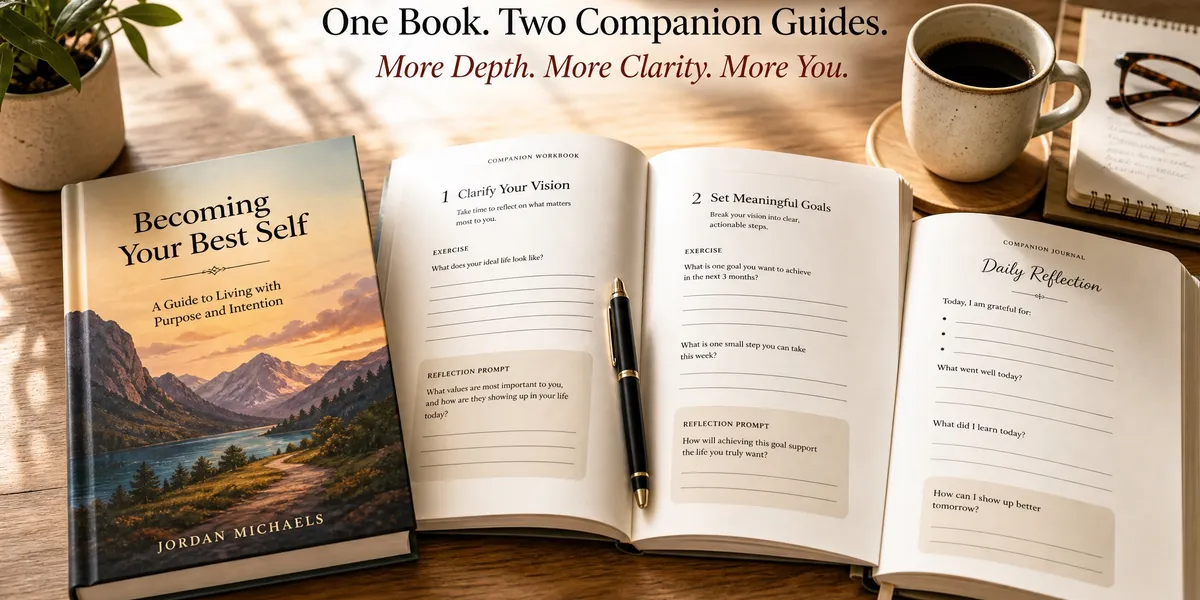
A companion workbook is an action-driven book that helps readers apply what they learned through structured exercises, checklists, templates, and goal-setting activities. It’s the most popular companion format for nonfiction authors.
A workbook mirrors your main book’s chapter structure but replaces explanatory prose with activities. If chapter three of your self-help book teaches a five-step goal-setting framework, the companion workbook gives readers blank templates to complete each step themselves.
Best for: Self-help, business, personal development, coaching, and education books.
2. Companion Journal
A companion journal is more reflective than a workbook. Instead of structured exercises, it offers open-ended prompts, guided reflection questions, and space for free-form writing. Journals invite readers to explore their thoughts and emotions around your book’s themes.
Best for: Memoir, spirituality, wellness, mindfulness, and personal growth books.
3. Study Guide
A study guide breaks your main book into digestible sections with comprehension questions, discussion prompts, key takeaways, and additional resources. It’s designed for group settings — book clubs, classrooms, church groups, or mastermind communities.
Best for: Academic, religious, philosophical, and leadership books used in group study.
4. Companion Novel
A companion novel is a fiction title set in the same world as your original novel but following different characters, a different timeline, or a different perspective. It’s not a sequel — it’s a parallel story that enriches the reader’s understanding of your fictional universe.
For example, if your main novel follows a detective solving a murder, a companion novel might tell the story from the victim’s perspective in the months before the crime. Same world, different lens.
Best for: Fantasy, sci-fi, romance, mystery, and any genre with rich worldbuilding. If you’re building a book series, companion novels add depth between main installments.
5. Resource Guide or Reference Companion
A resource guide compiles practical tools, templates, directories, checklists, and reference material related to your book’s topic. Think of it as the “toolkit” version of your expertise.
A how-to book about starting a podcast might have a companion resource guide listing recommended equipment, software comparisons, launch checklists, and guest outreach templates.
Best for: How-to books, technical guides, and instructional nonfiction.
How to Plan Your Companion Book
Before you write a single word, get clear on three things: who it’s for, what format fits best, and how it maps to your main book.
Define Your Reader’s Outcome
Your companion book needs its own clear transformation — separate from but connected to your main book. Ask yourself: “After finishing the main book, what does the reader still need help doing?”
If your main book teaches a concept, the companion helps readers implement it. If your main book tells a story, the companion helps readers explore it more deeply.
Write one sentence describing the companion book’s promise. Something like: “This workbook helps you complete all 12 exercises from Your Best Year in 30 days, with accountability tracking and reflection space.”
Map Your Structure to the Main Book
The fastest way to plan a companion book is to mirror your main title’s chapter structure. Pull up your book outline and map each chapter to companion content.
For a workbook, each main book chapter becomes a workbook section with 3-5 exercises. For a journal, each chapter becomes a set of 5-10 reflection prompts. For a study guide, each chapter becomes a discussion module with key terms, comprehension questions, and group activities.
This mapping approach works because your readers already know the structure. They can use both books side by side without confusion.
Decide on Standalone vs. Dependent
Some companion books make sense on their own. Others require the main book to be useful. This distinction affects your marketing and pricing.
Standalone companion books include enough context that a reader could pick them up without owning the main book. They still pair best with it, but they work alone. This broadens your potential audience.
Dependent companion books assume the reader has the main book open beside them. They reference specific pages, exercises, or passages. This narrows your audience but creates a stronger upsell from the main title.
For most authors, a semi-standalone approach works best — include brief context at the start of each section so the companion makes sense alone, but design the exercises to go deeper when paired with the main book.
How to Write a Companion Book Step by Step
Here’s the process for creating your companion book from start to finish.
Step 1: Extract Your Core Framework
Open your main book and highlight every framework, process, list, exercise, case study, and actionable takeaway. These are the raw materials for your companion book.
Don’t rewrite your main book’s explanations. Instead, distill each concept into a one-paragraph summary, then build companion content around it. Your workbook shouldn’t re-teach — it should help readers practice.
Step 2: Create Your Content Types
Every companion book needs a mix of content types to keep readers engaged. Choose 4-6 from this list based on your format:
- Fill-in-the-blank exercises — guided templates with blanks to complete
- Reflection prompts — open-ended questions for journaling
- Checklists — step-by-step action items readers can tick off
- Self-assessments — quizzes or rating scales for self-evaluation
- Case study analysis — real examples with guided questions
- Goal-setting templates — structured frameworks for planning
- Progress trackers — visual tools for monitoring implementation
- Discussion questions — prompts for group study or accountability partners
- Action plans — blank project plans tied to specific chapters
- Summaries and key takeaways — brief recaps that set up each section
Step 3: Write Section by Section
Work through your companion book one chapter at a time. For each section:
- Write a brief intro (2-3 sentences) that summarizes the main book’s chapter and frames the companion exercise
- Create 3-5 activities using your chosen content types
- Include enough white space for writing (if designing for print)
- Add a “Key Insight” callout that captures the most important idea
A good rhythm for workbook sections is: summary paragraph → main exercise → reflection prompt → action step → progress check. That gives readers a complete learning cycle in each chapter.
Step 4: Write the Front and Back Matter
Your companion book needs:
- Title page — include “A Companion to [Main Book Title]” prominently
- How to use this book — explain whether to read it alongside or after the main book, how much time each section takes, and what materials they need
- Introduction — 1-2 pages connecting the companion to the main book’s promise
- About the author — same as your main book, with a note about why you created the companion
- Resources page — links to your website, courses, or community
Step 5: Format and Design
Companion books — especially workbooks and journals — require more formatting attention than standard prose books. Readers need clear visual hierarchy, ample writing space, and intuitive navigation.
Use consistent formatting throughout: same heading styles, same box treatments for exercises, same spacing for write-in areas. Your book formatting choices directly affect usability.
For print workbooks, design for 8.5” x 11” or 6” x 9” trim size with generous margins. Digital versions should use fillable PDF fields so readers can type directly into them.
How to Create a Companion Book With AI
AI tools can dramatically speed up companion book creation — especially for generating exercise variations, reflection prompts, and discussion questions.
Our Pick — Chapter
Chapter helps you create companion books by generating structured exercises, prompts, and templates from your existing content. Upload your main book’s outline and Chapter builds companion sections around your framework.
Best for: Nonfiction companion workbooks, journals, and study guides Pricing: $97 one-time (nonfiction) Why we built it: Over 2,147 authors have used Chapter to create books — and many of them use it to build companion titles from their existing content, turning one book into an entire product suite.
Here’s how to use AI effectively for companion book creation:
Feed it your structure. Give the AI your main book’s table of contents and a summary of each chapter. Then ask it to generate exercises, prompts, or discussion questions for each section. This produces a first draft of companion content in hours instead of weeks.
Customize and add your voice. AI-generated exercises are a starting point. Review each one and add your personal examples, client stories, and proprietary frameworks. The AI handles the scaffolding; you add the expertise that makes it uniquely yours.
Generate variations. Ask the AI to create three versions of each exercise — beginner, intermediate, and advanced. This gives you flexibility to serve different reader segments without writing everything from scratch.
Build assessments. AI excels at creating self-assessment quizzes, rating scales, and diagnostic tools. Feed it your book’s core concepts and ask it to build a quiz that helps readers identify where they are in their journey.
Over 5,000 books have been created using AI-assisted workflows like this. The key is treating AI as your research assistant and first-draft generator, not your finished-product writer. Your expertise and voice are what make the companion book worth buying.
How to Publish Your Companion Book
Publishing a companion book follows the same path as publishing any self-published title — but with a few strategic considerations.
Pricing Strategy
Price your companion book lower than your main title. If your main book is $15.99, price the companion workbook at $9.99-$12.99. Better yet, create a bundle: main book + companion for a small discount. Amazon KDP lets you promote both titles together on your author page.
Some authors give away the digital companion for free as a lead magnet and sell the print version. This works especially well for workbooks — readers who try the digital version often buy the print version for the tactile writing experience.
Cover Design
Your companion book’s cover design should visually connect to your main title. Use the same color palette, typography style, and design elements with a clear label like “Companion Workbook” or “Study Guide.” Readers should immediately recognize it belongs with your main book.
Amazon KDP Setup
When publishing on Amazon KDP, link your companion book to your main title using:
- Series page — create a series that includes both titles
- A+ Content — add comparison images showing both books together
- Also-bought linking — buyers of one will see the other in recommendations
- Book description — mention the main title by name and include “companion to [Title]” in your subtitle
Format Options
Offer your companion book in multiple formats to maximize reach:
| Format | Best For | Considerations |
|---|---|---|
| Print (paperback) | Workbooks, journals | Best for write-in exercises; use quality paper stock |
| PDF (fillable) | Digital workbooks | Readers can type in answers; sell on your website |
| Kindle/ebook | Study guides, reference companions | Lowest production cost; widest distribution |
| Hardcover | Premium journals | Higher price point; gift market appeal |
How Long Does It Take to Create a Companion Book?
Creating a companion book takes 2-6 weeks for most authors, depending on format and whether you use AI writing tools to accelerate the process.
Here’s a realistic timeline:
| Phase | Without AI | With AI |
|---|---|---|
| Planning and outlining | 3-5 days | 1-2 days |
| Writing/creating content | 2-3 weeks | 4-7 days |
| Formatting and design | 3-5 days | 2-3 days |
| Review and editing | 3-5 days | 2-3 days |
| Total | 5-7 weeks | 2-3 weeks |
The biggest time savings come from content generation. Writing 50 unique reflection prompts from scratch takes days. Having AI generate initial versions and then refining them takes hours.
How Much Does a Companion Book Cost to Create?
Your companion book costs significantly less to produce than your original title because the core intellectual property already exists. You’re reformatting and extending ideas, not creating them from nothing.
Typical costs for self-published companion books:
- Cover design: $50-$300 (simpler since it mirrors your main cover)
- Interior formatting: $100-$500 (more if workbook has complex layouts)
- Editing/proofreading: $200-$600 (shorter than a full book edit)
- AI writing tool: $97 one-time with Chapter
- ISBN: $0 (free through KDP) or $125 (purchased through Bowker)
Total budget range: $150-$1,500 depending on how much you DIY.
Compare that to the $2,000-$5,000 typical cost of producing an original nonfiction book. A companion book gives you roughly half the revenue potential at a quarter of the production cost.
Common Mistakes to Avoid
- Rewriting your main book. Your companion should reference and build on the original, not repeat it. If readers feel like they’re paying for the same content twice, you’ll earn negative reviews fast.
- Skipping the “how to use this book” section. Readers need clear instructions on whether to use the companion alongside or after the main title, and how much time each section requires.
- Making it too long. Companion workbooks work best at 80-150 pages. Journals can be shorter. Don’t pad for length — concise, actionable content always beats bloated filler.
- Ignoring formatting. A workbook with cramped writing spaces, inconsistent layouts, or confusing navigation will frustrate readers. Invest in proper formatting.
- Not linking to the main book. Every companion book should include clear calls to action pointing readers to your main title. Don’t assume they already own it.
Can You Create a Companion Book for Fiction?
Yes — companion books work for fiction, though they take different forms than nonfiction companions. A fiction companion book can be a companion novel, a world guide, a character encyclopedia, or even a themed journal tied to your story’s universe.
Companion novels are especially popular in fantasy, sci-fi, and romance. If you’ve built a detailed fictional world, readers want to explore more of it. A companion novel set in the same universe but following different characters satisfies that hunger without requiring a direct sequel.
Other fiction companion formats include:
- World encyclopedia — maps, histories, character profiles, glossaries
- Themed journal — prompts inspired by your novel’s themes and settings
- Fan guide — behind-the-scenes notes, deleted scenes, author commentary
- Writing craft companion — teach readers to write in your genre using your novel as examples
If you’re working with a book series, companion titles add depth between main installments and keep readers engaged during gaps between releases.
How to Market Your Companion Book
Your companion book’s biggest advantage is that it already has a built-in audience: readers of your main title. Marketing focuses on reaching those existing readers and converting them.
Bundle promotions. Offer the main book and companion together at a slight discount. This increases perceived value and average order size.
Email your list. If you have an email list, announce the companion book to your existing readers first. They’re the most likely buyers.
Back matter cross-promotion. Add a page at the end of your main book promoting the companion title. Include a direct link or QR code. Update your main book’s manuscript and republish — every new reader of the main book now sees the companion.
Free chapter strategy. Give away the first chapter of your companion book as a PDF download. Readers who complete one exercise are far more likely to buy the full workbook.
Your book launch for the companion can be simpler than your original launch since you’re marketing to an existing audience rather than building awareness from scratch.
FAQ
What Is the Difference Between a Companion Book and a Sequel?
A companion book is a supplementary title that extends or applies the ideas from a primary book without advancing the same narrative. A sequel continues the same story with the same characters. Companion books can be read independently or alongside the original, while sequels typically require reading the previous book first.
How Many Pages Should a Companion Workbook Be?
A companion workbook should be 80 to 150 pages for most nonfiction topics. This gives enough space for exercises, reflection prompts, and writing areas without overwhelming readers. Shorter workbooks (40-60 pages) work for focused topics, while comprehensive study guides may run 150-200 pages.
Can You Sell a Companion Book Without the Main Book?
Yes, you can sell a companion book as a standalone product — and many authors do. The key is including enough context in each section that a reader can follow the exercises without owning the main title. Semi-standalone companions work best because they appeal to both existing readers and new buyers who discover the companion first.
Do Companion Books Sell Well on Amazon?
Companion books sell well on Amazon when they’re properly linked to the main title through series pages, A+ Content, and cross-references in both books’ descriptions. Workbooks and journals perform especially well in self-help, business, and education categories. Authors who bundle their main book with a companion typically see 40-60% higher per-reader revenue.
How Do You Create a Companion Book With AI?
You create a companion book with AI by uploading your main book’s outline and chapter summaries to an AI writing tool like Chapter. The AI generates exercises, prompts, discussion questions, and templates based on your existing framework. You then customize the output with your voice, personal examples, and proprietary methods to create a polished final product.