An AI developmental editor analyzes your entire manuscript and gives you structural feedback — plot holes, pacing problems, weak character arcs, thematic inconsistencies — in minutes instead of months. The best ones read your book the way a human developmental editor would, then deliver an actionable revision plan.
In this guide, you’ll learn:
- What an AI developmental editor actually evaluates (and what it misses)
- How to choose the right tool for your manuscript
- The 7-point checklist for evaluating any AI developmental editor
- How to combine AI and human editing for the strongest results
Here’s everything you need to pick the right AI developmental editor and get feedback that actually improves your book.
What Is an AI Developmental Editor?
AI developmental editor — Software that uses artificial intelligence to analyze the big-picture elements of your manuscript, including plot structure, character arcs, pacing, theme, and narrative coherence, then delivers a structured critique with revision suggestions.
A traditional developmental editor reads your entire manuscript and tells you what’s working, what isn’t, and how to fix the structural problems. They assess whether your plot structure holds up, whether your characters grow in believable ways, whether your pacing keeps readers engaged, and whether your theme lands.
An AI developmental editor does the same analysis using machine learning — but faster and cheaper. Where a human editor takes 2-6 weeks and charges $2,000 to $10,000 for an 80,000-word manuscript, AI tools deliver comparable structural analysis in under an hour for a fraction of the cost.
The tradeoff? AI excels at pattern recognition and consistency tracking across your full manuscript. It can hold every character mention, plot thread, and timeline detail in memory simultaneously. But it still struggles with emotional resonance — understanding why an ending feels unearned or how a relationship dynamic reads on a gut level. That’s why the smartest workflow combines both.
How Does an AI Developmental Editor Work?
Most AI developmental editors follow a three-stage process when they analyze your manuscript:
-
Full-manuscript ingestion. The tool reads your entire book at once — not chapter by chapter. This is critical because developmental feedback requires understanding how Part 1 connects to Part 3, how a character introduced in Chapter 2 pays off in Chapter 20, and whether tension builds or flatlines across the whole arc.
-
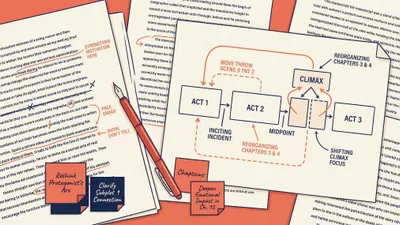
Structural pattern analysis. The AI maps your manuscript against known storytelling frameworks — three-act structure, Save the Cat beats, genre conventions, pacing curves — and flags where your book deviates from reader expectations in ways that might cause problems.
-
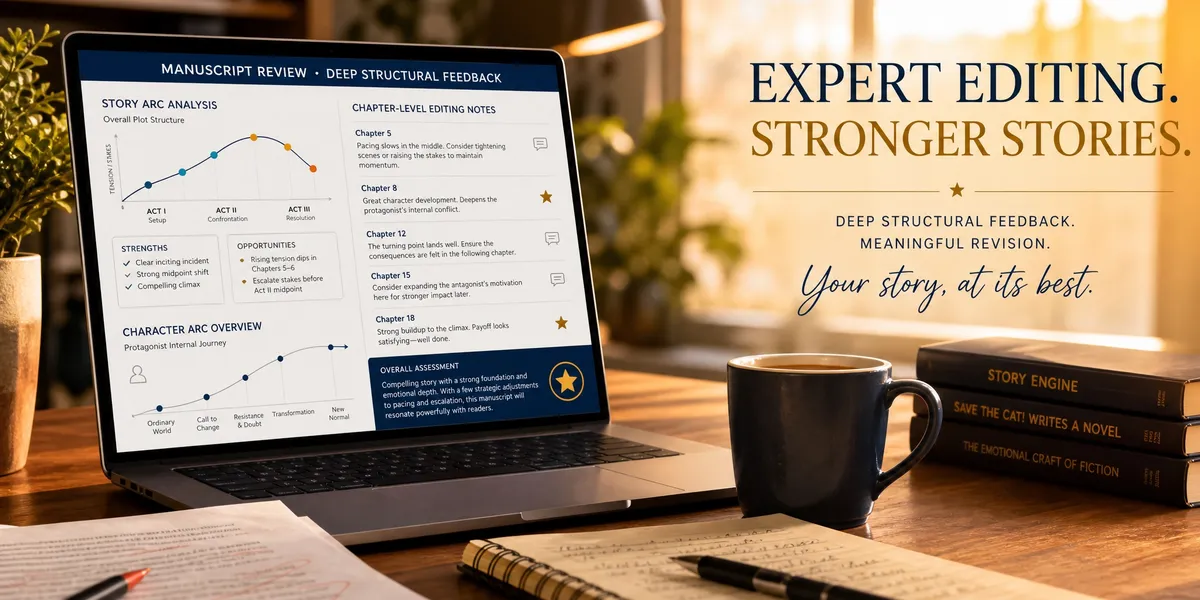
Report generation. You get a structured critique covering plot, characters, pacing, theme, and prose quality, usually organized by priority. The best tools don’t just flag problems — they suggest specific fixes and show you exactly where in the manuscript each issue occurs.
This is fundamentally different from copy editing or line editing, which work at the sentence level. A developmental editor doesn’t care about your comma usage. It cares about whether your story works.
What Does an AI Developmental Editor Evaluate?
The best AI developmental editors analyze seven core areas. Use this as a checklist when evaluating any tool — if it can’t cover most of these, it’s not doing true developmental editing.
1. Plot Structure and Story Arc
Does your story have a clear inciting incident, rising action, climax, and resolution? Are there plot holes or logic gaps? Does each scene advance the story or stall it? AI tools map your narrative arc and highlight structural weak spots — scenes that don’t connect, subplots that disappear, or a sagging middle where tension drops.
2. Character Arcs and Consistency
Do your characters change meaningfully from beginning to end? Are their motivations clear and consistent? AI can track every mention of every character across your manuscript and flag contradictions — a character who’s described as shy in Chapter 3 but boldly confronts the antagonist in Chapter 4 without any development in between.
3. Pacing Analysis
Where does your story drag? Where does it rush? AI developmental editors analyze pacing by measuring scene length, dialogue-to-narrative ratios, and tension curves across chapters. They’ll identify the exact pages where reader engagement is likely to drop — something even experienced human editors sometimes miss on a first read.
4. Dialogue Assessment
Is your dialogue doing double duty — revealing character and advancing plot? Do your characters sound distinct from each other? AI can analyze dialogue patterns and flag sections where characters sound interchangeable or where conversations run too long without narrative purpose.
5. Theme and Motif Tracking
Does your theme emerge consistently throughout the manuscript? Are motifs introduced and then abandoned? AI tools track thematic language and imagery across your full book, showing you where your theme is strong and where it fades. This kind of macro-level tracking is actually one of AI’s strongest advantages — a human editor might miss a subtle motif that appears in Chapters 2, 7, and 18, but AI catches every instance.
6. Point of View Consistency
Are you maintaining consistent POV throughout each scene? AI flags unintentional head-hopping, POV breaks, and places where the narrative voice shifts without reason. This is especially valuable for multi-POV novels where each character needs a distinct voice.
7. Genre Convention Alignment
Does your manuscript meet reader expectations for its genre? A romance beat sheet has different structural requirements than a thriller. AI tools benchmarked against genre databases can tell you whether your romance has enough relationship development beats or whether your mystery reveals the critical clue too early.
Best AI Developmental Editors for Authors
Not all AI editing tools do true developmental editing. Many claim to but only offer surface-level grammar checks or basic readability scores. Here are the tools that actually analyze manuscript structure.
Our Pick — Chapter
Chapter combines AI writing with full developmental analysis. Upload your manuscript and get structural feedback on plot, characters, pacing, and theme — all within the same platform where you write and revise. Over 2,147 authors have used Chapter to write more than 5,000 books.
Best for: Authors who want writing and developmental editing in one integrated workflow Pricing: $97 one time, 2 books included (fiction or nonfiction), 30-day money-back guarantee Why we built it: Most AI tools treat writing and editing as separate problems. Chapter connects them — your AI-generated draft feeds directly into structural analysis, creating a revision loop that actually improves the book.
Marlowe by Authors A.I.
Marlowe specializes in fiction analysis. It compares your manuscript against a database of published novels and delivers feedback on pacing, story beats, narrative drive, and genre alignment. The visual pacing chart — showing tension peaks and valleys across your entire book — is genuinely useful for spotting structural problems.
Best for: Fiction authors who want genre-specific benchmarking Pricing: Per-report pricing Strength: Visual pacing analysis and genre comparison data
ProWritingAid
ProWritingAid’s Manuscript Analysis feature goes beyond grammar to deliver structural reports on character development, plot pacing, and consistency. The 25+ report types cover everything from sentence variation to dialogue tags. It’s more of a comprehensive editing suite than a pure developmental editor, but the structural reports are solid.
Best for: Authors who want line-level and structural feedback in one tool Pricing: Subscription-based (annual plans available) Strength: Breadth of analysis — developmental, stylistic, and grammatical in one platform
Manuscripts.ai
Manuscripts.ai offers four distinct editing modes: Structural, Developmental, Copy, and Line Edit. The developmental mode focuses on narrative coherence, character tracking, and plot analysis. Having separate modes means you can get developmental feedback without noise from grammar corrections.
Best for: Authors who want clean separation between editing types Pricing: Subscription-based Strength: Dedicated developmental mode that doesn’t mix in copy editing concerns
Inkshift
Inkshift reads your full manuscript and delivers structural feedback covering story structure, character consistency, prose quality, setting, pacing, and marketability. It combines the feedback into a single actionable revision plan rather than a list of disconnected notes.
Best for: Authors who want a unified revision plan rather than scattered feedback Pricing: Per-report pricing Strength: Marketability analysis alongside structural feedback
AI Developmental Editor vs. Human Developmental Editor
This is the question every author asks: can AI replace my developmental editor? The honest answer is not entirely — but it can dramatically reduce what you need from one.
| Capability | AI Developmental Editor | Human Developmental Editor |
|---|---|---|
| Full manuscript analysis | Minutes | 2-6 weeks |
| Cost (80K-word manuscript) | $0-$200 | $2,000-$10,000 |
| Plot hole detection | Strong | Strong |
| Character consistency | Very strong | Strong |
| Pacing analysis | Strong | Strong |
| Emotional resonance | Weak | Very strong |
| Thematic depth | Moderate | Very strong |
| Market positioning advice | Moderate | Strong |
| Revision prioritization | Good | Excellent |
Where AI wins: Speed, cost, consistency tracking, and objectivity. AI doesn’t get tired on page 200. It catches every timeline contradiction, every character inconsistency, every POV slip — with the same attention on the last page as the first.
Where humans win: Emotional intelligence, creative judgment, and the ability to diagnose why something isn’t working at a gut level. A human editor can tell you that your protagonist’s grief doesn’t feel earned. AI can tell you the grief scene is shorter than genre averages.
The smartest approach: Use an AI developmental editor for your first structural pass. Fix the obvious problems — plot holes, pacing issues, inconsistencies. Then hand the revised manuscript to a human editor who can focus on the deeper creative questions instead of catching basic structural errors. You’ll get more value from your human editor because they’re working on a cleaner manuscript, and you’ll spend less because the easy fixes are already done.
How to Choose the Right AI Developmental Editor
Not every AI developmental editor is right for every project. Use these criteria to pick the best fit for your manuscript.
Does It Analyze Your Full Manuscript?
This is the deal-breaker. If a tool requires you to paste in chapters one at a time, it can’t do real developmental editing. Developmental analysis requires seeing the whole book — how Act 1 sets up Act 3, how a subplot introduced in Chapter 5 pays off in Chapter 15. Tools that work chapter by chapter miss cross-manuscript connections entirely.
Does It Separate Developmental Feedback From Copy Editing?
The best tools distinguish between “your plot has a hole in Chapter 7” and “you used a comma splice on page 12.” If all the feedback comes in one undifferentiated list, you’ll waste time sorting structural issues from grammatical ones. Look for tools that categorize feedback by type — or have dedicated developmental editing modes.
Does It Provide Actionable Suggestions?
“Your pacing drops in the middle” is observation. “Chapters 8-12 have an average scene length of 4,200 words compared to 2,100 in your opening — consider breaking the two longest scenes into multiple shorter scenes with cliffhanger transitions” is actionable feedback. The best AI developmental editors give you the second kind.
Does It Understand Your Genre?
A romance and a thriller have fundamentally different structural requirements. If the AI benchmarks your romance against thriller pacing norms, the feedback will be useless. Check whether the tool has genre-specific models or allows you to specify your genre before analysis.
Does It Show You Where Problems Are?
Vague feedback like “character development needs work” doesn’t help. You need to know which character, in which scenes, with which specific issues. The best tools link every piece of feedback to exact locations in your manuscript.
How to Get the Most From Your AI Developmental Editor
Getting good feedback from an AI developmental editor isn’t just about picking the right tool — it’s about how you use it. Here’s the workflow that gets the best results.
Run the analysis on a complete draft. Don’t feed in a half-finished manuscript. AI developmental editors need the full arc — beginning, middle, and end — to give meaningful structural feedback. An incomplete draft will generate misleading results because the AI can’t assess whether your setups have payoffs.
Start with the biggest problems first. When you get your feedback report, resist the urge to fix everything at once. Address structural issues in order of severity: plot holes first, then character arc problems, then pacing, then smaller concerns. Fixing a major plot hole might resolve several smaller issues downstream.
Run it again after major revisions. AI developmental editing isn’t a one-time pass. After you fix the structural problems from your first analysis, run the tool again. The second pass catches new issues that your revisions might have introduced and confirms that your fixes actually worked.
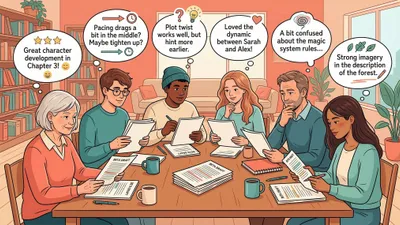
Combine with beta reader feedback. AI catches structural problems. Beta readers catch emotional ones. Use your AI revision assistant for the technical structural pass, then send the revised draft to beta readers who can tell you whether the story feels right. The combination covers both sides.
How Much Does an AI Developmental Editor Cost?
AI developmental editors are dramatically cheaper than human editors — but pricing varies widely by tool and model.
| Option | Cost for 80K-Word Manuscript | Turnaround |
|---|---|---|
| Human developmental editor | $2,000-$10,000 | 2-6 weeks |
| Chapter | $97 one-time | Minutes |
| ProWritingAid | $79-$120/year (unlimited) | Minutes |
| Marlowe | $20-$50 per report | Minutes |
| Manuscripts.ai | Subscription-based | Minutes |
| Inkshift | Per-report pricing | Minutes |
| ChatGPT/Claude (manual) | $20/month subscription | Hours (manual process) |
The cost savings are real. If you’re self-publishing, the editing budget is often your biggest expense. Using an AI developmental editor for the structural first pass can cut your overall editing cost by 30-60% because your human editor spends less time on basic structural issues.
You can also use general-purpose AI tools like ChatGPT or Claude for developmental feedback by uploading your manuscript and using specific prompts — but this requires more manual effort and produces less structured feedback than purpose-built tools. Writing tools built specifically for book-length projects deliver more consistent results because they’re designed for manuscript-scale analysis.
Can You Use AI for Developmental Editing on Nonfiction?
Yes — and in some ways, AI developmental editing is even more effective for nonfiction than fiction. Nonfiction manuscripts have clearer structural expectations: logical argument flow, evidence supporting claims, consistent terminology, and clear takeaways for the reader.
An AI developmental editor can verify that your nonfiction book:
- Follows a logical progression — each chapter builds on the previous one
- Supports claims with evidence — assertions aren’t left hanging without backup
- Maintains consistent terminology — you’re not calling the same concept three different names
- Delivers on its promise — the introduction’s promises are fulfilled by the conclusion
- Avoids redundancy — the same point isn’t made in three different chapters
For nonfiction authors using AI to write their book, developmental editing catches structural problems that the AI generation process sometimes introduces — like circular reasoning, repetitive sections, or gaps in the argument chain.
Common Mistakes When Using an AI Developmental Editor
Treating AI Feedback as Final
AI developmental feedback is a starting point, not a verdict. The AI might flag a slow-paced chapter that’s actually doing important emotional work. Use the feedback as diagnostic data — investigate every flag, but don’t blindly follow every suggestion.
Skipping the Genre Setting
If your tool allows genre specification, always set it. Generic developmental feedback misses genre-specific expectations. Your thriller needs different pacing advice than your literary fiction.
Running Analysis on Unfinished Drafts
A half-written book will get feedback about missing resolution, incomplete arcs, and absent payoffs — problems you already know exist because you haven’t written those parts yet. Wait until you have a complete draft.
Ignoring the Feedback You Disagree With
When AI flags something and your instinct says “that’s fine,” investigate before dismissing. Sometimes the AI is wrong. But sometimes it’s catching a problem you’re too close to see. At minimum, get a second opinion from a beta reader on any flag you’re tempted to ignore.
Using Copy Editing Tools for Developmental Feedback
Grammar checkers and style tools are not developmental editors. Running your manuscript through Grammarly and calling it “edited” skips the structural analysis that actually determines whether your book works. Make sure you’re using a tool that evaluates story structure and narrative elements, not just sentence quality.
Is an AI Developmental Editor Worth It?
If you’re writing a book — fiction or nonfiction — an AI developmental editor is one of the highest-value tools you can use. The structural feedback you get in minutes would cost thousands of dollars and weeks of waiting from a human editor.
That doesn’t mean you should skip human editing entirely. The strongest approach is layered: AI developmental edit first, human developmental edit second (if your budget allows), then copy editing and proofreading. Each layer catches different problems, and each works better because the previous layer already cleaned up the obvious issues.
For authors using Chapter, the developmental analysis is built into the writing workflow — you don’t need a separate tool or step. Write your book, get structural feedback, revise, and repeat until the manuscript is solid. Over 5,000 books have been created this way.
FAQ
What Is an AI Developmental Editor?
An AI developmental editor is software that analyzes your complete manuscript for structural elements — plot, character arcs, pacing, theme, and narrative coherence. Unlike grammar checkers, it evaluates whether your story works as a whole and provides revision suggestions for big-picture problems.
How Much Does a Developmental Editor Cost Compared to AI?
A human developmental editor typically costs $2,000 to $10,000 for an 80,000-word manuscript and takes 2-6 weeks. An AI developmental editor like Chapter costs $97 one-time, while other tools range from $20 per report to $120 per year. AI delivers comparable structural analysis in minutes.
Can AI Replace a Human Developmental Editor?
AI can handle structural analysis, consistency tracking, and pacing evaluation effectively — but it struggles with emotional resonance and creative judgment. The best workflow uses AI for the first structural pass, then a human editor for deeper creative feedback on the revised manuscript.
What Should I Look for in an AI Developmental Editor?
Look for full-manuscript analysis (not chapter-by-chapter), genre-specific benchmarking, actionable suggestions with exact manuscript locations, and separation between developmental and copy editing feedback. Tools that mix grammar corrections with structural critique are harder to use effectively.
When Should I Use an AI Developmental Editor?
Use an AI developmental editor after completing your first full draft — never on a partial manuscript. Run it before sending to human editors or beta readers. The AI catches structural problems early, making every subsequent round of feedback more productive and focused.