AI can write fiction — and in 2026, the results are genuinely impressive in some areas and stubbornly mediocre in others. The honest answer is that AI produces competent first-draft prose that needs significant human editing to reach publishable quality.
In this guide, you’ll learn:
- What AI fiction actually looks like in 2026 (with honest examples of strengths and weaknesses)
- The five specific areas where AI excels and the four where it consistently fails
- The co-writing workflow that turns AI drafts into fiction worth reading
Here is what the data, the research, and real-world experience actually show.
Can AI Write Good Fiction Right Now?
AI can write good fiction right now — but not great fiction on its own. The latest models (GPT-5, Claude, Gemini) produce prose that is grammatically polished, structurally sound, and occasionally surprising. In blind reading tests, readers sometimes preferred AI-generated short stories over human-written ones — particularly in genre fiction like sci-fi and romance.
But “good” has a ceiling. AI fiction tends to cluster around the middle of the quality spectrum. It avoids the worst mistakes of amateur writing (purple prose, head-hopping, clunky dialogue), but it also rarely achieves the best qualities of skilled human writing (genuine surprise, emotional complexity, a voice that feels unmistakably alive).
A 2025 study from University College Cork using literary stylometry confirmed what most fiction writers already sense: AI prose has a measurable stylistic fingerprint that is distinct from human writing. The patterns are consistent across models — tighter clustering, less variation, more predictable rhythms.
The practical answer? AI is good enough to be a useful co-writing partner for fiction. It is not good enough to replace a skilled fiction writer working alone.
What AI Does Well in Fiction Writing
AI has genuine strengths in fiction — and knowing what they are helps you use the tools effectively rather than fighting against their limitations.
Dialogue Generation
AI produces natural-sounding dialogue faster than most writers can draft it. You give it a scene setup, character profiles, and emotional context, and it returns conversations that feel real. The back-and-forth rhythm, the subtext, the interruptions — modern models handle these surprisingly well.
Where it works best: witty banter, interrogation scenes, casual conversation, and genre-specific dialogue patterns like noir patter or Regency-era formality.
Plot Structure and Outlining
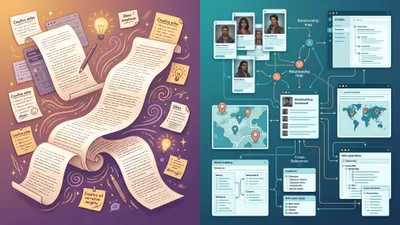
Ask AI to outline a thriller using a three-act structure, and you will get a competent skeleton. AI understands narrative beats — inciting incidents, midpoint reversals, dark nights of the soul, climactic confrontations. Tools like Chapter use these frameworks to generate full book outlines that give you a working roadmap for your novel.
This is arguably AI’s single strongest fiction application. Outlining with AI saves weeks of structural work.
World-Building Details
Need a magic system for your fantasy novel? A political structure for your sci-fi colony? The menu at a 1920s speakeasy? AI generates rich, internally consistent world-building details on demand. It draws from vast training data across genres, so it knows the conventions and can remix them intelligently.
First-Draft Speed
A writer who produces 2,000 words per day can use AI to draft 10,000-15,000 words in the same time. The AI co-writing workflow turns a six-month drafting process into a six-week one. More than 2,147 authors have used Chapter to write over 5,000 books — and speed is the most commonly cited benefit.
That speed only matters if the output is worth editing. Which brings us to the limitations.
Scene-Level Prose
Give AI a detailed scene brief — characters present, emotional beats, setting, sensory details, the goal of the scene — and it writes solid scene-level prose. Short, contained scenes are AI’s sweet spot. The output reads like a competent midlist novel: not award-winning, but not embarrassing.
Where AI Fails at Fiction Writing
AI fiction has consistent, predictable weaknesses. Understanding these is more important than knowing the strengths, because these are the problems you will spend your editing time fixing.
Voice and Style Consistency
AI writes in what researchers call “median prose” — a flattened, averaged-out style that sounds like no one in particular. Over a full novel, this is the single biggest problem. Your protagonist’s narration in chapter one sounds identical to chapter twenty. The sardonic detective talks like the earnest schoolteacher.
A study on AI creative writing found that even fine-tuned models struggle to maintain a consistent authorial voice across extended works. The prose is competent paragraph by paragraph, but the cumulative effect is a book that feels like it was written by a committee.
This is why adding a human touch to AI writing is not optional — it is the entire point of the editing process.
Emotional Depth and Subtext
AI writes emotion on the surface. Characters “felt a wave of sadness” or “anger surged through her.” What AI cannot reliably do is convey emotion through behavior, silence, avoidance, and contradiction — the way real people actually experience feelings.
A character who says “I’m fine” while methodically shredding a napkin is doing something AI rarely generates unprompted. Subtext, irony, and emotional complexity require a human writer who understands that the most powerful moments in fiction happen between the lines.
Long-Form Coherence
Even with GPT-5’s 400,000-token context window, AI struggles to maintain true narrative coherence across a full novel. Subplot threads get dropped. A character’s eye color changes. The gun on the mantelpiece in chapter three never fires.
The problem is not memory — modern models can technically hold an entire manuscript. The problem is that AI does not plan ahead. It generates the next paragraph based on what came before, not based on where the story needs to go. This is why using AI for novel writing requires a strong human-created outline as the backbone.
Originality and Surprise
AI fiction is derivative by design. It generates text based on patterns in its training data, which means it gravitates toward the most common tropes, structures, and phrasings. A study published in ScienceDirect found that AI-written stories rely more heavily on traditional genre tropes, while human-written stories from creative writing programs were more unusual and challenging.
You will notice this as stylistic tics: AI-generated fiction loves ghosts, whispers, shadows, and silence. Characters gaze out rain-streaked windows. Revelations happen through found letters. These are not bad techniques — they are just the default, every time.
How Does AI Fiction Compare to Human Writing?
AI fiction is roughly equivalent to a competent first draft by an intermediate-level writer. It is better than a beginner’s output and worse than a skilled author’s polished manuscript. The full comparison between AI and human writing quality shows that the gap is closing but remains significant in the areas that matter most to readers.
Here is how they compare across key fiction metrics:
| Quality Metric | AI Writing | Skilled Human Writing |
|---|---|---|
| Grammar and mechanics | Excellent | Excellent |
| Dialogue naturalness | Good | Excellent |
| Plot structure | Good | Varies widely |
| Emotional depth | Surface-level | Deep and nuanced |
| Voice consistency | Weak across long works | Strong (when practiced) |
| Originality | Formulaic | Ranges from derivative to groundbreaking |
| Pacing | Adequate | Instinctive when skilled |
| Subtext and irony | Rare | Core strength |
The key insight from Chapter’s 5,000+ published books is that the best AI-assisted fiction is not “AI fiction” at all. It is human fiction that used AI to get to the first draft faster. The authors who produce the strongest work treat AI output as raw material, not finished product.
The AI Fiction Writing Workflow That Actually Works
The gap between bad AI fiction and good AI fiction is not the model — it is the workflow. Here is the process used by authors who consistently produce publishable AI-assisted fiction.
Step 1: Create a Detailed Outline First
Write your outline yourself or use AI to help generate one, but do not skip this step. Your outline should include chapter-by-chapter plot beats, character profiles with voice notes, the emotional arc of each major character, and key scenes you have already envisioned.
The outline is your insurance policy against AI drift. When the model veers off course (and it will), you pull it back to the plan.
Step 2: Draft Scene by Scene, Not Chapter by Chapter
Feed AI one scene at a time with specific instructions: who is present, what needs to happen, the emotional tone, and any critical dialogue beats. Scene-level prompts produce dramatically better output than “write chapter 5.”
Chapter’s fiction software structures this process automatically, maintaining your story bible and feeding context to each scene generation.
Step 3: Edit for Voice Immediately
Do not wait until the manuscript is complete to edit for voice. After each AI-generated scene, spend 10-15 minutes rewriting the sentences that sound generic. Add your character’s specific speech patterns. Replace AI’s default descriptions with sensory details only your character would notice.
This is the step most writers skip, and it is the step that separates publishable AI fiction from obvious AI fiction.
Step 4: Handle Continuity Yourself
Keep a running document of established facts: character descriptions, timeline events, spatial relationships, and recurring motifs. AI will not track these reliably across a full manuscript, even with large context windows. You are the continuity editor.
Step 5: Rewrite the Emotionally Critical Scenes
Identify the five to ten scenes in your novel that carry the most emotional weight — the breakup, the betrayal, the climax, the quiet reconciliation. Rewrite these entirely by hand. AI can draft the connective tissue between these moments, but the moments themselves need to come from you.
This hybrid approach is how authors using Chapter have produced books that earned $13,200 in revenue, landed speaking engagements, and received genuine reader praise.
What Are the Best AI Tools for Fiction Writing?
The tool matters less than the workflow, but the right tool makes the workflow faster. Here is how the major options compare for fiction specifically.
Our Pick — Chapter
Chapter is purpose-built for book-length fiction. It maintains your story bible, generates scene by scene with full context, and keeps character voice consistent across your entire manuscript.
Best for: Authors who want a complete fiction writing system, not just a chatbot Pricing: $97 one time, 2 books included (fiction or nonfiction), 30-day money-back guarantee Why we built it: Because general-purpose AI tools lose the thread after a few chapters — and fiction writers need a tool that thinks in books, not prompts
Other strong options include Sudowrite for its Story Engine and prose-level controls, NovelCrafter for writers who want granular scene management, and ChatGPT with GPT-5 for its massive context window. The full comparison of AI novel writing tools covers eight options in detail.
Is AI-Written Fiction Ethical to Publish?
Yes — AI-assisted fiction is ethical to publish, and major platforms accept it. Amazon KDP, the largest self-publishing platform, allows AI-assisted books with disclosure. The key distinction is between AI-generated content (fully machine-written, no human editing) and AI-assisted content (human-directed, human-edited, with AI as a drafting tool).
The ethical consensus in 2026 is clear: if you direct the creative vision, write the outline, edit the prose, and ensure the quality, the book is yours. The AI is a tool, like a word processor or a grammar checker — just a more capable one.
The question of whether AI writing is cheating has largely been settled by the market. Readers care about whether a book is good, not whether a first draft was generated by software.
Will AI Replace Fiction Writers?
No — and the data supports this. The Authors Guild’s 2025 survey found that 67% of professional novelists now use AI tools, but as augmentation rather than replacement. Writers are producing more books, not fewer jobs.
AI replaces the mechanical parts of fiction writing — generating rough prose, brainstorming alternatives, catching inconsistencies. It does not replace the creative judgment that decides which story is worth telling, which character deserves the reader’s empathy, or which ending will haunt someone for days.
The writers who thrive with AI are the ones who understand what it cannot do and refuse to settle for output that stops at “good enough.”
How Long Does It Take to Write a Novel With AI?
Most authors complete an AI-assisted novel draft in 4-8 weeks, compared to 6-12 months writing traditionally. The time savings come primarily from the drafting phase — AI generates rough prose 5-10x faster than manual writing. But editing an AI draft takes roughly the same time as editing a human draft, sometimes longer.
The total timeline for a publishable AI-assisted novel looks like this: 1-2 weeks for outlining and setup, 2-4 weeks for AI-assisted drafting, and 2-4 weeks for human editing and revision. The authors who produce the best results on Chapter spend about 40% of their time on editing — which is where the human touch turns a decent draft into a book worth reading.
Can AI Write a Bestselling Novel?
AI-assisted novels have already hit bestseller lists. Authors using AI tools have reached Amazon category bestseller status, and some have generated significant revenue within days of launch. One Chapter user made $60,000 in 48 hours from a single AI-assisted book.
The pattern is consistent: the bestselling AI-assisted books are not “fully AI-written.” They are strategically planned, efficiently drafted with AI, and heavily edited by a human author who brings genuine creative vision. The AI accelerates the process. The human ensures the quality.
FAQ
How good is AI at writing fiction in 2026?
How good is AI at writing fiction? In 2026, AI produces competent first-draft fiction that is grammatically polished and structurally sound. It excels at dialogue, outlining, and world-building but struggles with voice consistency, emotional depth, and originality across novel-length works. The best results come from human-AI collaboration.
Can AI write a full novel by itself?
Can AI write a full novel by itself? Technically yes, but the result will lack voice consistency, emotional depth, and narrative coherence across the full manuscript. AI-generated novels without human editing read as formulaic and flat. The most successful approach uses AI for drafting and humans for creative direction and editing.
What is the best AI tool for writing fiction?
The best AI tool for writing fiction is Chapter, which is purpose-built for book-length fiction with story bible management and scene-by-scene generation. Other strong options include Sudowrite for prose-level controls and NovelCrafter for granular scene management.
Is AI-written fiction obvious to readers?
Is AI-written fiction obvious to readers? Unedited AI fiction is often detectable due to repetitive phrasing, surface-level emotions, and a “median prose” style. However, AI-assisted fiction that has been thoroughly edited by a human author is largely indistinguishable from traditionally written work, according to blind reading studies.
How much editing does AI fiction need?
How much editing does AI fiction need? Plan to spend 40-50% of your total project time on editing AI-generated fiction. You will need to fix voice consistency, deepen emotional scenes, correct continuity errors, and replace generic descriptions with specific, character-driven details. The editing phase is where AI fiction becomes genuinely good.