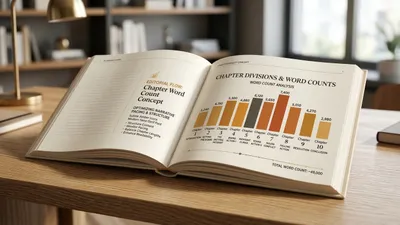
A chapter should be as long as it needs to be to complete one meaningful unit of story — but if you want a number, most chapters run 1,500 to 5,000 words, with the average landing between 3,000 and 4,000 words. There is no rule that decides the ideal length for you. Your story does.
The real question isn’t “what’s the correct word count?” It’s “how do I decide the right chapter length for my manuscript?” That’s a different problem, and it’s the one this guide solves.
In this guide, you’ll learn:
- The honest answer to how long a chapter should be (with real published examples)
- What actually determines your ideal chapter length
- Exactly when to break a chapter — and when to leave it long
- How chapter length controls pacing and the “one more chapter” effect
- How to keep your chapters consistent across an entire book
Let’s start with the numbers, then move to the decision that matters.
How Long Should a Chapter Be?
A chapter should be 1,500 to 5,000 words in most books, with 3,000 to 4,000 words being the sweet spot for adult fiction. But chapter length is a tool, not a target — published novels successfully run chapters from under 500 words to over 10,000.
What matters is that each chapter contains one complete unit of story and that your chapters feel consistent in rhythm across the book. A 1,200-word chapter and a 4,800-word chapter can live in the same novel, as long as each length is doing a job.
If you want the full breakdown by genre — thriller, romance, fantasy, literary, YA — see our companion guide on how many words in a chapter. This post focuses on the harder question: how to decide the right length for your specific book.
What Determines the Ideal Chapter Length?
The ideal chapter length is determined by four things: your genre, your pacing goals, the scene’s purpose, and your reader’s expectations. No single one wins — you balance them. A literary novel and a beach-read thriller can be the same total length and have wildly different chapters.
Here’s how each factor pulls on your decision.
Genre sets the baseline. Readers arrive with expectations. Thriller readers expect fast, short chapters that push them forward. Literary fiction readers expect room to sink into prose and reflection. Your genre is the starting point you adjust from, not a cage.
Pacing goals shape the rhythm. Short chapters speed a reader up. Long chapters slow them down and deepen immersion. If you want a breathless, can’t-put-it-down feel, you’ll lean shorter. If you want the reader to live inside a moment, you’ll go longer.
The scene’s purpose decides the unit. A chapter should cover one dramatic beat — a confrontation, a decision, a revelation, a turning point. When that beat is complete, the chapter is the right length, whether that took 900 words or 4,000.
Reader attention is the quiet constraint. Modern readers often read in short bursts — a commute, a lunch break, the ten minutes before sleep. Chapters that end at a natural pause give them a clean place to stop, which paradoxically makes them more likely to keep going.
What’s the Average Chapter Length in Real Books?
The average chapter length in published novels is roughly 2,000 to 4,000 words, but the range across bestsellers is enormous. Looking at real books reveals just how flexible chapter length is when it serves the story.
Here are average chapter lengths from well-known novels:
| Novel | Average Chapter Length |
|---|---|
| Along Came a Spider — James Patterson | ~1,100 words |
| Pride and Prejudice — Jane Austen | ~2,000 words |
| The Handmaid’s Tale — Margaret Atwood | ~2,100 words |
| The Fault in Our Stars — John Green | ~2,630 words |
| The Hunger Games — Suzanne Collins | ~3,700 words |
| 1984 — George Orwell | ~3,700 words |
| The Kite Runner — Khaled Hosseini | ~4,280 words |
| Harry Potter and the Sorcerer’s Stone — J.K. Rowling | ~4,560 words |
| Twilight — Stephenie Meyer | ~4,720 words |
| A Game of Thrones — George R.R. Martin | ~4,970 words |
Notice the spread. James Patterson built a career on ~1,100-word chapters — Along Came a Spider packs 97 chapters into 106,000 words, creating relentless momentum. George R.R. Martin sits at the top end near 5,000 words, giving each point-of-view chapter room to breathe.
Neither is “correct.” Patterson’s short chapters and Martin’s long ones both serve their stories perfectly. That’s the whole lesson: ideal chapter length is a function of intent, not a fixed rule.
When Should You Break a Chapter?
Break a chapter when the dramatic unit is complete, the energy shifts, or you want to create forward pull into the next chapter. The strongest chapter breaks fall at moments of change — a decision made, a question raised, a door that just closed.
Use these signals to know when to cut:
- A scene completes. The confrontation ends, the decision is made, the information lands. The story has finished one move.
- The energy changes. You’re shifting time, place, point of view, or emotional register. A break tells the reader the rules just changed.
- A question opens. You’ve planted something the reader now needs answered. Ending here turns the page for you — this is the engine of the “one more chapter” feeling.
- The reader needs to breathe. After an intense scene, a chapter break gives an emotional exhale before the next pressure builds.
The opposite is also true: don’t break a chapter just to hit a word count. If a scene needs 5,500 words to land, splitting it in half at the 2,750 mark to “even things out” usually kills the momentum. Length serves the scene, not the spreadsheet.
For a deeper structural view of how breaks accumulate into a whole book, see our guide on how many chapters should a book have.
How Chapter Length Controls Pacing
Chapter length is one of your most powerful pacing tools. Short chapters accelerate the reader; long chapters slow them down and deepen immersion. Master authors vary chapter length deliberately to control how fast a reader moves through the story.
Here’s the mechanism. Every chapter break is a tiny decision point: keep reading or stop. Short chapters arrive at that decision point constantly, and because the next chapter is short too, the reader thinks “I can fit one more.” That’s how a thriller becomes unputdownable.
Long chapters do the opposite work. They ask the reader to commit to a sustained stretch, which rewards them with depth — full scenes, layered emotion, immersive description. Literary fiction and epic fantasy lean on this.
The advanced move is breaking your own pattern for effect. If your novel averages 3,000-word chapters and you suddenly drop in a 400-word chapter two-thirds of the way through, that short chapter hits like a gut-punch. The contrast makes it land. Variation, used intentionally, is more powerful than uniformity.
This is why pacing matters more than any target number. A consistent chapter length isn’t the goal — a consistent reading experience is. Learn more about controlling rhythm in your book’s plot structure.
Should All Chapters Be the Same Length?
No — chapters do not need to be the same length, but they should feel rhythmically consistent. Most successful novels keep chapters within a recognizable range rather than at an identical word count. Readers sense the pattern subconsciously and trust it.
Think of it like a heartbeat. A steady rhythm reassures the reader and lets them settle in. Wild swings — a 600-word chapter followed by an 8,000-word one followed by a 1,200-word one — can feel jarring unless you’re doing it on purpose for a specific effect.
The practical guideline: pick a working range for your book (say, 2,500–4,000 words) and let most chapters live inside it. Then deviate deliberately when a scene demands it or when you want a jolt of contrast.
This is far more useful than chasing an exact number. A book where every chapter is precisely 3,000 words would feel mechanical. A book where chapters breathe within a consistent range feels alive.
How Long Should Nonfiction Chapters Be?
Nonfiction chapters typically run 2,000 to 5,000 words, often longer than fiction chapters because each one develops a complete idea, argument, or topic. Many nonfiction chapters are broken into labeled sub-sections to keep dense material navigable.
The logic differs from fiction. A fiction chapter covers a dramatic beat; a nonfiction chapter covers a concept. Your chapter is the right length when the idea is fully explained, supported with examples, and resolved into a takeaway the reader can use.
Structure matters more than raw length here. Use sub-headings, bullet points, and clear transitions so a 5,000-word chapter never feels like a wall of text. Readers should be able to scan, find their place, and absorb one self-contained lesson per chapter.
For the bigger picture on nonfiction scope, see our guide on how many words in a nonfiction book.
Common Chapter Length Mistakes to Avoid
Even experienced writers stumble on chapter length. Watch for these pitfalls:
- Writing to a word count. Forcing every chapter to hit 3,000 words makes some scenes bloated and others rushed. Let the scene set the length.
- Cramming multiple scenes into one chapter. If a chapter contains three distinct dramatic beats with different energy, it’s probably three chapters trying to be one.
- Ending chapters on flat notes. A chapter that ends where it began — no change, no question, no pull — gives the reader an easy place to quit. End on a hinge.
- Ignoring genre expectations entirely. You can break convention, but do it knowingly. A 6,000-word opening chapter in a fast-paced thriller fights your reader’s instincts.
- Inconsistent rhythm without purpose. Random wild swings in length confuse the reading experience. Vary deliberately, not accidentally.
How Do You Decide Your Chapter Length in Practice?
The most reliable method is to let your outline and your scenes determine chapter length, then refine during revision. Don’t choose a target number first. Identify your story’s natural units, write them, and adjust the rhythm once you can read the whole draft.
Here’s a practical workflow:
- Outline by scene, not by chapter. Map the dramatic beats of your story first. Each complete beat is a candidate chapter. A solid chapter outline template makes this fast.
- Draft each scene to its natural length. Write the beat until it’s complete. Don’t pad it, don’t truncate it.
- Read the full draft for rhythm. Note where pacing drags (chapter likely too long) or feels rushed (chapter likely too short or breaking awkwardly).
- Split and merge during revision. Break chapters that hold two distinct scenes. Merge chapters too thin to stand alone. This is where chapter length is truly set.
- Check consistency last. Confirm most chapters sit within a recognizable range, with deliberate exceptions for effect.
This is also where AI book-writing tools earn their place — they help you structure scenes into chapters and keep your pacing consistent before you’ve written a word of prose.
Our Pick — Chapter
Chapter turns your book concept into a structured, chapter-by-chapter outline — so you can see exactly how your scenes break into chapters and where your pacing lands before drafting. You describe your book, genre, and target reader, and it builds an editable outline with chapter breakdowns you can reshape.
Best for: Authors who want to map chapter structure and pacing before they draft, not guess at it afterward Pricing: $97 one time, 2 books included (fiction or nonfiction), 30-day money-back guarantee Why we built it: Over 2,147 authors have used Chapter to outline and write 5,000+ books, because the hardest part of chapter length isn’t the word count — it’s knowing where one unit of story ends and the next begins.
Once you have a structural skeleton, every chapter-length decision gets easier. You’re no longer staring at a blank page wondering how long to make things — you’re refining a shape that already exists.
What If You Want a Book With No Chapters?
Some books abandon chapters entirely, using section breaks or a single continuous narrative instead. This is a deliberate structural choice that works when you want the reader swept along without natural stopping points.
Cormac McCarthy’s Blood Meridian uses numbered sections of wildly varying length rather than traditional chapters. Terry Pratchett wrote many Discworld novels with no chapter breaks at all, trusting scene transitions to guide the reader.
For most books — especially commercial fiction and nonfiction — chapters are expected. They help readers navigate, mark progress, and find their place after a break. Skip them only when their absence actively serves your story’s effect, not by default.
FAQ
How many words should a chapter be?
A chapter should be 1,500 to 5,000 words in most books, with the average chapter landing between 3,000 and 4,000 words. The exact length depends on your genre, pacing, and the scene’s purpose. Thrillers often run shorter; literary fiction and epic fantasy run longer. There is no fixed rule — length should serve the story.
How many pages is a typical chapter?
A typical chapter is roughly 8 to 20 pages in a standard printed book, based on about 250–300 words per page. A 3,000-word chapter runs around 10 to 12 pages. Page count varies with trim size, font, and formatting, so word count is the more reliable measure of chapter length when you’re writing.
Is it bad to have very short chapters?
No — very short chapters are not bad and are often a deliberate craft choice. Authors like James Patterson use chapters under 1,500 words to create fast pacing and a “one more chapter” momentum. Short chapters work best in thrillers, suspense, and commercial fiction where speed and forward pull matter most.
Can chapters be different lengths in the same book?
Yes — chapters can and often should vary in length within the same book. Most novels keep chapters in a consistent range but break the pattern deliberately for effect, like dropping a 400-word chapter into a book of 3,000-word chapters to create a jolt. The key is rhythmic consistency, not identical word counts.
How long should a chapter be in a first novel?
For a first novel, aim for 2,000 to 4,000 words per chapter as a safe, reader-friendly default. This range matches most genre expectations and keeps your pacing comfortable while you develop craft. Once you understand how chapter length controls pacing, you can experiment with shorter or longer chapters intentionally.
The Bottom Line
How long should a chapter be? Long enough to complete one unit of story, short enough to keep the reader moving — which, for most books, means somewhere between 1,500 and 5,000 words.
But the number was never the real answer. The skill is learning to feel where a chapter wants to end, building rhythm across a whole book, and using length to control how your reader experiences the story. Master that, and you’ll never have to ask the word-count question again.
Start by outlining your scenes. Let the beats define your chapters. Refine the rhythm in revision. Your ideal chapter length will reveal itself — and it’ll be exactly right for your book.