You outline a novella by working backwards from a scene budget: decide your word count, divide it into scenes, and only then decide what happens in each one. That constraint is the whole job. A novella has roughly a third of a novel’s room, so the outline has to earn every scene before you write a word.
In this guide, you’ll learn:
- How to calculate your novella’s scene budget before you plot anything
- The compressed three-act beat map that fits 17,500 to 40,000 words
- How to reverse-engineer your ending so the character arc actually lands
- A copy-and-fill novella outline template with word counts per scene
Here’s the eight-step process, starting with the number that governs everything else.
What Makes a Novella Outline Different From a Novel Outline?
Novella outline — A scene-by-scene plan for a story of 17,500 to 40,000 words, built around a single point-of-view character, one central conflict, and at most one subplot.
A novel outline can afford exploration. You can plan a second POV, a slow-burn B-plot, three settings, and a cast of eight, and the length absorbs it.
A novella cannot. The Science Fiction and Fantasy Writers Association defines the novella at 17,500 to 39,999 words, and the Hugo Awards use the same band. That is 70 to 160 printed pages. Britannica treats prose length as a continuum rather than a set of boxes, and notes that the word novel is itself a truncation of novella — the shorter form came first.
At that length, a subplot that would be a pleasant detour in a novel becomes the thing that eats your climax. So a novella outline is less about generating material and more about rationing it.
Here’s the practical difference:
| Element | Novel outline | Novella outline |
|---|---|---|
| Word count | 70,000-100,000 | 17,500-40,000 |
| Scenes | 60-90 | 15-30 |
| POV characters | 1-5 | 1 (2 at most) |
| Subplots | 2-4 | 0-1 |
| Named cast | 8-15 | 3-6 |
| Settings | Many | 1-3 |
| Time span | Months to years | Days to weeks |
If your existing story idea does not fit the right-hand column, you do not have a novella yet. You have a novel you’re trying to compress, and the outline is where you find that out cheaply. Our guide on the difference between a novella and a novel covers how to tell which one your premise really is.
Step 1: Set Your Word Count Target and Scene Budget
Pick your target word count first, then divide by your average scene length to get your scene budget. At 2,000 words per scene, a 30,000-word novella is 15 scenes. At 1,200 words per scene, it’s 25.
This is the single most useful thing you can do before plotting, and almost no outlining advice starts here.
Most published novellas land between 20,000 and 35,000 words. Check the average novella word count for your genre before you commit — literary novellas skew shorter, romance and fantasy novellas skew longer.
Run the math:
- Choose a target word count (say 30,000).
- Choose an average scene length. Fast-paced genres run 1,000-1,500 words per scene; literary and quiet-voiced work runs 2,000-3,000.
- Divide. That number is your scene budget.
- Subtract 10% as slack. Scenes always run long.
A 30,000-word novella at 1,500 words per scene gives you 20 scenes, minus slack, so plan 18.
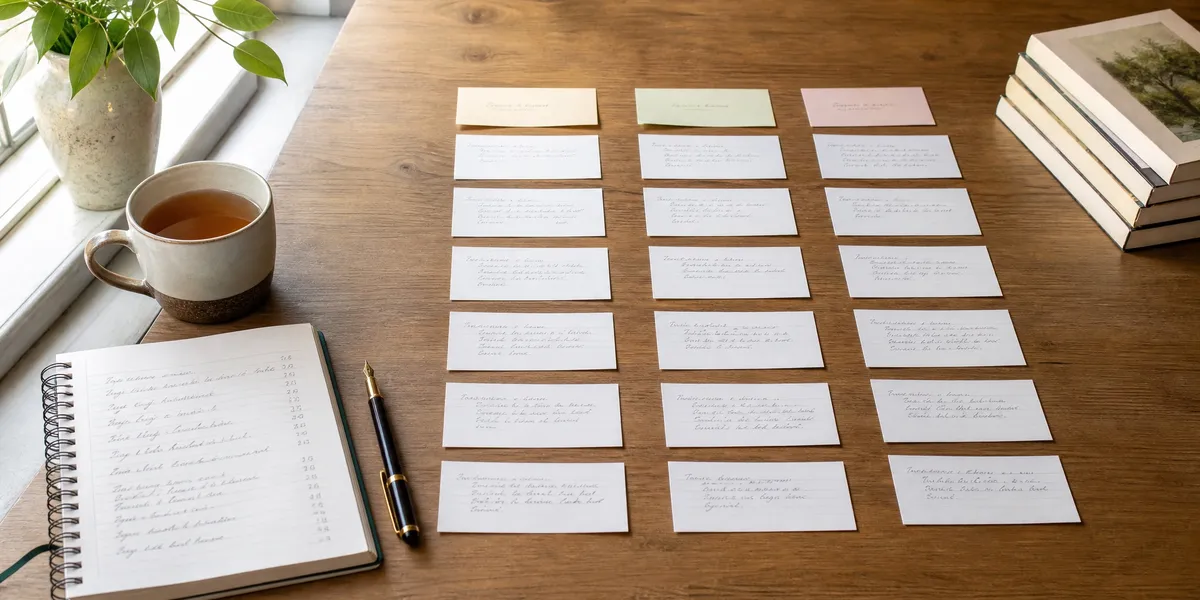
Eighteen index cards. That is the entire container your story has to live in, and now every plotting decision is a trade: adding a scene means cutting one.
Writers who skip this step end up with a 40-scene outline for a 25,000-word book, discover the mismatch at word 18,000, and abandon the draft.
Step 2: Write a Premise That Fits the Container
Your premise should name one character, one want, one obstacle, and one deadline in a single sentence. A premise with two protagonists or an open-ended timeline is a novel premise, and it will not compress.
The deadline is the part writers skip and the part that makes novellas work. A ticking clock does the structural labor that a novel accomplishes through accumulation.
Novel premise: A disgraced surgeon returns to her hometown and slowly confronts the family secrets that drove her away.
Novella premise: A disgraced surgeon has six days to get her estranged father to sign a consent form before his tumor becomes inoperable.
Same raw material. The second one has a container. Six days, one goal, one obstacle that is also the emotional wound.
Test your premise against three questions:
- Can it be resolved in days or weeks of story time?
- Does one character’s decision end it?
- Would adding a second POV improve it, or just widen it?
If the honest answer to the third question is “widen it,” you have a novella.
Step 3: Reverse-Engineer the Ending Before You Plot the Middle
Decide who your character is on the last page, then invert that to find who they are on the first page. Plotting forward from an opening image is a novel technique; at novella length it produces a soggy middle and a rushed climax almost every time.
Eva Deverell’s eight-stage One Page Novel formula — Stasis, Trigger, Quest, Bolt, Shift, Defeat, Power, Resolution — is explicitly plotted out of sequence for exactly this reason. You fix the Resolution, then define Stasis as its opposite. At short length, the arc has to be visible from the opening paragraph.
How to do it in four lines:
- Resolution state. Write one or two adjectives for who your protagonist is at the end. Forgiving. Rooted.
- Stasis state. Write the opposite. Vengeful. Rootless. That’s your opening.
- The lie. What belief holds the stasis state in place? “If I go back, I become them.”
- The proof. What single event makes the lie impossible to keep believing? That event is your midpoint.
You now have four fixed points before you’ve plotted a single scene. Every scene you add later has to move the character from line 2 toward line 1, or it gets cut.
This is also the fastest way to diagnose a novella that isn’t working: if you can’t state the stasis and resolution states in adjectives, the arc isn’t there yet. Our breakdown of the character arc covers the three arc types in more depth.
Step 4: Lock One POV and One Subplot Maximum
Choose a single point-of-view character and, at most, one subplot that shares a theme with the main plot. Every additional POV costs roughly 6,000 words of setup that a novella cannot spare.
Single-POV first person or third person limited are the workhorses of the format. They put you inside the arc immediately, which matters when you have 40 pages to make a reader care.
If you genuinely need two POVs — dual-POV romance being the common case — halve your scene count per character and accept that each gets a thinner arc. Write it into the outline explicitly: 9 scenes each, alternating.
For the subplot, apply one test: does it resolve in the same scene as the main plot, or one scene before? If it needs its own separate climax, cut it. A novella has room for one climax. See our guide on subplots for how to braid a secondary thread without stealing space.
Cast list: three to six named characters. Anyone who appears in fewer than three scenes should probably be merged into someone who appears in six.
Step 5: Map the Compressed Three-Act Beats
Assign your scene budget across three acts at roughly 20/60/20, then place five fixed beats: hook, inciting incident, midpoint reversal, crisis, and climax. In an 18-scene novella that’s Act One at 4 scenes, Act Two at 11, and Act Three at 3.
The three-act structure works at novella length, but the proportions shift. Act One compresses hardest — you have about 3,000 words to establish character, world, and want, where a novel gets 20,000.
Here is the beat map for an 18-scene, 30,000-word novella:
| Beat | Scene # | Approx. word | What it does |
|---|---|---|---|
| Hook | 1 | 0 | Character in stasis state, doing something that shows the lie |
| Inciting incident | 2 | 2,500 | The deadline arrives |
| Act One turn | 4 | 6,000 | Protagonist commits; no going back |
| Fun and games | 5-8 | 6,000-13,500 | Pursuing the want the wrong way |
| Midpoint reversal | 9-10 | 15,000 | The proof — the lie becomes untenable |
| Escalation | 11-13 | 16,500-22,500 | New approach, rising cost |
| Crisis / all is lost | 14 | 24,000 | Worst outcome; the old self fails |
| Act Three turn | 15 | 25,500 | Choice made from the resolution state |
| Climax | 16-17 | 27,000-28,500 | Main plot and subplot resolve together |
| Resolution | 18 | 29,000 | New stasis, 1,000 words maximum |
Two things to notice.
The midpoint sits almost exactly halfway and carries more weight than in a novel — it’s not a setback, it’s the arc’s hinge. Our post on the midpoint reversal breaks down why this beat does double duty in short-form fiction.
And the resolution is short. A novella earns its power from compression; a five-scene wind-down undoes that. One scene, then stop.
Step 6: Build the Scene List
Write one line per scene containing POV, location, the character’s goal, the obstacle, and the outcome. If any of the five is blank, the scene isn’t ready to write.
This is the step most outlining guides start with — Grammarly’s outlining walkthrough and MasterClass’s novella method both build a scene list early. At novella length it works better as step six, once the container and the arc are already fixed.
Use whatever medium you’ll actually look at: index cards, a spreadsheet, a Kanban board. The format matters less than the discipline of five fields.
Example scene line:
Scene 7 — Maya | Hospital cafeteria | Goal: get her brother to co-sign | Obstacle: he blames her for leaving | Outcome: refuses, and reveals Dad has been asking for her — no, but
That last tag is the scene’s exit state. Every scene should end in one of four ways: yes and, yes but, no and, no but. A run of three scenes with the same tag is a pacing problem you can see before you draft it.
Sequence your scenes so the tags alternate. Reader fatigue in novellas comes almost entirely from unbroken runs of the same outcome shape.
If you’re unclear on where one scene ends and the next begins, our post on the difference between a scene and a chapter is a useful companion here.
Step 7: Assign a Word Count to Every Scene
Write a target word count next to each scene line and total the column. If the total exceeds your target by more than 10%, cut scenes now rather than trimming prose later.
This is where the outline stops being a wish list.
Most writers discover at this step that scenes 5 through 8 — the “fun and games” stretch — are carrying four scenes’ worth of plot and eight scenes’ worth of ambition. Cut two. The middle is always where a novella bloats.
Vary the lengths deliberately:
- Hook and climax: longest scenes, 2,000-2,500 words
- Midpoint: long, 2,000 words
- Connective scenes: short, 800-1,200 words
- Resolution: short, under 1,000 words
Alternating long and short scenes creates pace on the page without any change to the prose. It’s the cheapest pacing tool available and it happens entirely in the outline.
Step 8: Stress-Test the Outline Before You Draft
Run four checks on the finished outline. Each one catches a failure mode that costs days of drafting if you find it later.
- The deletion test. Remove any scene. If the plot still works, that scene is decoration. Cut it or merge it.
- The want test. Read only the “goal” column top to bottom. It should read as one escalating pursuit, not five different wants.
- The arc test. Read only the “outcome” column. Your protagonist should be measurably different by scene 10.
- The clock test. Count story days. If your six-day deadline takes three weeks of story time, the pressure has leaked out.
Fix what these surface, then draft. An outline that survives all four is usually worth 20,000 words of avoided rewriting.
Novella Outline Template You Can Copy
Fill this in for each scene. Eighteen rows for a 30,000-word novella.
| # | Beat | POV | Location | Goal | Obstacle | Outcome tag | Words |
|---|---|---|---|---|---|---|---|
| 1 | Hook | 2,000 | |||||
| 2 | Inciting incident | 1,800 | |||||
| 3 | Reaction | 1,200 | |||||
| 4 | Act One turn | 1,800 | |||||
| … | |||||||
| 18 | Resolution | 900 |
Above the table, keep a five-line header: premise, stasis state, resolution state, the lie, the deadline. Those five lines are what you check the outline against every time you’re tempted to add a scene.
If you’d rather start from a longer pre-built structure, our novel outline template scales down cleanly — delete the second POV column and halve every act.
Common Mistakes to Avoid
- Outlining a novel and calling it a novella. If your outline has two POVs and three subplots, you have a 90,000-word book. Decide now, not at word 30,000.
- Front-loading the setup. Four scenes of world and backstory before the inciting incident is 25% of your book spent on preamble. Start the clock by scene 2.
- A midpoint that’s just a setback. In a novella the midpoint has to change what the character believes, not just what they’re doing.
- Too many named characters. Every name a reader has to hold costs attention you need for the arc. Merge minor roles ruthlessly.
- Planning a full-length resolution. Novellas end fast. One scene of aftermath, then the last line.
- Skipping the word count column. Without it, an outline is a wish list. With it, it’s a plan.
How Long Does It Take to Outline a Novella?
Outlining a novella takes four to twelve hours for most writers, spread across two or three sessions. The premise and reverse-engineered arc take about an hour; the scene list takes three to six; the stress-test takes one. That is far less than the drafting time it saves.
Give it a night between the scene list and the stress-test. Problems in a scene sequence are much easier to see after a day away from it.
Should You Outline a Novella If You’re a Pantser?
Yes — at least to the beat-map level. Discovery writing works at novel length because you have room to write your way out of a wrong turn. At novella length a wrong turn at word 12,000 costs you a third of the book.
The compromise that works: outline the five fixed beats and the ending, then discovery-write the scenes between them. You keep the freedom and the container. Our comparison of outlining methods for novels covers seven approaches if the scene-card method doesn’t suit you.
Can AI Help You Outline a Novella?
AI helps most with the mechanical parts of a novella outline — generating scene variations, pressure-testing whether a subplot resolves in time, and reformatting a scene list into a beat map. It’s weakest at the part that matters most: deciding what your character believes and why.
Used well, the workflow is: you write the premise, the stasis and resolution states, and the lie. Then you hand the AI those five lines and ask for eighteen scene one-liners that move from stasis to resolution. You keep four, rewrite ten, and delete the rest.
Chapter works this way for fiction — you set the structure and it builds out the scene-level detail, which is roughly the division of labor that produces usable outlines rather than generic ones. More than 2,147 authors have used it, and 5,000+ books have been created on the platform.
If you want the broader workflow rather than novella specifics, see how to use AI to outline a book and our review of the best AI book outline generators.
Whatever tool you use, the outline is still yours to judge. AI can generate eighteen scenes in a minute; only you can tell which four of them are true.
FAQ
How many chapters should a novella have?
A novella usually has 8 to 20 chapters, depending on whether you use one scene per chapter or group two or three scenes together. At 30,000 words, 12 chapters of roughly 2,500 words each is a common and readable shape. Genre matters: romance and thriller novellas favor shorter, more frequent chapter breaks.
How many scenes should a novella outline have?
A novella outline should have 15 to 30 scenes. Calculate yours by dividing your target word count by your average scene length — 30,000 words at 1,500 words per scene gives 20 scenes. Subtract 10% for slack, because scenes almost always run longer than planned.
Can a novella have a subplot?
A novella can have one subplot, and only if it resolves in the same scene as the main plot or the scene immediately before. A subplot that needs its own separate climax will crowd out your ending. Thematic echo, not narrative independence, is what makes a novella subplot work.
What is the best structure for a novella?
The best structure for a novella is a compressed three-act structure at roughly 20/60/20 proportions, with five fixed beats: hook, inciting incident, midpoint reversal, crisis, and climax. Act One compresses hardest — you have about 3,000 words to establish character, want, and deadline before the story must move.
Do I need a full outline, or is a beat sheet enough?
A beat sheet is enough to start a novella if you’re comfortable discovery-writing between fixed points. Map the five structural beats and the ending, then improvise the connective scenes. At novella length, though, the word-count column is the part you shouldn’t skip — it’s what keeps a 25,000-word plan from becoming a 45,000-word draft.
Related Reading
- How to Write a Novella — the full drafting process once your outline is done
- Average Novella Word Count — genre-by-genre length targets
- How to Write a Story Outline — the general outlining process
- Three-Act Structure — the structural backbone, explained
- Midpoint Reversal — why this beat carries a novella