You can write a TV pilot script that hooks readers from the cold open — if you understand how pilot episodes differ from features, nail the structure, and follow a proven drafting process.
In this guide, you’ll learn:
- How to develop a series concept and write a logline that sells
- The exact structure and page counts for half-hour and hour-long pilots
- How to write a cold open that grabs attention in the first two pages
- The revision strategy that turns a rough draft into a submission-ready script
Here’s the step-by-step process.
What Is a Pilot Script?
A pilot script is the screenplay for the first episode of a television series. It introduces the central characters, establishes the world, sets up the core conflict, and — most importantly — proves the show can sustain multiple episodes.
That dual purpose makes pilot writing harder than writing a feature film. A movie script resolves its central conflict by the final page. A pilot script opens conflicts you won’t resolve for episodes, seasons, or even the entire series run. You need to deliver a satisfying first episode while making your reader desperate to see what happens next.
If you’re new to screenwriting, start by reading produced pilots in your genre. The Writers Guild of America library and sites like Script Slug offer free access to award-winning pilot scripts.
How Does a Pilot Differ From a Spec Script?
A pilot script is an original work — you created the series concept, the characters, and the world from scratch. A spec script is an episode written for an existing show, using characters and storylines someone else created.
Both demonstrate your writing ability, but they serve different purposes in the industry. A spec script shows you can write in another showrunner’s voice. A pilot script shows you can create a world from nothing — and that’s what gets you staffed on a writing team or gets your show optioned.
Most working TV writers maintain both in their portfolio. But if you’re choosing where to invest your time, write the pilot first. Original voices get noticed faster.
Step 1: Develop Your Series Concept
Every pilot begins with a concept strong enough to sustain years of storytelling. Before you type a single scene heading, answer these five questions:
- Who is the protagonist? What do they want, and what flaw stands in their way?
- What is the engine? What recurring conflict drives every episode?
- What is the world? Where does this story take place, and what rules govern it?
- Why today? Why does your pilot begin at this specific moment in the protagonist’s life?
- Why keep watching? What unresolved tension pulls the audience into episode two?
The “engine” question matters most for television. A feature film needs one story. A TV series needs a story machine that generates fresh conflict every episode while advancing longer arcs across seasons.
Write your concept as a one-paragraph pitch before you go further. If you cannot explain the show in four sentences, the idea needs more focus.
How to Write a Logline for Your Pilot
A logline compresses your entire series premise into one to two sentences. It captures the protagonist, the central conflict, and the stakes — and it’s the first thing any producer or agent reads.
Use this formula: When [inciting incident], a [protagonist with a defining trait] must [goal] or face [consequences], but [obstacle] makes it nearly impossible.
Strong pilot loglines look like this:
- “When a chemistry teacher is diagnosed with terminal cancer, he partners with a former student to manufacture drugs — risking his family, his freedom, and his soul.”
- “A mid-level bureaucrat discovers her entire department is unknowingly working for a shadowy organization, and her quest for answers threatens to destroy the only life she knows.”
Notice that both loglines imply seasons of story, not a single plot that wraps up neatly. Your pilot logline should make readers ask “What happens next?” — not “How does it end?”
Test your logline on people who don’t know your concept. If they lean forward and ask questions, you have something worth writing.
Step 2: Build Your World Before You Write
Pilots that feel thin almost always share the same problem: the writer started scripting before the world was fully built. Worldbuilding isn’t just for fantasy and sci-fi. Every TV series has a world with its own rules, hierarchies, and textures.
Before you write your pilot, create a brief world document covering:
- Setting details — Geography, time period, social environment, visual tone
- Rules — What is normal in this world? What is forbidden? What are the power structures?
- Daily life — What does an ordinary day look like for your protagonist before the story disrupts it?
- Recurring locations — Television shows return to the same sets. Identify your 3-5 anchor locations now.
This document doesn’t need to be long. Two to three pages of focused prose will save you from writing yourself into corners later. Professional TV writers call this a “story area” — a short prose summary that tests whether your world holds up before you commit to script format.
Your world should feel like it existed before your pilot starts and will continue after it ends. Drop your characters into a living environment, not a stage built for one scene.
Step 3: Create Characters That Drive a Series
The best TV protagonists are not static heroes. They are flawed, contradictory people with enough internal tension to sustain character arcs across multiple seasons.
Your Protagonist Needs a Core Contradiction
Great TV characters want something that conflicts with what they need. Tony Soprano wants power and control — but needs genuine human connection. Walter White wants to provide for his family — but needs the validation and ego that power gives him.
Define your protagonist’s want and need before you outline the pilot. That gap between want and need is where your series lives.
Build a Cast That Creates Conflict
Television is an ensemble medium. Your pilot needs to introduce secondary characters who:
- Challenge the protagonist — An antagonist, rival, or authority figure who blocks their goals
- Reflect the protagonist — A partner, friend, or ally who highlights their strengths and weaknesses
- Represent the world — Characters who show the audience how this world works
Introduce 4-6 named characters in your pilot. More than that overwhelms the reader. You can expand the ensemble in later episodes.
Introduce Characters Through Action
Show characters doing something that reveals who they are. A detective who arrives at a crime scene eating breakfast tells you more in one action line than a paragraph of backstory ever could. For more on building memorable characters, see our guide on character development.
Step 4: Outline Your Pilot Before You Write
Writing a pilot without an outline leads to bloated scripts, meandering subplots, and months of rewrites. Outline first. Always.
Write a Story Area First
Before creating a scene-by-scene outline, write a “story area” — a two-to-three page prose document that tells the story of your pilot episode in narrative form. No scene headings. No dialogue. Just the story from beginning to end.
This technique, used in professional writers’ rooms, forces you to focus on story logic before you get seduced by clever dialogue or cool set pieces. If a story problem exists, you’ll spot it here — not sixty pages into your script.
Then Build a Scene-by-Scene Outline
Once your story area works, expand it into a detailed outline. For each scene, write:
- Scene heading — Where and when
- Purpose — What this scene accomplishes for the story
- Conflict — What tension drives the scene
- Outcome — How the scene changes the story’s direction
A half-hour pilot outline typically runs 8-12 scenes. An hour-long drama runs 20-35 scenes. Your outline should be 8-10 pages of clear, organized prose.
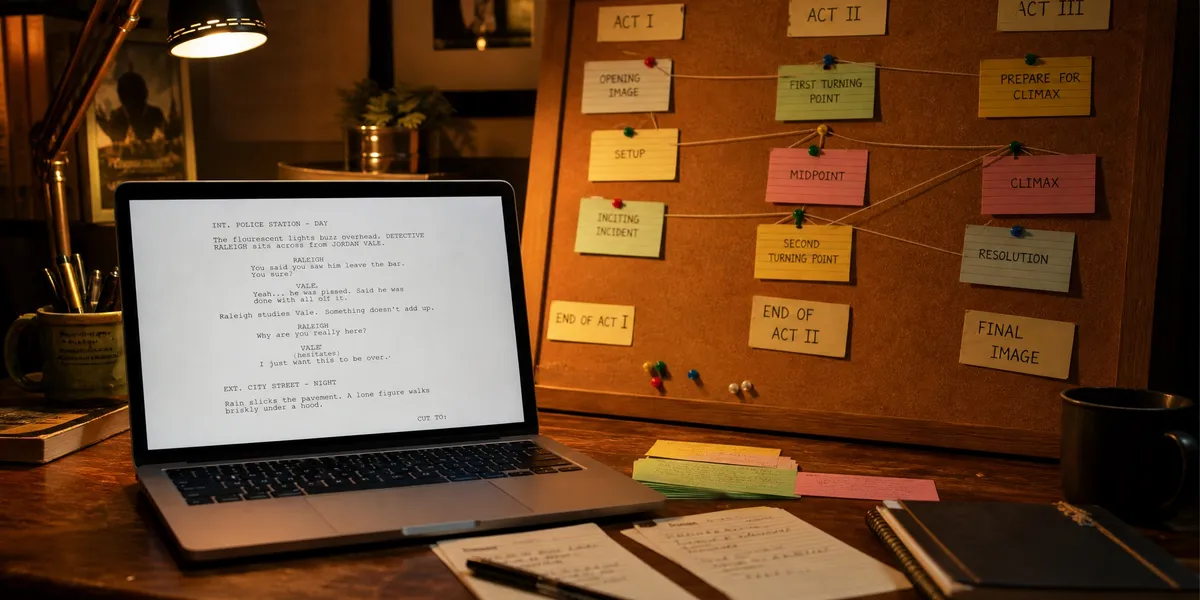
If you use a beat sheet structure, map your outline beats to the act breaks required by your format. This ensures every act ends on a moment of tension that pulls the viewer through the commercial break — or the next episode chapter on streaming.
What Is the Structure of a TV Pilot?
TV pilot structure depends on your show’s format. The two primary formats are the half-hour (comedy) and the hour-long (drama), and each follows different structural rules.
Half-Hour Pilot Structure (Comedy)
A half-hour pilot runs 25 to 35 pages. The standard structure uses two acts, though some networks and streaming shows use three.
| Beat | Page Range | Purpose |
|---|---|---|
| Cold Open / Teaser | 1-3 | Hook the audience, establish tone |
| Act One | 4-17 | Set up the central conflict of the episode |
| Act Two | 18-32 | Escalate, complicate, resolve (with a twist for series) |
| Tag / Button | 33-35 | Final joke or moment that resets or hints at what’s next |
Comedy pilots live or die on voice and pacing. Every page needs to earn its place. If a scene doesn’t advance the plot or land a joke, cut it.
Hour-Long Pilot Structure (Drama)
An hour-long pilot runs 50 to 65 pages. Most use a four-act or five-act structure, depending on the network. Streaming pilots sometimes use a looser structure without hard act breaks.
| Beat | Page Range (5-Act) | Purpose |
|---|---|---|
| Cold Open / Teaser | 1-5 | Grab attention, establish stakes |
| Act One | 6-18 | Introduce the world and protagonist, launch the central conflict |
| Act Two | 19-30 | Deepen the conflict, introduce complications |
| Act Three | 31-42 | Raise the stakes, protagonist faces a major setback |
| Act Four | 43-52 | Push toward climax |
| Act Five | 53-60 | Climax and aftermath — resolve the episode, open the series |
For five-act structures, aim for 9-12 pages per act. The old benchmark was 15 pages per act in a four-act structure, but modern pacing and commercial time adjustments have shifted these numbers.
Study the screenplay structure of produced pilots in your genre. Breaking down three to five successful pilots will teach you more about act structure than any textbook.
How to Write a Cold Open That Hooks the Audience
A cold open (also called a teaser) is the scene or sequence that plays before the opening credits. It’s the single most important pages of your pilot because it determines whether the reader keeps going.
Your cold open should accomplish at least one of these goals:
- Establish the tone — Is this dark? Funny? Suspenseful? The cold open tells the audience what kind of show they’re watching.
- Introduce the protagonist — Show your main character in a moment that reveals their personality and situation.
- Create a question — Set up a mystery, conflict, or situation that the audience needs to see resolved.
- Show what’s at stake — Demonstrate the consequences that drive the series.
The strongest cold opens do all four simultaneously. The opening scene of a great pilot gives you the protagonist, the tone, a question, and the stakes — all in two to five pages.
Keep it short. A cold open that runs longer than five pages loses its punch. Get in, hook the reader, and cut to the main titles.
Step 5: Write Your First Draft
You have your concept, your world, your characters, and your outline. Now write the script.
Set Your Page Target
Before you start, know your target:
- Half-hour comedy: 25-35 pages
- Hour-long drama: 50-65 pages
- Limited series or prestige pilot: Up to 70 pages (rare, only if the story demands it)
The one-page-per-minute rule still applies. If your hour-long pilot hits 80 pages, it’s overwritten. Cut scenes, tighten dialogue, and trim action lines.
Write in Present Tense, Active Voice
Pilot scripts are written in present tense. “She crosses the room and picks up the phone” — not “She crossed the room and picked up the phone.” Everything happens now, on screen, in front of the audience.
Use active voice. “MARCUS fires the gun” — not “The gun is fired by Marcus.” Active voice creates urgency and keeps the read fast.
Format Your Script Correctly
Formatting matters. A script in the wrong font or with non-standard margins gets rejected before anyone reads the story. Use industry-standard screenplay format:
- Font: 12-point Courier or Courier New
- Margins: 1.5 inches left, 1 inch right, 1 inch top and bottom
- Scene headings: ALL CAPS — INT. LOCATION - TIME OF DAY
- Character names: CENTERED, ALL CAPS above dialogue
- Parentheticals: Used sparingly, only when the line reading isn’t obvious from context
- Act breaks: Centered, underlined, all caps — this is the key formatting difference between TV and feature scripts
Use professional screenwriting software. Final Draft is the industry standard. WriterSolo, Highland, and Fade In are solid alternatives. Free options like WriterDuet work well for beginners. The software handles formatting automatically so you can focus on the story.
Write the Vomit Draft
Your first draft will not be good. That’s expected. Professional screenwriters call this the “vomit draft” — you get everything on the page without worrying about polish. Follow your outline, write fast, and finish. Getting to “FADE OUT” on a complete first draft is the hardest part. Everything after that is craft.
Step 6: Write Your Series Bible
A series bible is a companion document that accompanies your pilot script. It tells producers what the show becomes beyond the first episode. Include a logline, character breakdowns, a season one episode outline, tone references, and a long-term vision for 3-5 seasons.
Not every submission requires a series bible, but having one ready signals professionalism. It also forces you to think beyond the pilot — which strengthens the pilot itself.
Common Mistakes to Avoid in Your Pilot Script
- Too many characters — Introducing more than 6-7 named characters in a pilot overwhelms the reader. Establish your core cast and expand in later episodes.
- Resolving the central conflict — Your pilot is not a standalone movie. Leave the series-level conflict open. The episode conflict can resolve, but the show’s engine must keep running.
- Ignoring the “why today” question — Every pilot begins at a specific moment for a reason. If your story could start at any point in the protagonist’s life, you haven’t found the right inciting incident.
- Overwriting action lines — Keep scene descriptions lean. Two to three lines per action block maximum. White space on the page signals a fast, cinematic read.
- Skipping the outline — Writers who jump straight to script almost always produce pilots that lose focus in the second act. Outline first.
Step 7: Revise Your Pilot Script
Revision is where amateur pilots become professional ones. Plan for at least three full revision passes after your first draft.
Pass 1: Story and Structure
Read the entire script with fresh eyes (wait at least a week after finishing the first draft). Ask:
- Does every scene advance the plot or deepen a character?
- Do the act breaks land on moments of tension?
- Is the “why today” clear within the first five pages?
- Does the ending make you want to see episode two?
Cut any scene that doesn’t serve the story. Combine scenes that accomplish similar goals. Tighten the structure before you touch a word of dialogue.
Pass 2: Character and Dialogue
Now focus on voice. Read the dialogue out loud. Ask:
- Can you tell which character is speaking without reading the character name?
- Does every character have a distinct speech pattern?
- Are there lines that sound written instead of spoken?
Cut on-the-nose dialogue — lines where characters say exactly what they feel or think. Real people talk around their emotions. Your characters should too. For techniques on writing natural-sounding dialogue, see our guide on how to write dialogue.
Pass 3: Polish and Page Count
The final pass is about craft. Tighten action lines. Cut redundant words. Check your page count against your format’s target. A half-hour pilot at 45 pages or an hour-long at 75 pages needs cutting — no exceptions.
Check formatting one final time. Make sure act breaks are labeled correctly, character names are consistent, and scene headings follow the INT./EXT. convention throughout.
What Tools Do You Need to Write a Pilot Script?
You need three categories of tools: screenwriting software for formatting, outlining tools for structure, and research resources for studying the craft.
Screenwriting software handles the strict formatting requirements automatically. Final Draft remains the industry standard. WriterSolo and Highland are popular alternatives. Free options like WriterDuet and Celtx work for beginners who aren’t ready to invest.
Outlining and brainstorming tools help you develop your story before you start scripting. Many writers use index cards (physical or digital), beat sheets, or dedicated outline software. If you want AI assistance with brainstorming story concepts, character development, or plot structure, tools like Chapter can help you generate and refine ideas before you move into screenplay software.
Craft resources accelerate your learning. Read produced pilot scripts, study screenwriting books, and break down shows you admire into their structural components. The more pilots you analyze, the faster your writing improves.
How Long Does It Take to Write a TV Pilot?
Writing a TV pilot typically takes 4 to 12 weeks from concept to polished draft, depending on your experience level and the complexity of the project. Here’s a realistic breakdown:
| Phase | Timeline |
|---|---|
| Concept and logline development | 3-5 days |
| World and character building | 5-7 days |
| Story area and outline | 7-10 days |
| First draft (vomit draft) | 7-14 days |
| Revision pass 1 (story/structure) | 5-7 days |
| Revision pass 2 (character/dialogue) | 3-5 days |
| Revision pass 3 (polish) | 2-3 days |
Experienced TV writers working on assignment can produce a polished pilot draft in 4-6 weeks. First-time writers should expect 8-12 weeks, and that’s fine. Speed comes with practice.
Don’t rush the outlining phase. Time spent on structure before scripting saves far more time during revision.
What Happens After You Finish Your Pilot?
A finished pilot script is the beginning, not the end. Get feedback from trusted readers or a professional script consultant. Submit to competitions like the Austin Film Festival, the Nicholl Fellowship, or the PAGE Awards — placing opens industry doors. Query managers and agents with your polished pilot and logline.
If you’re interested in how scripts move from page to screen, our guide on how to sell a screenplay covers the business side of the industry, and how to adapt a book into a screenplay explores a different path into TV writing.
FAQ
How many pages should a pilot script be?
A pilot script should be 25 to 35 pages for a half-hour comedy or 50 to 65 pages for an hour-long drama. The industry standard is roughly one page per minute of screen time. Streaming pilots occasionally run slightly longer, but exceeding 70 pages signals overwriting.
What is the difference between a pilot script and a spec script?
A pilot script is an original screenplay for a new TV series you created. A spec script is an episode written for an existing show using its established characters. Pilots demonstrate your ability to create original worlds and characters, while specs show you can write in another creator’s voice.
Do you need screenwriting software to write a pilot?
You need screenwriting software or a properly formatted template to write a pilot script. Industry-standard formatting is non-negotiable — scripts submitted in incorrect format are rejected before anyone reads the story. Final Draft, WriterSolo, Highland, and the free WriterDuet all handle formatting automatically.
Can you sell a pilot script without an agent?
You can sell a pilot script without an agent, though it’s harder. Screenwriting competitions, fellowship programs like the Sundance Episodic Lab, and platforms like the Black List and InkTip connect writers directly with producers. Winning or placing in a major competition is one of the most common paths to representation.
How do you format act breaks in a TV pilot?
Act breaks in a TV pilot are formatted as centered, underlined, all-caps text — for example, “END OF ACT ONE.” Each act should end on a moment of tension, revelation, or cliffhanger that compels the audience to keep watching. Label every act clearly, including the cold open (teaser) and tag (button) if your format uses them.