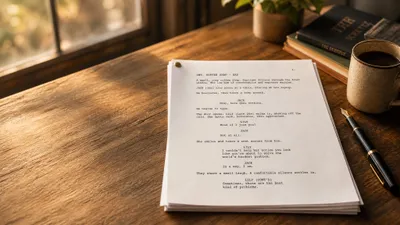
You can write a professional screenplay from scratch — even if you’ve never formatted a scene heading before. The process breaks down into clear, repeatable steps that every working screenwriter follows.
In this guide, you’ll learn:
- How to develop your idea into a producible screenplay concept
- The three-act structure that drives every successful film
- Proper screenplay formatting that gets your script read (not tossed)
- How to write dialogue that sounds natural and moves scenes forward
- The revision process that separates amateur scripts from professional ones
Here’s the complete step-by-step process.
What Is a Screenplay?
A screenplay — also called a script — is the written blueprint for a film or television show. It contains every line of dialogue, scene description, and action that will appear on screen. Unlike a novel, a screenplay only includes what you can see and hear. You can’t write what a character is thinking — you have to show it through their actions, words, and choices.
A standard feature film screenplay runs 90 to 120 pages. Each page roughly equals one minute of screen time. That constraint shapes everything about how you write — every word earns its place or gets cut.
If you’re coming from novel writing or story writing, the shift to screenwriting requires a different mindset. You’re no longer painting with prose. You’re writing a production document that directors, actors, and crew will use to build a visual experience.
Step 1: Start With a Logline
Before you write a single scene, you need a logline. A logline is a one- or two-sentence summary of your entire film’s premise, conflict, and stakes.
A strong logline follows this formula:
When [inciting incident], a [specific protagonist] must [goal/action] before [stakes/consequence].
Here are examples of loglines that work:
- Jaws: When a killer shark starts attacking beachgoers, a small-town sheriff must overcome his fear of water to hunt it down before tourist season.
- The Pursuit of Happyness: When a struggling salesman loses everything, he must survive a brutal unpaid internship while raising his son alone — with one shot at a career that could change their lives.
Your logline isn’t just a marketing tool. It’s your compass. Every scene you write should serve the conflict and stakes your logline establishes. If a scene doesn’t connect back to the logline, cut it.
Spend real time here. A weak logline leads to a screenplay that wanders. A sharp one keeps your story focused through 110 pages.
Step 2: Build Your Characters
Characters drive your screenplay. The plot is what happens — but the characters are why anyone cares.
Start with your protagonist. Answer these questions before you write a single page:
- What do they want? (External goal — the thing they’re chasing)
- What do they need? (Internal need — what they actually must learn)
- What’s their flaw? (The thing preventing them from getting what they need)
- What’s at stake? (What happens if they fail)
The gap between want and need creates your character arc. In Good Will Hunting, Will wants to stay safe in his comfort zone. He needs to risk vulnerability and genuine connection. That tension drives the entire film.
Your antagonist matters just as much. The best antagonists aren’t evil for the sake of it — they have their own logic, their own goals that directly conflict with your protagonist’s. The stronger your antagonist, the stronger your story.
Build a one-page character profile for every speaking role. Include their background, speech patterns, and what they want in the story. If you need help developing complex characters, AI character development prompts can help you think through backstories and motivations you might miss.
Step 3: Outline Your Story With the Three-Act Structure
Every produced screenplay follows a version of three-act structure. It’s not a rigid formula — it’s the natural rhythm of storytelling. Your story outline is where you map this out before diving into pages.
Here’s how the three acts break down:
Act One: Setup (Pages 1-25)
You get roughly 25 pages to establish your world, introduce your protagonist, and launch the central conflict.
- Opening image (page 1): Sets the tone and visual world of your film
- Setup (pages 1-10): Establish your protagonist’s ordinary life and flaw
- Inciting incident (pages 10-12): The event that disrupts everything
- End of Act One turning point (pages 25-30): Your protagonist commits to the journey. No turning back.
Act Two: Confrontation (Pages 25-85)
This is the longest act — roughly 60 pages. Your protagonist faces escalating obstacles, learns hard lessons, and gets pushed to their breaking point.
- Rising action: Each scene raises the stakes. New complications arrive. Allies and enemies emerge.
- Midpoint (around page 55): A major revelation or reversal that reframes the entire story
- “All is lost” moment (around page 75): Your protagonist hits rock bottom. The goal seems impossible.
Act Three: Resolution (Pages 85-110)
The climax and resolution. Everything your protagonist has learned gets tested in a final confrontation.
- Climax (pages 85-100): The decisive confrontation where the central conflict is resolved
- Resolution (pages 100-110): The new normal. Show how the world has changed.
- Final image: Mirrors the opening image, showing transformation
Beat Sheet Template
Use this template to outline your screenplay before you start writing:
| Beat | Page Range | Your Film |
|---|---|---|
| Opening Image | 1 | |
| Setup / Ordinary World | 1-10 | |
| Inciting Incident | 10-12 | |
| Act One Turning Point | 25-30 | |
| Fun & Games / Rising Action | 30-55 | |
| Midpoint Reversal | 55 | |
| Complications Escalate | 55-75 | |
| All Is Lost | 75 | |
| Act Two Turning Point | 80-85 | |
| Climax | 85-100 | |
| Resolution | 100-110 | |
| Final Image | 110 |
Fill this in with index cards or a book outline template adapted for screenplay structure. Having every major beat mapped before you write your first scene saves you months of structural rewrites later.
Step 4: Write a Treatment
A treatment is a 5- to 15-page prose summary of your entire film. No dialogue. No formatting. Just the story told clearly, scene by scene, as if you’re describing the movie to a friend.
Think of the treatment as the bridge between your outline and your first draft. It forces you to:
- Test your story’s flow — Does the pacing work? Are there dead spots?
- Find structural holes — It’s easier to fix a plot problem in a 10-page summary than in a 110-page script.
- Clarify character arcs — Can you trace your protagonist’s transformation through the treatment?
Write your treatment in present tense, third person. Describe what we see on screen. Keep paragraphs short. If a section bores you to write, it’ll bore audiences to watch — fix it now.
Many screenwriters skip the treatment and regret it later. A solid treatment prevents the most common screenwriting mistake: starting your draft with a broken structure.
Step 5: Learn Screenplay Formatting
Proper formatting isn’t optional. Industry readers will reject a script that doesn’t follow standard formatting — it signals that the writer is an amateur.
Here are the core formatting elements:
Scene Headings (Sluglines)
Every scene starts with a scene heading in ALL CAPS:
INT. COFFEE SHOP - DAY- INT. (interior) or EXT. (exterior)
- Location — be specific
- Time — DAY, NIGHT, DAWN, etc.
Action Lines
Describe what we see and hear. Present tense. Active voice. Keep it lean.
Sarah pushes through the crowded café, scanning faces.
She spots Marcus at a corner table. He doesn't look up.
Write only what the camera can capture. Not what characters think or feel — what they do.
Character Introductions
The first time a character appears, write their name in ALL CAPS with a brief description:
SARAH CHEN (30s, sharp eyes, rumpled blazer) drops her
bag on the empty chair.
Dialogue
Center the character name in ALL CAPS above their lines:
                    SARAH
          You said you'd be honest with me.

                    MARCUS
          I was. You just didn't like the answer.
Parentheticals
Use sparingly — only when the delivery contradicts the words:
                    SARAH
                (forcing a smile)
          That's fine. Really.
Transitions
Use CUT TO:, SMASH CUT TO:, or FADE TO: between scenes only when the transition itself matters to the storytelling. Most scene transitions don’t need a written transition — the scene heading handles it.
Software
Use dedicated screenwriting software. Final Draft is the industry standard. WriterSolo, Highland, and Fade In are solid alternatives. Free options include WriterDuet and the open-source KIT Scenarist. These tools handle the formatting automatically so you can focus on the story.
How to Write a Movie Script for Beginners
If you’re writing your first screenplay, the process above might feel overwhelming. Here’s a simplified approach to get your first script done.
Start small. Write a short film script (5-15 pages) before attempting a feature. A short film teaches you the fundamentals — visual storytelling, tight dialogue, scene structure — without the complexity of a three-act, 110-page story.
Pick a story you know. Your first screenplay shouldn’t require extensive research. Write about a world, community, or experience you already understand. Authenticity reads better than research every time.
Focus on one conflict. Beginners often pack too many plot threads into a script. Pick one central conflict. Follow it through setup, escalation, and resolution. That’s your movie.
Write badly on purpose. Your first draft will be rough. That’s normal. Professional screenwriters routinely write 5 to 10 drafts. The goal of draft one is to get the story on paper — not to write perfect dialogue.
Read produced screenplays. You can find professional scripts online at sites like The Script Lab and SimplyScripts. Read five screenplays in your genre before you start writing. Notice how working screenwriters handle description, pacing, and dialogue. This teaches you more than any book about screenwriting.
If you want to write a story in any format, the fundamentals are the same: strong characters, clear conflict, and a structure that builds toward a satisfying resolution.
How to Write Dialogue for a Script
Dialogue is where most beginner screenplays fail. Great screen dialogue sounds natural but is carefully crafted. Every line does work — it reveals character, advances the plot, or both.
The Rules of Strong Dialogue
1. People don’t say what they mean.
Subtext is the engine of great dialogue. Characters talk around the real issue, avoid the truth, or say the opposite of what they feel. A character who says “I’m fine” when they’re clearly not is more compelling than one who delivers a monologue about their feelings.
2. Each character speaks differently.
Read your dialogue aloud. Can you tell which character is speaking without the name above the line? If every character sounds the same, you haven’t found their voice yet. Vary sentence length, vocabulary, rhythm, and directness.
3. Cut the small talk.
In real life, conversations start with “Hey, how are you?” and meander. In a screenplay, enter the scene late and leave early. Cut everything before the conflict starts.
4. Use silence.
Sometimes the most powerful dialogue is no dialogue at all. A character who doesn’t answer a question tells you more than one who does. Stage directions like “long beat” or “Sarah says nothing” can be devastating.
5. Read it out loud.
If a line feels awkward in your mouth, it’ll feel awkward coming from an actor. Read every scene aloud — or better yet, have two people read the dialogue while you listen.
For longer dialogue-heavy projects, an AI dialogue generator can help you draft conversational exchanges and test different character voices before committing to your final version.
Dialogue Formatting Tips
- Keep speeches short. If a character talks for more than four lines, find a place to break it with action.
- Avoid on-the-nose dialogue. Characters shouldn’t narrate what’s happening or explain things they both already know.
- Use (O.S.) for off-screen dialogue and (V.O.) for voiceover narration.
Screenwriting Tips for Beginners
Beyond the step-by-step process, here are the most important lessons that separate produced screenwriters from people with unfinished scripts on their hard drives.
Show, don’t tell. This rule matters more in screenwriting than in any other form of writing. You can’t write “John is heartbroken.” You have to show John sitting alone at a table set for two, slowly removing the second plate.
Write visually. Before you type an action line, picture the shot. What does the camera see? Your job is to create images, not describe feelings.
Every scene needs conflict. If two characters agree on everything in a scene, the scene is dead. Conflict doesn’t have to mean argument — it can be tension, competing goals, or unspoken friction.
Kill your darlings. That brilliant monologue you spent three hours on? If it doesn’t advance the story, cut it. Professional screenwriters are ruthless editors.
Learn the business side. Writing a great screenplay is half the battle. Understanding how scripts get sold, what producers are looking for, and how to write a query letter matters too. If you’re interested in the Hollywood pipeline, our guide on how to sell book-to-movie rights covers the adaptation and pitch process.
Write every day. Screenwriting is a craft. It improves with consistent practice, not sporadic bursts of inspiration. Even 30 minutes a day keeps your story muscles engaged. Creative writing exercises can help on days when your screenplay feels stuck.
How to Write a Short Film Script
Short films follow the same principles as features but demand extreme economy. You have 5 to 15 pages to tell a complete, emotionally resonant story.
Limit your scope. One protagonist. One conflict. One location if possible. Short films that try to cover too much ground end up feeling rushed rather than tight.
Start as late as possible. If your short film is about a breakup, don’t start with the couple meeting. Start at the moment things fall apart.
Focus on a single moment of change. The best short films capture one turning point — a decision, a revelation, a loss. Your entire script should build toward that moment.
Keep dialogue minimal. Short films are a visual medium first. Many award-winning shorts have little or no dialogue. Let images carry the emotional weight.
Write for production reality. Short films are often self-funded or low-budget. Write something you can actually shoot. One location, two actors, natural lighting — those constraints often produce more creative work than unlimited resources.
Short Film Structure
| Element | Page Range (10-page short) |
|---|---|
| Setup | Pages 1-2 |
| Inciting Incident | Page 2-3 |
| Rising Tension | Pages 3-7 |
| Climax | Pages 7-9 |
| Resolution | Pages 9-10 |
Step 6: Write Your First Draft
You’ve got your logline, characters, outline, treatment, and formatting knowledge. Now write.
Set a schedule. Professional screenwriters typically draft a feature screenplay in 4 to 12 weeks. A reasonable pace is 2 to 5 pages per day. At that rate, you’ll have a complete first draft in 6 to 8 weeks.
Rules for your first draft:
- Don’t edit while you write. Push forward. Fix problems in revision.
- Follow your outline — but stay flexible. If a scene wants to go somewhere unexpected and it works, follow it. You can realign later.
- Write in present tense, active voice. Always. “Sarah runs” not “Sarah was running.”
- Keep action lines to 3-4 lines max. Dense paragraphs of description slow readers down. White space is your friend.
- End every scene with a reason to keep reading. A question, a threat, a surprise, an emotional hook. Never let the reader find a convenient stopping point.
Your first draft won’t be good. That’s the point. You’re building the skeleton. The real writing happens in revision.
If you use AI tools in your creative process, AI for writing first drafts can help you generate scene variations and push past writer’s block — but the story structure and character voice should always come from you.
Step 7: Revise and Polish Your Screenplay
Professional screenwriters do a minimum of three drafts. Many do five to ten. Here’s a structured approach to revision:
Draft Two: Structure
Read your entire script in one sitting. Don’t edit — just take notes. Then ask:
- Does every scene advance the plot or reveal character? If not, cut it.
- Is the inciting incident in the right place?
- Does Act Two sag? (It almost always does on the first pass.)
- Is the climax earned — or does it feel rushed?
- Does the protagonist change?
Rewrite scenes. Move them. Delete them. This draft is about getting the bones right.
Draft Three: Character and Dialogue
Now focus on the people in your story:
- Does every character have a distinct voice?
- Is there subtext in the dialogue, or are characters saying exactly what they mean?
- Are there scenes where a character’s action contradicts their words? (Good — that’s interesting.)
- Can you cut 20% of the dialogue and lose nothing?
Draft Four: Polish
Line-by-line editing:
- Tighten action lines. Cut every unnecessary word.
- Replace weak verbs with specific ones. “Walks” becomes “shuffles,” “strides,” or “limps.”
- Check formatting consistency.
- Read the entire script aloud.
Get Feedback
After draft three or four, get outside readers. Not friends who’ll tell you it’s great — people who’ll tell you where they got bored, confused, or disengaged.
Look for screenplay feedback from:
- Writing groups and screenwriting workshops
- Trusted fellow writers who understand the format
- Coverage services (professional script readers who provide detailed notes)
- Film school communities and screenwriting forums
Take every note seriously. You don’t have to agree with every suggestion — but if three readers flag the same scene, that scene has a problem.
Common Mistakes to Avoid
- Writing “we see” or “we hear.” Just describe the action. The camera is implied.
- Including camera directions. Unless a shot is critical to the story (a key detail revealed in close-up), leave camera choices to the director.
- Over-writing action lines. Keep descriptions lean. If an action block runs more than 4 lines, break it up.
- Characters who all sound identical. Read your dialogue without character names. If you can’t tell who’s speaking, rewrite.
- Ignoring page count. A 150-page screenplay is an immediate red flag. Stay between 90 and 120 pages for features.
- Starting too late on revision. The real work is in rewriting. Budget more time for revision than for your first draft.
How Long Does It Take to Write a Screenplay?
A first feature screenplay typically takes 3 to 6 months from concept to polished draft. Professional screenwriters working on assignment often complete drafts in 10 to 12 weeks. The breakdown looks roughly like this:
| Phase | Time |
|---|---|
| Concept and logline | 1-2 weeks |
| Character development | 1-2 weeks |
| Outline and treatment | 2-3 weeks |
| First draft | 4-8 weeks |
| Revision (2-3 drafts) | 4-8 weeks |
| Total | 12-23 weeks |
Speed improves with experience. Your first screenplay will take the longest. Your fifth will come faster because you’ve internalized structure, pacing, and format.
Can You Write a Screenplay With AI?
You can use AI tools to accelerate parts of the screenplay writing process — but AI won’t write a producible screenplay for you.
Where AI helps most:
- Brainstorming concepts and loglines — Generate dozens of “what if?” premises quickly
- Character development — Explore backstories, motivations, and relationship dynamics
- Dialogue drafts — Test different voices and conversational approaches
- Outline generation — Map beat sheets and scene sequences
- Revision notes — Get feedback on pacing, structure, and consistency
Our Pick — Chapter
Chapter helps writers develop and draft long-form creative projects with AI. While built primarily for book writing, its scene-by-scene drafting workflow and character development tools adapt naturally to screenplay pre-production work — outlining, character bibles, treatment writing, and dialogue exploration.
Best for: Writers who want AI assistance with the development and outlining phase of screenwriting Pricing: $97 one time, 2 books included (fiction or nonfiction), 30-day money-back guarantee Why we built it: Over 10,000 authors have used Chapter to create projects, and the same story development workflow that powers book writing translates directly to screenplay preparation.
The creative vision — your unique voice, your story’s emotional core, the specific choices that make a screenplay yours — that stays human. AI is a tool in the toolbox, not the craftsperson.
FAQ
How do you write a screenplay step by step?
To write a screenplay step by step, start with a logline that captures your premise and conflict. Then build your characters, outline using three-act structure, write a treatment, and draft your script in proper screenplay format. Revise at least three times — focusing on structure, then dialogue, then polish. The process typically takes 3 to 6 months.
What is the correct format for a screenplay?
The correct format for a screenplay uses 12-point Courier font with 1.5-inch left margins and 1-inch right margins. Scene headings appear in ALL CAPS (e.g., INT. OFFICE - NIGHT). Character names are centered and capitalized above dialogue. Action lines are written in present tense. Each page equals roughly one minute of screen time.
How long should a screenplay be?
A feature film screenplay should be 90 to 120 pages long, with each page equating to approximately one minute of screen time. Comedies often run shorter (90-100 pages). Dramas can run longer (100-120 pages). Scripts over 130 pages are considered too long by most producers and will face automatic resistance from industry readers.
Can a beginner write a screenplay?
Yes, a beginner can write a screenplay. Start by reading 5-10 produced screenplays in your genre to understand the format. Use free screenwriting software like WriterDuet or KIT Scenarist to handle formatting automatically. Write a short film script first (5-15 pages) before attempting a feature. Every professional screenwriter started as a beginner with zero credits.
What is the three-act structure in screenwriting?
The three-act structure in screenwriting divides a film into setup, confrontation, and resolution. Act One (25% of the script) introduces characters and conflict. Act Two (50%) escalates obstacles and complications. Act Three (25%) delivers the climax and resolution. This structure provides the natural rhythm that audiences expect from a well-told story.