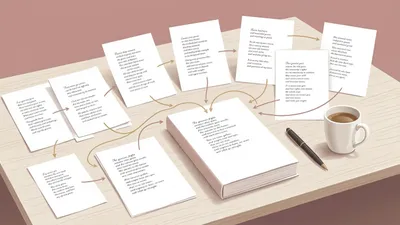
You can write a poetry chapbook in as little as a few weeks — if you already have a stack of poems and a clear theme to bind them together.
In this guide, you’ll learn:
- How to choose a unifying theme that holds your chapbook together
- The step-by-step process for selecting and sequencing your poems
- Formatting standards publishers and contests actually expect
- Every publishing path available to you — contests, presses, and self-publishing
Here’s how to build a chapbook from raw poems to finished manuscript.
What Is a Poetry Chapbook?
A poetry chapbook is a short collection of poems, typically 20 to 40 pages, organized around a single theme, narrative, or emotional arc. Think of it as a focused playlist rather than a greatest-hits album — every poem earns its place because it serves the whole.
Chapbooks have a long literary history. The term dates back to 16th-century England, where “chapmen” sold small printed pamphlets at markets. Today, chapbooks are one of the most respected formats in contemporary poetry. Presses like Two Sylvias Press, Black Lawrence Press, and Bull City Press publish award-winning chapbooks every year.
For emerging poets, a chapbook is often the first major publication — a stepping stone between journal credits and a full-length collection.
How Many Poems Do You Need for a Chapbook?
Most chapbooks contain 15 to 30 poems across 20 to 40 pages. The exact count depends on poem length. A chapbook of haiku might include 30 or more pieces. A chapbook of longer narrative poems might hold only 12 to 15.
Here’s a quick breakdown:
| Chapbook Type | Typical Poem Count | Page Range |
|---|---|---|
| Micro chapbook | 5-10 poems | 10-15 pages |
| Standard chapbook | 15-30 poems | 20-40 pages |
| Long chapbook | 25-40 poems | 35-48 pages |
| Full-length collection | 40-80 poems | 50-100+ pages |
Start with more poems than you need. If your target is 25 poems, draft or gather 40 to 50. You’ll cut the weakest pieces during revision — and having surplus material gives you real choices about what stays and what goes.
Step 1: Gather All Your Poems in One Place
Before you can shape a chapbook, you need to see everything you have. Pull together every poem you’ve written in the last year or two — published, unpublished, finished, half-finished.
Print them out if you can. Spreading physical pages across a table lets you see connections that a scrolling screen hides. You’ll notice recurring images, repeated themes, and tonal patterns you didn’t plan.
Don’t judge quality yet. This step is about inventory, not editing. You’re answering one question: what material do I have to work with?
Step 2: Find Your Unifying Theme
Every strong chapbook has a center of gravity — a single thread that connects every poem. This doesn’t mean every poem is “about” the same thing. It means they share a concern, a question, or an emotional landscape.
Common chapbook themes include:
- A specific place — poems rooted in a city, a childhood home, a landscape
- A relationship — love, grief, family, friendship
- An experience — illness, immigration, motherhood, addiction, recovery
- A question — identity, faith, mortality, belonging
- A form or constraint — all sonnets, all prose poems, all erasures
Look at your pile of poems and ask: which 20 to 30 of these could live in the same room together? Group them by intuition first, then name the thread you see.
If you don’t have a natural theme yet, poetry writing prompts can help you generate focused material around a single subject.
Step 3: Kill Your Darlings — Selecting the Strongest Poems
This is the hardest step. You need to cut good poems that don’t serve the collection.
A poem can be excellent on its own and still wrong for your chapbook. If it breaks the tonal consistency, wanders from the theme, or duplicates what another poem already does better — it goes.
Here’s a practical framework for cutting:
- Read each poem aloud. Does it feel like it belongs with the others?
- Check for redundancy. If two poems cover the same ground, keep the stronger one.
- Test the edges. Poems that are only loosely connected to your theme weaken the whole collection.
- Ask a trusted reader. Another poet can spot the outliers you’re too close to see.
Aim to cut 30% to 40% of your initial pile. If you started with 45 poems, you should be down to 25 to 30 after this step.
Step 4: Sequence Your Poems for Maximum Impact
The order of your poems matters as much as the poems themselves. A chapbook isn’t a random stack — it’s a curated experience with a beginning, middle, and end.
Your opening poem sets the tone for everything that follows. Choose something accessible, vivid, and representative of your theme. This is the poem that convinces a reader (or contest judge) to keep going.
Your closing poem should feel like an arrival — a shift, a resolution, or a deliberate opening outward. It’s the last impression your chapbook leaves.
For the middle, consider these sequencing strategies:
- Chronological — poems follow a timeline (childhood to adulthood, season to season)
- Emotional arc — tension builds, peaks, then resolves or transforms
- Thematic clusters — group related poems into sections, then order the sections
- Contrast and conversation — alternate tones, forms, or perspectives so poems speak to each other
Read the full sequence aloud in one sitting. Notice where your attention drifts — that’s where the order needs work. Move poems around until the collection feels like it has momentum.
Step 5: Write a Title That Works Hard
Your chapbook title does three jobs: it signals your theme, it intrigues a reader, and it distinguishes your manuscript in a pile of contest submissions.
Strong chapbook titles often:
- Borrow from a line in one of the poems (the most common approach)
- Name the central image or metaphor of the collection
- Create tension between two ideas (e.g., “Bright Dead Things” by Ada Limon)
- Stay concise — one to five words is the sweet spot
Avoid generic titles like “Poems About Love” or “A Collection.” Your title should make someone pick the book up, not set it down.
Step 6: Add Front and Back Matter
A polished chapbook manuscript includes more than just poems. Here’s what you need:
- Title page — chapbook title, your name, contact information
- Table of contents — poem titles with page numbers
- Epigraph (optional) — a quote that frames the collection
- Dedication (optional) — keep it brief
- Acknowledgments page — list journals where poems were previously published
- Author bio — 50 to 100 words, third person
The acknowledgments page matters more than you might think. Listing prior publications signals that your work has been vetted by editors — a credibility marker for contest judges and publishers.
If you’re wondering how to write an effective author bio, keep it focused on your relevant writing credentials and current projects.
Step 7: Format Your Manuscript
Formatting standards vary by publisher, but these guidelines work for most submissions:
- Font: Times New Roman or Garamond, 12pt
- Margins: 1 inch on all sides
- Spacing: Single-spaced within stanzas, double-spaced between stanzas
- Pagination: Each poem starts on a new page
- Page numbers: Bottom center, starting after the title page
- File format: PDF unless the submission guidelines say otherwise
- Header: Your last name and chapbook title on each page (some contests prefer anonymous submissions — check first)
If your poems have unusual visual formatting — concrete poetry, wide indentations, columns — test how they render in PDF before submitting. What looks right in your word processor may break in conversion.
For a deeper look at manuscript formatting, our guide on how to format a manuscript for submission covers the technical details.
Step 8: Revise the Collection as a Whole
After sequencing and formatting, read the entire chapbook again — not as individual poems, but as one unified piece.
Ask yourself:
- Does the opening poem hook you immediately?
- Is there a dead zone in the middle where energy drops?
- Does the final poem leave the reader with something to carry?
- Are there tonal shifts that feel jarring rather than intentional?
- Does every poem earn its place, or are you keeping some out of attachment?
This is also the stage to check for accidental repetition. If you use the word “light” as a metaphor in five different poems, you’ll want to revise at least three of those instances.
Consider sharing the full manuscript with 2 to 3 trusted readers — ideally other poets who read contemporary chapbooks. Their feedback on the collection as a whole is more valuable than line-level edits at this stage.
How to Publish Your Poetry Chapbook
You have three main paths to publication. Each has trade-offs.
Chapbook Contests
Contests are the most prestigious route. Winning a chapbook contest means publication, often a cash prize, and a significant credential.
Major chapbook contests include:
- Two Sylvias Press Chapbook Prize — strong reputation, thoughtful editing
- Black Lawrence Press Black River Chapbook Competition — publishes innovative work
- Bull City Press Frost Place Chapbook Competition — known for intimacy and precision
- Tupelo Press Snowbound Chapbook Prize — $1,000 prize plus publication
- Center for Book Arts Annual Chapbook Competition — emphasis on book as art object
Entry fees typically range from $10 to $25. Most contests accept submissions for a window of 2 to 4 months. You can find current deadlines at Poets & Writers and Submittable.
The downside: Contest acceptance rates are extremely low — often below 1%. Budget your submission fees and submit widely.
Independent Presses (Open Reading Periods)
Some small presses accept chapbook manuscripts outside of contests during open reading periods. This route is less competitive than contests and still carries the credibility of a press-published book.
Look for presses that publish work similar to yours. Read their recent titles before submitting — a press that publishes experimental poetry won’t be the right fit for formal verse, and vice versa.
Self-Publishing Your Chapbook
Self-publishing gives you full creative control over design, pricing, and distribution. For a deeper walkthrough of the process, see our complete self-publishing guide.
You can self-publish through Amazon KDP for free, use print-on-demand services for physical copies, or create handmade limited-edition chapbooks — a tradition with deep roots in the poetry community.
Our Pick — Chapter
If you’re ready to draft new poems for your chapbook using AI as a creative collaborator, Chapter can help you generate rough drafts, explore variations, and overcome blank-page paralysis. It won’t replace your voice — but it can accelerate the raw material phase.
Best for: Poets who want AI-assisted brainstorming and drafting tools Pricing: $97 one time, 2 books included (fiction or nonfiction), 30-day money-back guarantee Why we built it: To help writers get from idea to manuscript faster, without sacrificing their creative vision
Common Mistakes to Avoid
- No unifying theme. A random assortment of your best poems isn’t a chapbook — it’s a folder. Find the thread.
- Too many poems. More isn’t better. Twenty-five focused poems beat forty scattered ones. Resist the urge to include everything.
- Weak opening poem. Contest judges read hundreds of manuscripts. If your first poem doesn’t grab them, they may never reach your best work.
- Ignoring formatting guidelines. Submitting a .docx when a press asks for a .pdf signals carelessness. Follow every guideline exactly.
- Skipping the revision pass on the whole. Individual poems can be polished while the collection as a whole feels disjointed. Always revise at the manuscript level.
How Long Does It Take to Write a Chapbook?
Writing a poetry chapbook typically takes 3 to 12 months, depending on whether you’re starting from scratch or assembling existing work. If you already have 30 to 40 poems written, you could shape a chapbook in a few weeks of focused editing and sequencing.
The timeline breaks down roughly like this:
- Gathering and drafting poems: 1-6 months
- Selecting and sequencing: 1-2 weeks
- Revision and feedback: 1-3 months
- Formatting and submitting: 1-2 weeks
Don’t rush the revision stage. The difference between a good chapbook and a great one is almost always in the editing — both of individual poems and of the collection’s arc.
Can You Publish a Chapbook if You’ve Never Been Published Before?
Yes. Many chapbook contests and presses specifically welcome emerging poets. Prior journal publications help your submission stand out, but they’re rarely a strict requirement.
That said, publishing individual poems in literary journals before assembling a chapbook has real benefits. It validates your work through editorial selection, builds your acknowledgments page, and helps you develop relationships in the poetry community.
If you’re just starting your publication journey, our guide on how to get published as a poet walks through the process step by step.
What’s the Difference Between a Chapbook and a Poetry Collection?
A chapbook is shorter and more focused than a full-length poetry collection. Chapbooks run 20 to 40 pages and center on a single theme or arc. Full-length collections run 50 to 100+ pages and can cover broader thematic territory.
| Feature | Chapbook | Full-Length Collection |
|---|---|---|
| Page count | 20-40 pages | 50-100+ pages |
| Poem count | 15-30 poems | 40-80 poems |
| Thematic scope | Narrow, focused | Broad, multi-section |
| Common first book? | Yes — most poets start here | Usually a second or third book |
| Publishing path | Contests, small presses, self-pub | University presses, major small presses |
For a broader look at assembling a larger manuscript, see our guide on how to publish a poetry collection.
FAQ
How many poems should be in a chapbook?
A poetry chapbook typically contains 15 to 30 poems across 20 to 40 pages. The exact count depends on individual poem length — a chapbook of short lyric poems might include 30 pieces, while a chapbook of longer narrative poems might hold only 12 to 15.
What is the best length for a chapbook?
The best length for a chapbook is 20 to 40 pages of poetry. Most chapbook contests and publishers define this range in their submission guidelines. Manuscripts under 20 pages may be considered micro chapbooks, while manuscripts over 48 pages typically qualify as full-length collections.
Do chapbooks need to have a theme?
Yes — the strongest chapbooks are organized around a unifying theme, narrative arc, or emotional thread. A chapbook without a theme reads like a random assortment of poems rather than a cohesive collection. Themes can be subject-based (grief, place, identity) or formal (all sonnets, all prose poems).
How do you submit a chapbook to contests?
To submit a chapbook to contests, prepare a formatted PDF manuscript (20-40 pages), write a brief cover letter, and submit through platforms like Submittable or the publisher’s website. Entry fees range from $10 to $25. Track deadlines at Poets & Writers and submit to multiple contests simultaneously.
Can you self-publish a poetry chapbook?
Yes, you can self-publish a poetry chapbook through Amazon KDP, print-on-demand services like IngramSpark, or by creating handmade limited editions. Self-publishing gives you full control over design and distribution. Many poets also sell chapbooks directly at readings, through personal websites, or at local bookstores on consignment.