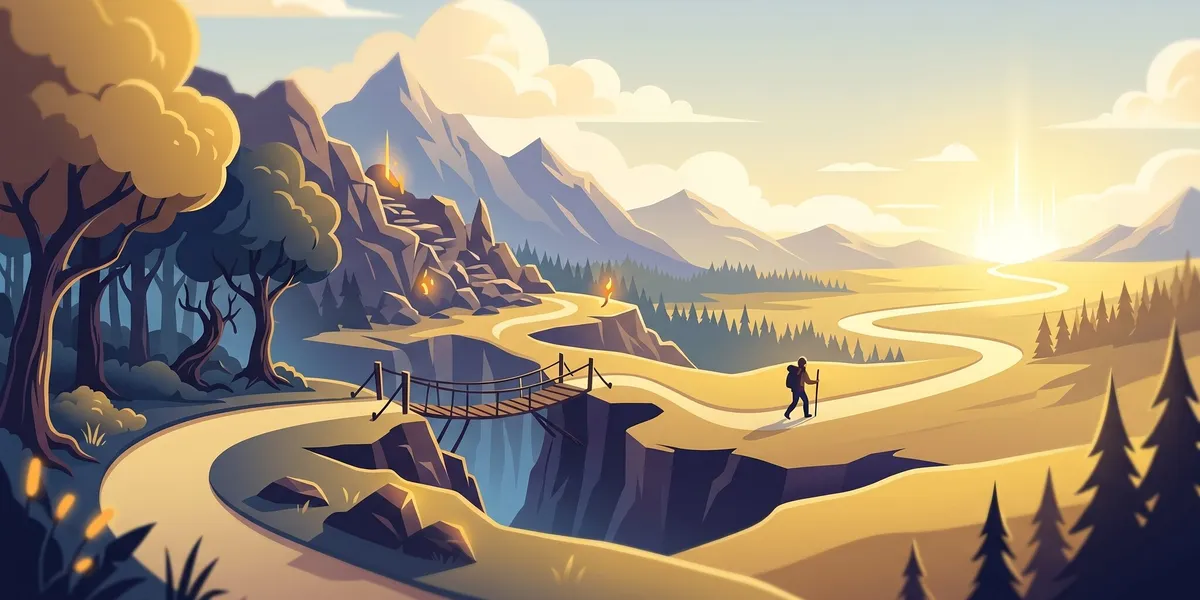
You can write a compelling quest narrative by giving your protagonist a clear goal, building obstacles that test their resolve, and transforming them through the journey itself.
In this guide, you’ll learn:
- The five essential elements every quest narrative needs
- How to structure your quest from the call to the return
- Techniques for keeping readers hooked through the long middle
- Common mistakes that flatten quest stories (and how to fix them)
Here’s your step-by-step process for writing a quest narrative that captivates readers.
What Is a Quest Narrative?
Quest narrative — A story structure where a protagonist leaves their familiar world to pursue a specific goal, facing escalating obstacles and returning transformed by the journey.
The quest is one of the oldest story forms in human history. From Homer’s Odyssey to Tolkien’s The Lord of the Rings to modern fantasy novels, the quest provides a natural engine for plot momentum. Your reader asks one question from page one: will the hero succeed?
What separates a quest narrative from a simple adventure is transformation. The hero doesn’t just retrieve an object or reach a destination. They become someone different through the pursuit. That internal change is what gives quest stories their emotional resonance.
The Five Essential Elements of a Quest Narrative
Christopher Booker identified the quest as one of the seven basic plots in literature. Every effective quest narrative contains these five elements:
1. The Call to Adventure
Your protagonist needs a reason to leave home. This can be external (a messenger arrives, a loved one is kidnapped, a prophecy demands action) or internal (a burning curiosity, a sense of duty, an unbearable status quo).
The call should establish two things immediately:
- What the protagonist must find or achieve
- Why it matters enough to risk everything
Think of Frodo learning that the One Ring must be destroyed. The stakes are clear and the urgency is undeniable.
2. The Quest Object
Every quest needs a goal. This is the thing your protagonist pursues — a sacred artifact, a person, a place, a piece of knowledge, or even an abstract concept like freedom or redemption.
The best quest objects work on two levels. On the surface, they drive the plot forward. Beneath that, they represent something the protagonist needs internally. Indiana Jones seeks the Ark of the Covenant, but his real quest is to prove that faith has power beyond academic study.
3. Companions and Guides
Quest heroes rarely travel alone. Their companions serve multiple narrative purposes:
- The mentor provides wisdom and training (Gandalf, Obi-Wan)
- The loyal friend offers emotional support and comic relief (Samwise, Ron Weasley)
- The skilled ally fills gaps in the hero’s abilities (Legolas, Hermione)
- The reluctant companion creates internal conflict within the group
Your companions should each bring something the protagonist lacks. They also give you natural dialogue partners, which helps you avoid long stretches of solo narration.
4. Obstacles and Trials
This is where most of your word count lives. The middle of a quest narrative is a series of escalating challenges that test your protagonist in different ways:
- Physical obstacles — monsters, treacherous terrain, environmental hazards
- Temptations — offers to abandon the quest for comfort or power
- Moral dilemmas — choices where doing the right thing comes at a cost
- Betrayals — trusted allies revealing hidden agendas
- The “dark night” moment — the point where success seems impossible
Each obstacle should raise the stakes and reveal something new about your characters. If an obstacle could be removed without changing the character, it’s just padding.
5. The Return and Transformation
The quest ends with either success or failure — but either way, the protagonist returns transformed. This is what separates a quest from a simple errand.
The return often includes:
- A final confrontation that requires everything the hero has learned
- A moment of choice that defines who the hero has become
- A homecoming that shows how the hero (and sometimes home itself) has changed
How to Structure Your Quest Narrative
Now that you understand the elements, here’s how to organize them into a working structure. This framework adapts naturally whether you’re writing a short story or a full novel.
Act One: The Ordinary World and the Call (10-15% of your story)
Establish your protagonist’s normal life first. Show what they stand to lose. Then introduce the inciting incident — the event that makes the quest unavoidable.
Your opening chapters should accomplish three things:
- Make the reader care about your protagonist
- Establish the quest object and its importance
- Create urgency — why can’t this wait?
Act Two: The Journey and Escalating Trials (70-75% of your story)
This is where quest narratives live or die. The middle section needs variety, escalation, and character development woven through every obstacle.
Structure your trials in waves. Each wave should:
- Present a new type of challenge
- Force a different response from your protagonist
- Raise the overall stakes
- Reveal new information about the quest or the world
Between major obstacles, include breathing room. Campfire scenes, moments of beauty, quiet conversations between companions — these pauses make the action hit harder when it returns.
The midpoint should deliver a major revelation or reversal. Your protagonist learns the quest is harder than expected, the goal isn’t what they thought, or the true enemy reveals themselves.
Act Three: The Climax and Return (15-20% of your story)
Your protagonist faces their greatest challenge. Everything they’ve learned, every ally they’ve gathered, every sacrifice they’ve made converges in this final push.
The climax of a quest narrative works best when it tests the protagonist’s internal transformation, not just their physical skills. They succeed (or fail meaningfully) because of who they’ve become, not just what weapons they carry.
How to Keep the Middle From Sagging
The biggest challenge in quest narratives is filling the middle with compelling content. Here’s how to avoid the “and then this happened, then this happened” trap.
Vary Your Obstacle Types
If every challenge is a fight, readers get numb. Alternate between physical confrontations, intellectual puzzles, emotional conflicts, and moral choices. Each type engages readers differently and showcases different facets of your characters.
Use Subquests
Break the larger quest into smaller, achievable objectives. Each subquest has its own mini-arc with setup, conflict, and resolution. This gives readers regular payoffs while building toward the larger goal.
Develop Companion Relationships
Your companions shouldn’t remain static. Build alliances, create friction, reveal backstories, test loyalties. The interpersonal dynamics within the quest group create a second layer of narrative tension that sustains interest between major plot events.
Plant and Pay Off Information
Every detail you introduce should either pay off later or deepen world-building. A peculiar rune on a cave wall means nothing — unless it becomes the key to the final door. This technique rewards attentive readers and creates satisfying structural unity.
Quest Narrative Examples You Can Study
Learning from established quest narratives helps you internalize the form. Here are examples across different genres:
| Book | Quest Object | What Makes It Work |
|---|---|---|
| The Lord of the Rings | Destroy the One Ring | Humble hero, impossible odds, corrupting influence of the goal itself |
| The Odyssey | Return home to Ithaca | Each obstacle tests a different virtue; the hero changes as much as the journey |
| The Wizard of Oz | Find the Wizard | The thing she seeks was always within her — but she needed the journey to realize it |
| Moby Dick | Kill the white whale | An obsessive quest that destroys the quester — showing what happens when the goal consumes you |
| The Alchemist | Find personal treasure | The treasure was at home all along, but the journey’s wisdom was the real reward |
Study how each author handles pacing, companion dynamics, and the relationship between external goals and internal transformation.
How to Write Compelling Quest Characters
Your protagonist’s character arc is the emotional spine of your quest narrative. Without internal change, a quest is just a travelogue.
Give Your Hero a Flaw That Matters
The protagonist’s flaw should directly interfere with their quest. A hero afraid of leadership who must lead a party. A hero who trusts no one who needs allies to succeed. The quest forces them to confront exactly what they most want to avoid.
Make the Quest Personal
The best quest narratives connect the external goal to an internal need. Your hero seeks a magical cure, but they’re really seeking forgiveness. They hunt a legendary creature, but they’re really proving their worth.
This dual-layer structure ensures every plot beat carries emotional weight.
Let Companions Challenge the Hero
Your supporting characters shouldn’t just agree with the protagonist. Give them competing values, different approaches to problems, and reasons to question the quest itself. These conflicts create rich dialogue and force your hero to articulate (and sometimes revise) their beliefs.
How Does a Quest Narrative Differ From the Hero’s Journey?
The quest narrative and the hero’s journey overlap significantly, but they’re not identical.
The hero’s journey (Joseph Campbell’s monomyth) is a specific mythic structure with defined stages: the call, crossing the threshold, the road of trials, the ordeal, and the return with the elixir. It emphasizes the hero’s psychological and spiritual transformation through a specific sequence.
A quest narrative is broader. It simply requires a protagonist pursuing a goal through a journey. Not every quest follows Campbell’s exact stages. Detective stories are quests. Travel narratives are quests. Even a character searching for the truth about their family is on a quest.
Think of the hero’s journey as one specific type of quest narrative — the mythic, transformational variety. Your quest can follow that template or diverge from it entirely.
Can You Write a Quest Narrative in Any Genre?
Absolutely. While fantasy dominates the quest conversation, the structure works across every genre:
- Mystery — The detective quests for truth (every Sherlock Holmes story)
- Literary fiction — A character quests for identity or meaning (On the Road, Wild)
- Science fiction — Crews quest across space for new worlds or lost civilizations
- Romance — A character quests for love, sometimes literally traveling to find the right person
- Thriller — A protagonist races against time to retrieve something critical
- Creative nonfiction — Writers quest for understanding, experience, or answers
The Dan Harmon Story Circle is another framework that adapts the quest structure for modern storytelling, breaking it into eight intuitive beats.
Common Mistakes to Avoid
These pitfalls weaken quest narratives. Watch for them in your drafts:
- The quest object doesn’t matter enough — If your reader doesn’t care whether the hero succeeds, nothing else works. Establish stakes early and raise them consistently.
- The middle is just a series of fights — Variety is essential. Mix physical, emotional, intellectual, and moral challenges throughout the journey.
- Companions are interchangeable — Each companion needs a distinct voice, motivation, and role. If you can swap two companions without changing any scenes, one of them is underdeveloped.
- The world overshadows the story — Resist the urge to cram every worldbuilding detail into the narrative. Reveal your world through the quest, not despite it.
- The hero doesn’t change — If your protagonist is the same person at the end as at the beginning, you’ve written an adventure, not a quest narrative. Transformation is non-negotiable.
- No rest between trials — Constant action becomes white noise. Give readers (and characters) moments to breathe, bond, and reflect.
How Long Should a Quest Narrative Be?
Quest narratives vary enormously in length. A short story quest might cover 5,000 words. An epic fantasy quest spans 300,000+. The length depends on:
- Number of obstacles — More trials need more pages
- Companion depth — More characters require more development space
- World complexity — Elaborate settings need more establishment
- Subplot density — Additional storylines add length organically
For a first quest narrative, aim for novella length (20,000-50,000 words). This gives you enough space for proper structure without the commitment of a full epic. You can always expand later if the story demands it.
If you’re planning a longer quest narrative, outlining your novel before drafting helps you pace your trials and avoid the sagging middle.
Writing Your Quest Narrative With AI Tools
AI writing tools can accelerate your quest narrative process without sacrificing quality. They’re particularly useful for:
- Brainstorming obstacles — Generate dozens of challenge ideas, then select the ones that test your protagonist’s specific weaknesses
- Developing companion voices — Use AI to draft dialogue variations until each character sounds distinct
- Worldbuilding details — Fill in setting descriptions, cultural elements, and environmental hazards
- Outlining structure — Map your quest beats before drafting to ensure proper pacing
Our Pick — Chapter
Chapter’s AI writing assistant helps you develop your quest narrative from outline to polished draft. The AI generates scene suggestions, develops character dialogue, and maintains consistency across your entire manuscript — so your quest stays coherent even at epic length.
Best for: Fiction writers developing quest-driven novels and novellas Pricing: $97 one time, 2 books included (fiction or nonfiction), 30-day money-back guarantee Why we built it: Because quest narratives have complex moving parts — and AI can help you track them all without losing your creative vision.
What Comes After the First Draft?
Once you’ve written your quest narrative, the revision process focuses on specific structural elements:
- Map the escalation curve — Are your obstacles genuinely increasing in difficulty and stakes?
- Track character transformation — Can you identify specific moments where your protagonist changes?
- Check companion utility — Does each companion contribute something irreplaceable?
- Verify pacing — Are there breathing rooms between intense sequences?
- Test the ending — Does the resolution feel earned by everything that came before?
Reading your draft specifically for these structural elements helps you catch quest-specific issues that a general edit might miss.
FAQ
What is a quest narrative in simple terms?
A quest narrative is a story where a character leaves home to pursue a specific goal, facing obstacles along the way and returning changed by the experience. The structure appears across all genres — from fantasy epics to detective novels to personal memoirs. The key ingredient is a clear objective that drives the protagonist forward through escalating challenges.
What are the five stages of a quest narrative?
The five stages of a quest narrative are the call to adventure, the quest object, the journey with companions, obstacles and trials, and the return with transformation. Christopher Booker identified these stages in The Seven Basic Plots. Each stage builds on the previous one, creating a natural arc from ordinary world to extraordinary journey and back.
How is a quest different from the hero’s journey?
A quest narrative is broader than the hero’s journey — it simply requires a protagonist pursuing a goal through a journey. The hero’s journey (Joseph Campbell’s monomyth) is one specific type of quest with defined mythic stages. All hero’s journeys are quests, but not all quests follow Campbell’s exact 17-stage structure. Detective stories and travel narratives are quests without being hero’s journeys.
What makes a good quest object?
A good quest object works on two levels simultaneously — it drives the plot forward on the surface while representing something the protagonist needs internally. The One Ring represents corrupting power. The Holy Grail represents spiritual worthiness. The best quest objects test the hero’s character, not just their physical abilities, and become more meaningful as the story progresses.
Can a quest narrative end in failure?
Yes — a quest narrative can end in meaningful failure that still delivers transformation. Moby Dick ends with Ahab’s destruction. Some quest stories reveal that the goal was wrong all along, or that the journey itself was the true prize. What matters is that the protagonist changes through the pursuit, whether they achieve the objective or not.