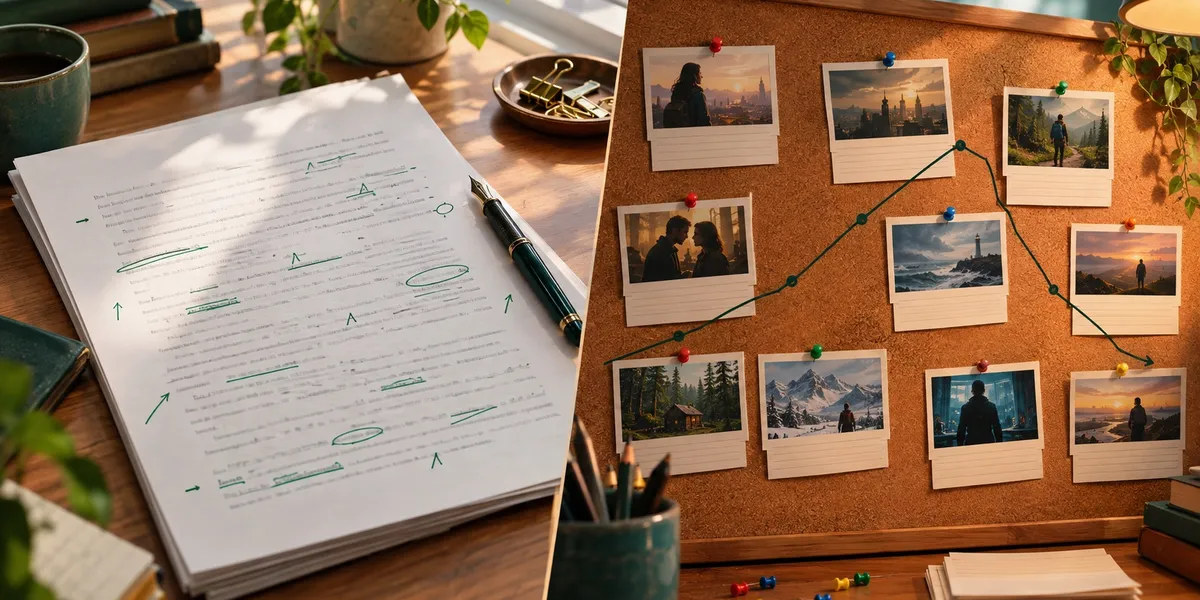
Grammarly vs Fictionary is a choice between two different layers of your book. Grammarly fixes sentences: spelling, grammar, punctuation and clarity. Fictionary fixes stories: scenes, plot, character goals and pacing. If your draft is structurally sound but messy on the page, pick Grammarly. If you suspect the story itself sags, pick Fictionary first.
In this comparison, you’ll learn:
- What each tool actually reads in your manuscript, and what it ignores
- Verified October 2026 pricing for every plan, monthly and annual
- Which one to run first, and when paying for both makes sense
- Where both tools beat Chapter, and where Chapter is the better starting point
Here is the side-by-side.
Grammarly vs Fictionary at a Glance
The short version: Grammarly is a sentence-level writing assistant with a working free plan; Fictionary is a scene-level structural editor for fiction with a 7-day trial. Both work on words you have already written. Neither writes your novel for you.
| Feature | Grammarly | Fictionary |
|---|---|---|
| Core job | Grammar, spelling, clarity, tone | Story structure and scene analysis |
| Editing layer | Words and sentences | Scenes, plot arc, characters, setting |
| Closest human equivalent | Copy editor and proofreader | Developmental editor |
| Framework | Rules engine plus generative AI | 38 Story Elements, 15 Story Insights |
| AI features | Rewrites, tone, 100 to 2,000 AI prompts a month, agents like Reader Reactions | AI scene feedback from a built-in instructor called Edwina |
| Works where | Browser, desktop apps, Word, Google Docs, its own editor | Inside Fictionary, after a .docx import |
| Full-novel limit | 100,000 characters per document in the web editor | Whole manuscript in one import |
| Free option | Free plan, $0 | 7-day free trial, no card |
| Entry paid price | $12/month billed annually, $30 month to month | $19/month, or $14/month billed annually |
| Best for | Cleaning up a draft whose story already works | Diagnosing a draft that is broken somewhere |
What Is the Difference Between Grammarly and Fictionary?
The difference between Grammarly and Fictionary is the size of the unit each one reads. Grammarly reads one sentence at a time and asks whether it is correct and clear. Fictionary reads your novel one scene at a time and asks whether each scene does a job in the story.
In editorial terms, Grammarly sits close to copy editing and proofreading. Fictionary sits close to developmental editing, the big-picture pass that asks whether the book works at all.
Editors do these jobs in a fixed order: structure, then scenes, then sentences. Our guide to line editing vs copy editing explains why. Polishing sentences in a chapter you are about to cut is wasted time.
Sentence-Level Editing: Where Grammarly Wins
Grammarly wins on anything that happens inside a sentence. It catches typos, agreement errors, missing commas and clunky phrasing in real time, everywhere you type. Fictionary does not check grammar at all, so this round is not close.
Here is what Grammarly does well for a fiction writer:
- Real-time correction in your browser, desktop apps, Microsoft Word and Google Docs, so you never have to export anything
- Full-sentence rewrites and tone adjustment on the Pro plan, per Grammarly’s Pro page
- Plagiarism and AI-text detection, useful if you work with co-writers or ghostwriters
- A free plan that is a real product, with grammar, spelling, punctuation, tone detection and 100 AI prompts a month
Grammarly has also grown beyond spellcheck. In August 2025 it launched eight AI agents in its own docs surface, including Reader Reactions, which predicts what a target reader will take away or find confusing. That is the closest Grammarly gets to story feedback, and it is aimed at essays and work documents, not novels.
The limitation: Grammarly’s clarity rules are tuned for standard prose. It flags intentional fragments, dialect and natural-sounding dialogue as errors. Reedsy’s test on The Great Gatsby showed it questioning comma choices Fitzgerald made on purpose. You can dismiss those suggestions, but a newer writer who accepts them all sands their voice flat.
Our full Grammarly review covers the fiction trade-offs in more depth.
Story Structure: Where Fictionary Wins
Fictionary wins on anything that happens between scenes. If you know your novel is not working but cannot say why, Fictionary is built for exactly that problem. Grammarly has no concept of a scene, a plot arc or a character goal.
You import your manuscript, and Fictionary splits it into chapters and scenes. For each scene you record story elements like the point-of-view character, their goal, the scene purpose, the entry hook, the exit hook and the setting. The full list is in Fictionary’s 38 Story Elements guide.
Those answers roll up into 15 Story Insights, according to Fictionary’s StoryTeller page. The headline insight is the story arc graph, which plots your actual manuscript against a recommended arc.
That graph is why writers buy it. Seeing your climax land at 62% of the way through the book is more persuasive than a beta reader saying the ending felt rushed. It turns a vague feeling into a scene you can move.
Fictionary is also honest about what it is not. It does not check grammar, does not analyse prose style and does not write anything for you. Our Fictionary review walks through the scene-card workflow in detail.
Can Grammarly Check a Whole Novel?
Grammarly cannot check a full-length novel in one pass in its web editor. According to Grammarly’s support documentation, a document is capped at 100,000 characters including spaces, with further limits of 50,000 words per 24 hours and 150,000 words per 30 days.
One hundred thousand characters is roughly 16,000 to 18,000 words. An 80,000-word novel therefore needs five or six separate chunks in the web editor, and the daily cap means a full pass takes at least two days.
The workaround is to run Grammarly inside your word processor instead. The same support page says the Windows and Mac desktop apps have no limit beyond what your text editor imposes, so checking a manuscript chapter by chapter in Word or Google Docs is the practical route.
Chunking has a second cost. Grammarly never sees two chapters together, so it cannot notice that a character is Cathy in chapter three and Kathy in chapter twenty. That kind of continuity check needs whole-manuscript awareness.
Does Fictionary Check Grammar or Spelling?
No, Fictionary does not check grammar or spelling. It is a structural editing tool, so it evaluates scenes, plot and characters rather than sentences. You still need a separate grammar checker such as Grammarly, or a human proofreader, for the final mechanical pass.
This is the main reason the two tools are complements rather than rivals. Fictionary will tell you a scene has no goal. Grammarly will tell you that scene has a dangling modifier. Neither can do the other job.
How Do Grammarly and Fictionary Use AI?
Grammarly and Fictionary both use AI, but in opposite directions. Grammarly’s AI generates and rewrites text for you. Fictionary’s AI comments on structural answers you supplied, and never generates prose.
Grammarly’s AI covers sentence rewrites, tone shifts, paraphrasing and freeform prompts. The free plan includes 100 AI prompts a month and Pro includes 2,000, per Grammarly’s plans page. Be careful with it on fiction, because generative rewrites push toward a generic house voice.
Fictionary’s AI is a built-in writing instructor called Edwina. Fictionary’s homepage describes it as giving immediate, scene-specific feedback, and the StoryTeller plan promises AI-powered feedback on every scene you write.
The practical difference matters. Because Fictionary’s structural map comes from your own scene answers, it cannot invent a subplot you never wrote. It costs you more time, but you can trust what it shows you.
How Much Time Does Each Tool Take?
Grammarly is almost instant: open a chapter and the underlines appear as you scroll. Fictionary is slow by design: on a 90-scene novel, budget roughly six to ten hours of scene-by-scene data entry before the most useful insights fill in.
That time cost is invisible in the sticker price, and it is the part most writers underestimate when they start a 7-day trial.
The hours are not wasted, though. Answering “what does the POV character want here?” for every scene is itself an editing exercise. Somewhere around scene fourteen, the honest answer will be “nothing,” and you have just found a scene to cut.
A setup note: Fictionary imports Word .docx files only. Per Fictionary’s import guide, Scrivener users compile to .docx first, Google Docs users download as .docx, and each chapter must start with the word “Chapter” or a Heading 1. Our Scrivener guide covers compiling.
Grammarly vs Fictionary Pricing
Grammarly Pro costs $12/month billed annually ($144) or $30/month billed monthly. Fictionary StoryTeller costs $19/month or $168/year. Grammarly has a permanent free plan; every Fictionary plan has a 7-day free trial with no credit card. Prices below were checked on each vendor’s pricing page on October 1, 2026.
| Plan | Monthly | Annual | What you get |
|---|---|---|---|
| Grammarly Free | $0 | $0 | Grammar, spelling, punctuation, tone detection, 100 AI prompts/month |
| Grammarly Pro | $30/mo | $12/mo ($144/yr) | Sentence rewrites, tone adjustment, unlimited suggestions, plagiarism and AI detection, 2,000 AI prompts/month |
| Grammarly Enterprise | Quote | Quote | Security controls, unlimited AI prompts |
| Fictionary StoryTeller | $19/mo | $14/mo ($168/yr) | Structural editing, 15 Story Insights, genre templates, AI scene feedback, 3 manuscripts at a time |
| Fictionary StoryTeller Premium | $39/mo | $29/mo ($348/yr) | Everything in StoryTeller, plus track changes, comments and 10 manuscripts |
| Fictionary StoryCoach | $49/mo | $33/mo ($396/yr) | Editor-facing tools for structural edits, up to 20 clients |
Sources: Grammarly plans, Grammarly Pro and Fictionary pricing.
Two things change the maths. First, Grammarly’s monthly price is two and a half times its annual rate, so month-to-month only makes sense for one intensive editing sprint. Our Grammarly pricing breakdown has the full numbers.
Second, Fictionary is naturally a short-term tool. Most writers need it for one revision pass, not all year. A realistic budget is one or two months of Fictionary ($19 to $38) plus Grammarly Free or a year of Pro ($144).
Against human editing, both are cheap. The Editorial Freelancers Association rate chart puts both developmental editing and copy editing of a full novel into four figures. Our guide to how much a book editor costs has current ranges.
Which Should You Use First: Grammarly or Fictionary?
Use Fictionary first, then Grammarly. Structural editing can cut, merge or reorder whole scenes, so any sentence-level polishing you did beforehand may be thrown away. Fix the story with Fictionary, revise, then run Grammarly as your final clean-up pass.
Here is a simple order that works for most novelists:
- Finish the draft. Neither tool helps with a blank page.
- Run Fictionary on the full manuscript and fix the scenes and arc it flags.
- Send it to beta readers to check whether the fixes landed.
- Run Grammarly chapter by chapter in Word or Google Docs.
- Hire a human proofreader for the final pass if you are publishing.
The one exception: if you are submitting a short excerpt this week, such as a query letter and first ten pages, Grammarly is the faster win. Our guide to proofreading vs editing explains where each pass fits.
Can You Use Grammarly and Fictionary Together?
Yes, and most serious self-editors do. The tools do not overlap. Fictionary handles structure, Grammarly handles mechanics, and together they cover the developmental and proofreading ends of the editing process for a fraction of what human editors charge.
The cheapest workable stack is a month or two of Fictionary StoryTeller plus Grammarly Free, roughly $19 to $38 in total. Add Grammarly Pro if you want sentence rewrites and plagiarism checks.
What the pair still misses is the middle layer: line editing for voice, rhythm and word choice. Neither tool does that well. If you want a prose-style analyser instead, compare AutoCrit vs Fictionary or ProWritingAid vs Grammarly.
Where Grammarly and Fictionary Beat Chapter
We build Chapter, so read this knowing the bias. There is a specific list of things these two tools do that Chapter does not do at all, and you should know it before you buy anything.
Grammarly corrects your own writing everywhere you type. Your emails, your query letter, your newsletter, your Amazon description, the scene you are drafting in Google Docs at midnight. Chapter is a book-writing workspace. It does not follow you into Gmail and underline your typos.
Grammarly has a genuinely useful free plan. You can use it indefinitely for $0. Chapter is a $97 one-time purchase, with a 30-day money-back guarantee rather than a free tier.
Fictionary audits a manuscript Chapter never touched. Import a novel you wrote by hand in 2019, or one a co-author sent you, and Fictionary will map every scene. Chapter checks the books it writes against their own outline. It does not run a structural audit on an arbitrary imported manuscript.
Fictionary’s 38-element framework is a deeper diagnostic vocabulary. Entry hooks, exit hooks, scene purpose, POV goals and setting per scene, plus a visual story arc graph of your existing draft. Chapter has no equivalent report on a book you wrote yourself.
Fictionary teaches you to edit. Because every story element explains why it matters, sustained use sharpens your structural instincts. Fictionary’s StoryCoach plan also serves professional editors with client tools, which Chapter is not built for.
Both keep every sentence yours. If you write for a contest, publisher or market that disqualifies AI-generated prose, Fictionary writes nothing and Grammarly only edits what you give it. Chapter writes the draft, so it is the wrong tool for that situation.
That is a real list. If you already have a finished, hand-written novel and want it measured and proofread, the honest answer is Fictionary plus Grammarly, not Chapter.
When Chapter Is the Better Starting Point
Our Product — Chapter
Chapter is AI book writing software that builds your story bible and a structured outline modelled on bestselling story structures, then writes the full manuscript in your voice. Books run from 20,000 to 120,000+ words, and its DoubleCheck pass compares every chapter against your outline and against earlier chapters for continuity.
Here is the problem Grammarly and Fictionary share: both need a finished draft. Grammarly edits sentences that exist. Fictionary maps scenes that exist. A large share of writers comparing editing tools do not have a finished draft yet. They have an idea, a stalled 20,000 words and a suspicion the structure is wrong.
Chapter solves the problem upstream. It builds the arc first, using frameworks like the three-act structure and the Save the Cat beat sheet, and only then writes. Fictionary can tell you your climax lands in the wrong place. Chapter puts it in the right place before a word is drafted.
It also covers some of the continuity ground Grammarly’s chunking misses. Chapter checks chapter 3 against chapter 30 for details like a character’s eye colour, which a sentence-level checker never sees.
Best for: fiction and nonfiction authors who need a finished, structured manuscript, not a report about one. Pricing: $97 one time, 2 books included (fiction or nonfiction), no subscription, you keep 100% of the rights, 30-day money-back guarantee. Track record: 2,147+ authors have created 5,000+ books on Chapter, and it has been featured in USA Today and the New York Times.
The honest workflow for many authors is all three, in order. Write and structure the book with Chapter, revise it with your own judgement, then run Grammarly for the mechanical pass. Our guide to editing an AI-written book covers that revision step, and our Chapter vs Fictionary and Chapter vs Grammarly comparisons go deeper on each pairing.
The Verdict: Grammarly or Fictionary?
If you have no finished draft, start with Chapter, because neither editing tool can help with pages that do not exist yet. Our guide on how to write a novel covers the drafting stage either way.
If you have a finished draft and the story feels wrong, choose Fictionary. It is the only one of the two that can see your story structure, and structure problems are the ones that sink novels.
If you have a finished draft and the story works, choose Grammarly. It is faster, cheaper to start and catches thousands of mechanical errors before a proofreader ever sees the file.
If you are serious about publishing, use both, Fictionary first and Grammarly last.
FAQ
Is Grammarly better than Fictionary?
Grammarly is not better than Fictionary; they solve different problems. Grammarly is better for grammar, spelling and sentence clarity. Fictionary is better for story structure, scene goals and plot pacing. A novelist with structural problems gets more from Fictionary, while a writer with a sound story gets more from Grammarly.
Does Fictionary check grammar?
No, Fictionary does not check grammar or spelling. It is a structural editing tool that evaluates scenes against 38 story elements and shows the results as 15 story insights. You still need a separate grammar checker like Grammarly or a human proofreader for the final sentence-level pass on your manuscript.
Can Grammarly edit a whole novel?
Grammarly can edit a whole novel, but not in one pass in its web editor. The editor caps documents at 100,000 characters, roughly 16,000 to 18,000 words, with a 50,000-word daily limit. The practical route is the Grammarly desktop app running inside Word or Google Docs, checked chapter by chapter.
Is Fictionary worth it for self-published authors?
Fictionary is worth it for self-published authors who have a finished draft with structural problems. One or two months at $19 a month costs far less than a human developmental edit. It is poor value if you are still drafting, because its scene analysis needs a complete manuscript to be useful.
Can Grammarly or Fictionary write a book for me?
Neither Grammarly nor Fictionary can write a full book for you. Grammarly can rewrite sentences and draft short passages, and Fictionary writes nothing. If you need a complete manuscript, an AI book writer like Chapter builds the outline and writes the full draft, which you can then edit with either tool.