A short story is a complete work of fiction, typically between 1,000 and 7,500 words, built around a single change. One character, one conflict, one shift — and the reader walks away feeling that something whole just happened.
Writing a short story is not about writing a small novel. The form has its own rules, its own structure, and its own rewards. Here is how to write one that works.
The One-Thing-Changes Principle
Every effective short story can be reduced to a single statement: a character starts in one state and ends in another. That is the arc. Everything else — setting, dialogue, description — exists to serve that transformation.
The change does not have to be dramatic. It can be a realization, a decision, a loss, or a quiet shift in understanding. But it must be real. A story where nothing changes is a vignette. A story where everything changes is probably a novel.
In Raymond Carver’s “Cathedral,” a man who cannot connect with anyone learns to see through another person’s blindness. That is the entire story. One change, rendered with precision.
In Shirley Jackson’s “The Lottery,” a community’s ordinary morning becomes an act of violence. One shift in understanding — for the reader, not the characters — carries the entire narrative.
Ask yourself before you start writing: what changes? If you cannot answer in one sentence, the idea may not be a short story yet.
How a Short Story Differs from a Novel Chapter
This distinction trips up many writers. A chapter is a unit within a larger structure. It can end on a cliffhanger, leave threads unresolved, and rely on context from previous chapters. A short story cannot do any of these things.
A short story must:
- Establish context quickly. The reader knows nothing about your world. You have roughly 200 words to orient them.
- Contain a complete arc. Setup, complication, resolution. All three, in compressed form.
- Resolve its central question. Not every thread needs tying, but the core tension must reach some form of conclusion.
- Stand alone. A reader encountering your story with zero prior context should understand it fully.
A novel chapter asks “what happens next?” A short story asks “what happened here?” — and answers it.
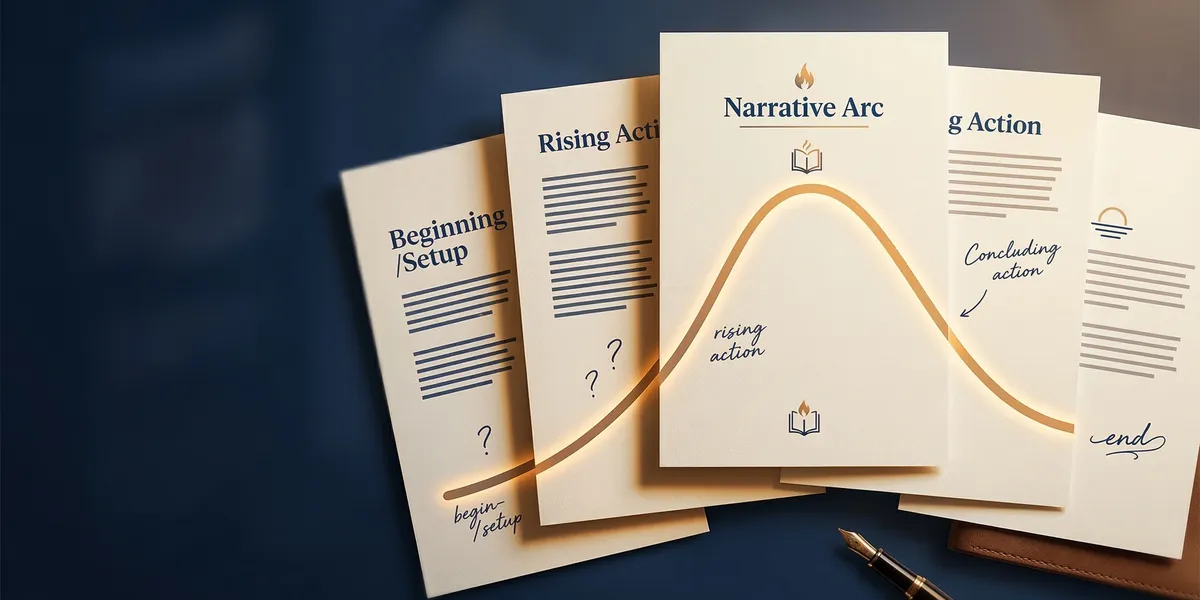
Structure: Setup, Complication, Resolution
The three-part structure of a short story is simple to describe and demanding to execute.
Setup (roughly 15-20% of word count)
Introduce the character, the situation, and the stakes. In a 5,000-word story, that gives you 750 to 1,000 words — enough for a scene that shows the character’s world and hints at what is about to disrupt it.
The setup should accomplish three things simultaneously:
- Establish the character’s voice or situation
- Create a question in the reader’s mind
- Plant the seed of the conflict
Flannery O’Connor’s “A Good Man Is Hard to Find” opens with a family argument about vacation plans. Within two paragraphs, we know the grandmother’s character, the family dynamic, and the direction of the trip. The setup does triple duty.
Complication (roughly 60-70%)
This is where the central conflict develops. Something disrupts the character’s status quo, and they must respond. The complication should escalate — each attempt to resolve the problem should make it worse or reveal new dimensions.
In a short story, you typically have room for two to three escalating complications before the climax. Each one should:
- Raise the stakes
- Reveal something about the character
- Move toward the inevitable (but surprising) ending
Avoid the temptation to add subplots. A short story lives or dies on the strength of its single narrative line.
Resolution (roughly 15-20%)
The resolution answers the story’s central question. It does not need to be happy, neat, or even fully explained. The best short story endings carry a sense of inevitability — the feeling that the story could only have ended this way.
Three types of endings that work in short stories:
The revelation. The character (or reader) understands something they did not before. James Joyce called these “epiphanies.”
The decision. The character makes a choice that defines them. The reader may agree or disagree, but the choice feels authentic.
The image. The story ends on a concrete, specific image that encapsulates the entire narrative. This is the hardest ending to write and the most powerful when it works.
Writing Short Stories by Genre
The short story form works differently across genres. Here are approaches for the most common ones.
Literary Fiction
Focus on interiority and language. The plot may be minimal — what matters is the depth of observation. Models: Alice Munro, George Saunders, Jhumpa Lahiri.
Science Fiction
One speculative premise, explored through character. The best SF short stories take a single “what if” and follow it to its human conclusion. Models: Ted Chiang, Ursula K. Le Guin, Ken Liu.
Horror
Build dread through withholding. The reader’s imagination is more frightening than anything you can describe. Short stories are arguably horror’s natural format. Models: Shirley Jackson, Carmen Maria Machado, Paul Tremblay.
Romance
Two characters, one obstacle, emotional resolution. Short romance needs immediate chemistry and a satisfying (if not always happy) ending. Models: Nora Roberts’ short fiction, various anthology contributors.
Mystery/Crime
Plant the question in paragraph one. Keep the cast small. The reveal should reframe everything the reader thought they knew. Models: Arthur Conan Doyle, Agatha Christie’s short fiction, Dennis Lehane.
Fantasy
Build a world through implication, not exposition. Show one corner of your universe in rich detail rather than painting the whole map. Models: Kelly Link, Neil Gaiman’s short fiction, Nnedi Okofor.
Practical Steps for Your First Draft
Step 1: Start with the change. Write one sentence describing what shifts in this story. Keep it visible while you draft.
Step 2: Write the opening scene. Drop the reader into the character’s world. Resist the urge to explain everything. Trust the reader to orient themselves.
Step 3: Introduce the complication. What disrupts the status quo? Make it specific and concrete. “She received bad news” is not a complication. “The letter from the school confirmed what the bruises already told her” is.
Step 4: Escalate. Each scene should tighten the pressure. Think of the story as a fist slowly closing.
Step 5: Write the ending before you think you are ready. Short stories almost always benefit from ending one scene earlier than planned.
Step 6: Cut the first paragraph. This is the single most effective revision technique for short fiction. The second paragraph is almost always the real beginning.
Where to Publish Short Stories
The market for short fiction is robust and growing.
Literary magazines: The New Yorker, Ploughshares, One Story, Granta, and hundreds of smaller publications accept submissions. Duotrope and Submittable help you find the right markets.
Genre magazines: Clarkesworld (SF), Nightmare (horror), Ellery Queen’s Mystery Magazine (crime), and many others publish genre short fiction at professional rates.
Anthologies: Both open-call and invitation anthologies provide publication opportunities. Genre anthologies are particularly active.
Self-publishing. Amazon allows publication of single short stories as Kindle ebooks, though collections of three to five stories tend to perform better commercially.
Contests. The O. Henry Prize, Pushcart Prize, and hundreds of smaller competitions offer both recognition and publication.
Common Mistakes to Avoid
- Starting too early in the story. Begin as close to the complication as possible. Backstory can be woven in later — or left out entirely.
- Too many characters. A short story can sustain two to four characters comfortably. Each additional character dilutes focus and requires precious word count for differentiation.
- Resolving every thread. The main tension needs resolution. Secondary questions can remain open. Ambiguity in the right places makes a story richer, not weaker.
- Writing an idea instead of a story. An interesting premise is not a narrative. The premise needs a character who wants something, encounters resistance, and is changed by the experience.
- Overwriting description. Every descriptive sentence should do at least two things — establish setting AND reveal character, or create mood AND advance plot. Description that only describes is dead weight.
FAQ
How long should a short story be? Most markets accept stories between 1,000 and 7,500 words. The ideal length is whatever your story needs to complete its arc — no longer, no shorter.
Can a short story have multiple points of view? It can, but it rarely should. A single perspective is more powerful in compressed fiction. Multiple POVs split the reader’s attention in a form that rewards focus.
How many short stories should I write before trying to publish? Write until you have produced something you would want to read if a stranger wrote it. For some writers that takes five stories. For most it takes closer to twenty.
What is the difference between a short story and flash fiction? Flash fiction is generally under 1,000 words and relies heavily on implication and compression. A short story has more room for scene, dialogue, and character development, though it still demands economy.
Do I need an outline for a short story? Not necessarily. Many short story writers draft by feel and revise structurally. But knowing your ending before you start — even roughly — prevents the most common failure mode: a story that wanders without arriving anywhere.
Need help turning your story ideas into a finished draft? Chapter’s fiction tools help you develop characters, structure scenes, and draft complete stories with AI assistance. Try Chapter for fiction writing.