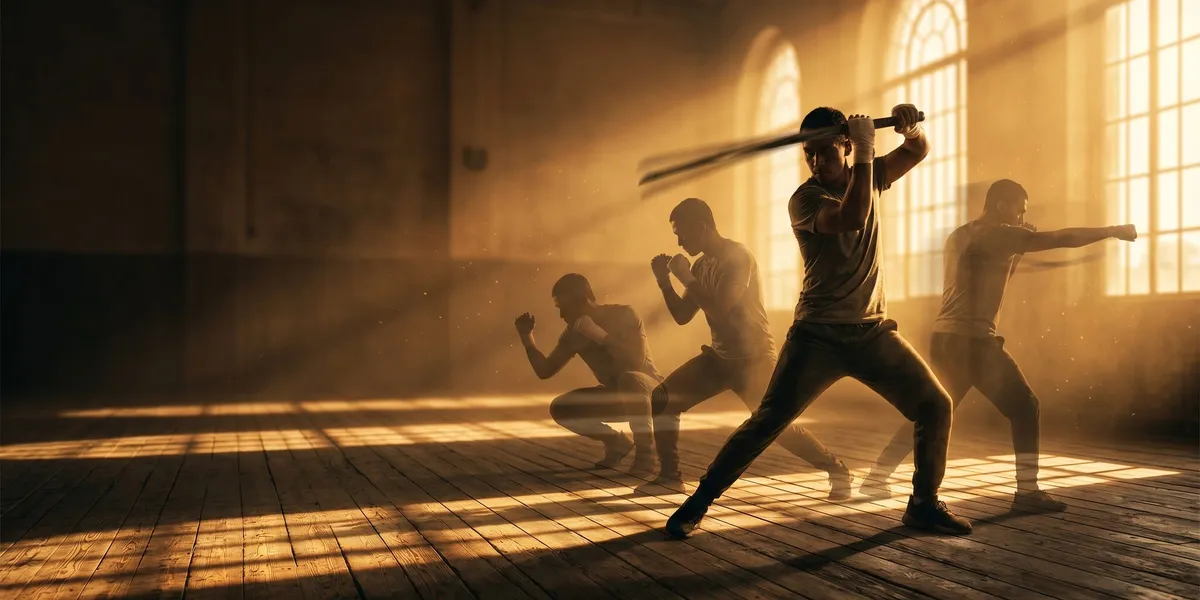
You can write a training montage that compresses weeks or months of character growth into a few gripping pages — if you understand the difference between summarizing time and dramatizing transformation.
In this guide, you’ll learn:
- How to structure a training montage in prose (not just screenwriting)
- Which moments to show in full detail and which to compress
- How to build tension and stakes into every stage of the training
- Common mistakes that make training montages feel like a boring checklist
Here is the step-by-step process for writing training montages that readers actually feel.
What Is a Training Montage in Writing?
Training montage — A sequence of compressed scenes showing a character developing skills, strength, or knowledge over time, where each beat demonstrates measurable progress toward a specific goal.
In film, a training montage is easy. You play a driving soundtrack, show a series of quick cuts — your hero doing push-ups, sparring, failing, then finally nailing the technique — and it is over in ninety seconds. Audiences understand the convention instantly.
In prose, you do not have a soundtrack or quick cuts. You have sentences, paragraphs, and the reader’s imagination. That means your training montage needs to work harder — and differently — to compress time while still feeling alive on the page.
The purpose is identical across mediums: show the audience that a character is transforming through effort, without narrating every single repetition. A good training montage in fiction gives readers just enough to feel the sweat, the setbacks, and the breakthroughs.
Why Training Montages Matter for Your Story
A training montage is not filler. It serves three critical functions in your narrative.
It proves the character earns what comes next. If your protagonist defeats the antagonist in chapter thirty, readers need to believe that victory is plausible. The training montage is where you build that credibility. Without it, climactic victories feel unearned and hollow.
It deepens character. How a character trains reveals who they are. The perfectionist who drills the same move two hundred times is not the same person as the rebel who improvises new techniques. Training scenes are character development disguised as action.
It controls pacing. Training montages compress large chunks of story time into compact sequences. This prevents the saggy middle problem that plagues many novels. Instead of narrating six months of daily practice in real time, you condense it into scenes that keep the story’s pacing tight and the reader engaged.
How to Structure a Training Montage Step by Step
Step 1: Define the Starting Point and the Goal
Before you write a single training scene, establish two things clearly: where the character is right now and where they need to be.
The gap between those two points is the engine of your montage. A farmhand who has never held a sword needs to become competent enough to survive a duel. A hacker who can crack simple firewalls needs to breach military-grade encryption. A boxer with raw talent but no discipline needs to develop the control to go twelve rounds.
Make both the starting point and the goal concrete and specific. “Getting stronger” is vague. “Being able to climb the fortress wall in under three minutes while carrying forty pounds of gear” gives you a measurable target that readers can track.
Step 2: Choose Your Key Beats
This is the most important decision in writing a training montage: which moments do you show?
You cannot show every training session. You should not try. Instead, select four to six key beats that represent the arc of transformation. Think of these as a staircase — each beat lifts the character one step closer to the goal.
A strong set of beats typically follows this pattern:
- The first attempt — Show the character failing or struggling. Establish the size of the gap they need to close.
- The method — Introduce how they will train. A mentor’s unusual technique, a grueling regimen, a creative workaround.
- A small victory — Early progress that tastes like hope.
- The setback — A complication that threatens to derail everything. Injury, self-doubt, a rival who is improving faster.
- The breakthrough — The moment where something clicks. Not the final goal, but a turning point that signals real change.
- The test — A scene that proves the training worked, just before the real stakes arrive.
You do not need all six. But you do need at least a failure, a turning point, and a proof. Those three beats are the minimum skeleton of a training montage that feels earned.
Step 3: Vary the Level of Detail
Not every beat gets the same word count. This is where many writers go wrong — they give every training scene the same level of detail and the montage becomes monotonous.
Full scenes for the most emotionally significant moments. The first humiliating failure. The breakthrough. The setback that makes the character question everything. These get dialogue, sensory detail, and internal reaction. Give them 300-500 words each.
Summary passages for the repetitive grind between key moments. A paragraph that covers two weeks of dawn runs, blistered hands, and incremental improvement. These keep the montage moving without skipping the sense of effort. Give them 50-100 words.
Single-image snapshots for quick beats that mark progress. One vivid sentence — “By the third week, she could hold the handstand for a full minute without shaking” — can communicate an entire phase of training.
This variation in detail creates rhythm. Full scene, summary, snapshot, full scene. The reader feels the compression of time without losing the emotional thread.
Step 4: Anchor Each Beat in Sensory Detail
Training is physical. Your prose should feel physical too.
Do not write: “She trained hard for weeks and gradually improved.”
Write: “Her shoulders burned by the fifteenth rep. Chalk dust coated her palms. When she finally cleared the bar, the landing jarred through her knees and she tasted copper at the back of her throat.”
Sensory detail is what separates a training montage from a summary. You are compressing time, yes — but within each beat you select, the reader should smell the sweat, hear the impact, feel the exhaustion. This is show, don’t tell at its most literal.
Focus on different senses across different beats. The sound of wooden swords cracking in one scene. The taste of iron in the mouth during another. The feeling of calloused hands that no longer blister. This variety keeps the montage from becoming repetitive even when the activity is similar across beats.
Step 5: Use Time Markers to Signal Compression
Readers need signals that time is passing between beats. Without them, your montage reads like a series of events on the same day.
Effective time markers include:
- Seasonal changes. “By the time the leaves turned, she could run the course without stopping.”
- Physical changes. “His arms had thickened. The shirt that hung loose in September stretched tight across his shoulders.”
- Skill benchmarks. “The drill that took her forty minutes on day one now took twelve.”
- Calendar references. “Three weeks before the tournament, he finally landed the throw.”
- Environmental shifts. “They trained through rain, then mud season, then the first hard frost.”
The best time markers do double duty — they communicate elapsed time while also showing progress. A character’s hands that go from soft to calloused to scarred tells you both how long they have been training and how much it has cost them.
Step 6: Weave in Emotional Stakes
A montage of pure physical progression gets boring fast. What keeps readers engaged is the emotional story running underneath the training.
Every training montage should carry at least one of these emotional undercurrents:
- Fear of failure. The character knows what happens if the training does not work. A rising tension that builds alongside their skills.
- A strained relationship. The mentor pushes too hard. A friend gets left behind. Training demands sacrifices that cost the character something they care about.
- Self-doubt. Even as the character improves, they question whether it will ever be enough. This is especially powerful when paired with a rival or a ticking clock.
- Evolving identity. The character who finishes the training is not the same person who started. Show that shift. The shy kid who starts speaking up. The loner who learns to trust a training partner.
These emotional threads give readers a reason to keep reading beyond “will they get stronger?” The answer to that question is almost always yes. The interesting question is: what will it cost them?
Training Montage Examples from Published Fiction
Seeing how experienced authors handle training montages makes the technique concrete.
Ender’s Game by Orson Scott Card — Ender’s training at Battle School is one of the most famous examples in fiction. Card does not show every battle room session. Instead, he selects key beats: Ender’s first humiliating loss, his invention of new tactics, the isolation that comes with his rapid promotion, and the increasing difficulty of rigged battles. Each training beat advances both Ender’s skill and his psychological deterioration.
The Name of the Wind by Patrick Rothfuss — Kvothe’s training at the University compresses years into selected moments. Rothfuss uses character motivation brilliantly here: Kvothe’s poverty forces him to excel faster than his classmates, turning every training scene into a survival scene. The academic montage carries genuine stakes because failure means expulsion and homelessness.
The Hunger Games by Suzanne Collins — Katniss’s training before the Games is compact and purposeful. Collins shows the scoring session, the private skill demonstrations, and the interview preparation. Each training beat serves dual purpose: it builds Katniss’s story arc while also revealing the political dynamics of the Capitol.
Mistborn by Brandon Sanderson — Vin’s Allomancy training with Kelsier follows a clear progression from ignorance to mastery. Sanderson selects specific powers to train in specific scenes, each one expanding the reader’s understanding of the magic system while showing Vin’s growing confidence and shifting identity from street urchin to revolutionary.
How to Transition Into and Out of a Training Montage
One of the trickiest parts of writing a training montage is the entry and exit. You need to shift the reader’s sense of time without creating whiplash.
Entering the montage: Use a clear narrative signal. A character making a decision (“She would train every day until she could beat him”), a plot structure turning point, or a mentor announcing a regimen all work. The reader should know that time is about to compress.
During the montage: Vary your sentence rhythm. Short, punchy paragraphs for intense beats. Longer, flowing sentences for summary passages. White space between beats signals time jumps. Section breaks can mark larger gaps.
Exiting the montage: End on a concrete moment — not a summary. The final beat should be a scene that proves the training is complete and snaps the reader back into real-time narrative. A test, a confrontation, or a quiet moment of recognition where the character realizes how far they have come.
The transition out is critical. If you end your montage with “and after months of training, she was ready,” you deflate everything you built. End on a specific moment instead: “She caught the blade mid-swing. The master blinked. In three months, no student had done that.”
Common Mistakes to Avoid
- Showing every session. If you narrate Monday through Friday of training week after week, you do not have a montage. You have a repetitive slog. Select your beats and skip the rest.
- No failures or setbacks. A montage where the character improves smoothly from start to finish has zero tension. Include at least one moment where progress stalls or reverses.
- Identical pacing throughout. If every beat gets the same word count and the same level of detail, the montage feels flat. Vary your compression.
- Forgetting emotional stakes. Physical transformation without emotional transformation is just a workout log. Make sure something internal changes alongside the external.
- Skipping the montage entirely. Some writers jump from “I must train” to “six months later, I was ready” with nothing in between. This robs the climax of its emotional foundation. You do not need ten pages, but you need something.
Can You Write a Training Montage With AI?
If you are working on a novel and struggling with a training montage, AI writing tools can help you draft and refine the sequence faster.
Our Pick — Chapter
Chapter helps you write entire books — including complex sequences like training montages. You can prompt it with your character’s starting point, goal, and key beats, then refine the output until the montage feels right.
Best for: Fiction and nonfiction authors writing full-length books Pricing: $97 one time, 2 books included (fiction or nonfiction), 30-day money-back guarantee Why we built it: Over 10,000 authors have used Chapter to write and publish books, including novels with complex training arcs and character development.
AI is particularly useful for generating the summary passages between your key beats — the connective tissue that compresses time. You write the emotionally significant scenes yourself, then use AI to draft the transitional material that ties them together.
How Long Should a Training Montage Be?
A training montage in fiction should be 500 to 2,000 words, depending on how central the training is to your story’s plot structure. Training that is the main arc of the book (like Ender’s Game) can be much longer, spread across multiple chapters. Training that serves as a bridge between the inciting incident and the climax should be tighter — a single scene or a few pages.
The key metric is not word count. It is whether every beat earns its place. If you can cut a training beat and lose nothing, cut it. If a beat reveals character, raises stakes, or marks a turning point, keep it.
What Is the Difference Between a Montage and a Time Skip?
A time skip jumps forward without showing what happened. “Six months later” — and the reader fills in the blanks or simply accepts the gap.
A training montage compresses time while still showing selected moments from within that period. The reader experiences a curated version of the training rather than being told it happened.
Use a time skip when what happens during the gap does not matter. Use a montage when the gap contains transformation that the reader needs to witness — even in compressed form — to believe in what comes next.
FAQ
How Do You Write a Training Montage in a Novel?
To write a training montage in a novel, select four to six key beats that show your character’s progression from starting point to goal. Show failures early, a turning point in the middle, and proof of mastery at the end. Vary the level of detail — write full scenes for emotional moments and brief summaries for repetitive sessions.
What Makes a Good Training Montage?
A good training montage has clear stakes, visible progression, and at least one setback. The best training montages combine physical skill development with emotional transformation — the character who finishes training is not just stronger but fundamentally changed. Sensory details and varied pacing keep readers engaged.
How Long Should a Training Montage Be in Fiction?
A training montage should be 500 to 2,000 words in most novels. The length depends on how central the training is to your plot. A training arc that spans the entire book can be longer, while a montage bridging two plot points should stay tight. Every beat should earn its place by revealing character or raising stakes.
Can You Write a Montage Without a Mentor Character?
Yes, you can write a training montage without a mentor. Self-directed training montages work well when the character learns through trial and error, books, observation, or pure determination. The key is that someone or something must provide the method — even if it is the character’s own resourcefulness and willingness to fail repeatedly.
What Is the Difference Between a Training Montage and an Info Dump?
A training montage shows progress through selected scenes, while an info dump tells the reader what happened through exposition. If your training sequence reads like a report — “She learned swordplay, then archery, then horseback riding” — it is an info dump. If it reads like a series of vivid moments with sensory detail and emotional stakes, it is a montage.