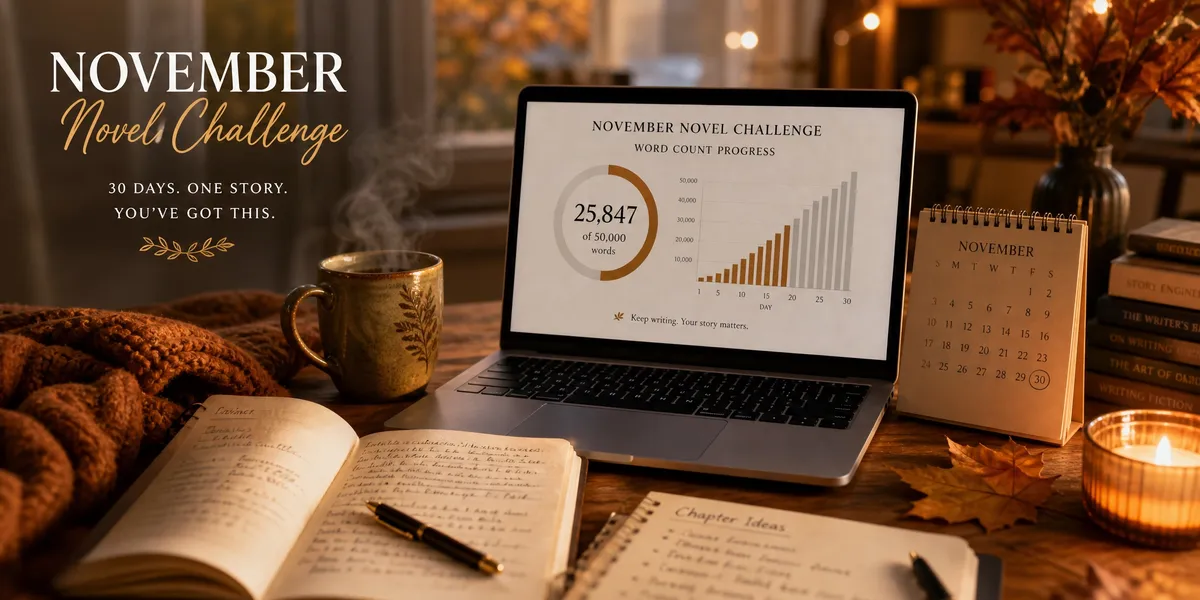
NaNoWriMo shut down in April 2025 after years of financial losses, a child safety scandal, and backlash over its stance on AI in writing. But the idea behind it — write a novel draft in 30 days with community support — didn’t die with the nonprofit.
In this guide, you’ll find:
- 9 NaNoWriMo alternatives that replace the challenge, the community, or both
- Which options are free, which cost money, and which actually help you finish
- A comparison table so you can pick the right one in 60 seconds
- How to build your own writing challenge if none of these fit
Here are the best replacements for NaNoWriMo in 2026.
Quick Comparison Table
| Alternative | Type | Cost | Best For | November-Specific? |
|---|---|---|---|---|
| Chapter | AI writing tool | $97 one-time | Finishing a full manuscript fast | No — works year-round |
| Reedsy Novel Sprint | Writing challenge | Free | Cash prizes + literary agent access | Yes — November |
| ProWritingAid Novel November | Writing challenge | Free | Structured workshops + community | Yes — October-November |
| Order of the Written Word | Writing challenge | Free | Anti-AI, craft-focused writers | Yes — November |
| 4thewords | Gamified writing app | Free / paid tiers | Motivation through gamification | No — year-round |
| StoryADay | Short fiction challenge | Free | Short story and flash fiction writers | May + September |
| Shut Up & Write | Writing community | Free | Local meetups + accountability | No — year-round |
| TrackBear | Goal tracking tool | Free | Self-directed writers who want metrics | No — year-round |
| DIY Challenge | Self-organized | Free | Writers who want full control | Whenever you want |
1. Chapter — Best for Actually Finishing Your Novel
Our Pick — Chapter
Chapter doesn’t replace the NaNoWriMo community experience — it replaces the outcome. Instead of staring at a blank page trying to hit 1,667 words per day, you work with AI to build a complete manuscript from outline to finished draft.
Best for: Writers who want a finished book, not just a word count
Pricing: $97 one time, 2 books included (fiction or nonfiction), 30-day money-back guarantee
Why we built it: NaNoWriMo proved that writers want structure, deadlines, and momentum. Chapter gives you all three — plus an AI co-writer that keeps your project moving when motivation fades.
Here’s what makes Chapter different from a traditional writing challenge. You pick a story structure — Save the Cat, Three Act, Hero’s Journey, Romance Beat Sheet — and the AI builds a complete narrative arc before writing the first chapter. The output is a cohesive manuscript, not a pile of disconnected daily word sprints you have to stitch together in December.
Over 2,147 authors have used Chapter to create more than 5,000 books. The platform has been featured in USA Today and the New York Times, and authors have reported results ranging from $13,200 in book revenue to $60K earned in 48 hours after publishing.
Style training lets you feed in writing samples so the output matches your voice. Genre-specific frameworks for romance, thriller, fantasy, and sci-fi help the AI hit reader expectations without defaulting to generic prose.
NaNoWriMo gave you a deadline. Chapter gives you a finished book.
2. Reedsy Novel Sprint — Best Free Challenge With Real Prizes
Reedsy’s Novel Sprint is the closest spiritual successor to NaNoWriMo’s original format. The goal is the same — write 50,000 words during November — but Reedsy adds something NaNoWriMo never had: cash prizes and industry access.
Winners receive $5,000 (first place), $2,500 (second), and $1,000 (third), plus a consultation with a literary agent from Reedsy’s network. You track your progress through Reedsy Studio, their free writing tool, and connect with other participants through the platform’s community features.
Best for: Writers who want the classic NaNoWriMo sprint format with professional publishing connections.
Cost: Free
Limitations: November-only. Requires using Reedsy Studio for tracking (fine for drafting, but you’ll export for serious editing later). No year-round community.
3. ProWritingAid Novel November — Best for Structured Learning
ProWritingAid partnered with Scrivener, Lulu, Kickstarter, and other publishing companies to create Novel November — a month-long challenge combining writing sprints with expert-led workshops.
The format is looser than NaNoWriMo’s rigid 50K target. You set your own daily word count goal and attend live sessions with bestselling authors throughout October and November. Planning workshops in October help you outline your novel before November’s drafting push.
Best for: Writers who want accountability paired with craft education.
Cost: Free to participate (ProWritingAid’s editing tool is a separate subscription)
Limitations: Heavily tied to ProWritingAid’s ecosystem. Less community depth than the original NaNoWriMo forums.
4. Order of the Written Word (O2W) — Best for Craft-Focused Writers
Founded by YA author Holly Rhiannon — who spent three years as a NaNoWriMo Municipal Liaison in Montreal — the Order of the Written Word emerged specifically in response to NaNoWriMo’s controversial AI stance in late 2023.
O2W offers three distinct challenge tracks, which makes it more flexible than NaNoWriMo’s one-size-fits-all 50K target:
- The Novelist’s Initiation: Write 30,000 words of new fiction
- The Trials of Verse & Vignette: Create 15 poems or 8 short stories
- The Refinement Ritual: Revise an existing manuscript
Best for: Writers who disagreed with NaNoWriMo’s AI position and want a deliberately craft-focused, human-centered challenge.
Cost: Free
Limitations: Smaller community than NaNoWriMo had at its peak. November-only.
5. 4thewords — Best for Gamified Motivation
4thewords turns writing into a role-playing game. You battle monsters by hitting word count targets, complete quests through daily challenges, and earn rewards that unlock new areas in a fantasy game world with 44+ regions and 500+ creatures.
This is the NaNoWriMo alternative that solves the motivation problem most directly. NaNoWriMo’s progress bar was motivating — 4thewords takes that concept and wraps an entire game around it. Timed writing battles, endurance sprints, multiplayer challenges, and streak tracking keep you coming back.
Best for: Writers who need external motivation systems and respond well to gamification.
Cost: Free tier available. Paid tiers unlock unlimited files, streak saving, event perks, and monthly refills.
Limitations: The game layer isn’t for everyone — some writers find it distracting. It’s a writing environment, not a book-writing tool with publishing features.
6. StoryADay — Best for Short Fiction Writers
StoryADay is a free month-long challenge founded in 2010 by creativity coach Julie Duffy. The format is simple: write and finish a short story every day during May and September.
This works for NaNoWriMo refugees who found the 50K novel goal too rigid or who write short fiction rather than novels. The daily completion aspect builds finishing skills — you learn to bring a narrative to a close instead of just accumulating words.
Best for: Short story and flash fiction writers. Also useful for novelists who want to practice plotting and pacing at a compressed scale.
Cost: Free
Limitations: May and September only. Focused on short fiction, not novels.
7. Shut Up & Write — Best for Local Accountability
Shut Up & Write is a community-based platform focused on in-person and virtual writing meetups. The format is simple: show up, write silently alongside other writers for a set period, then socialize.
This replaces the part of NaNoWriMo that many writers miss most — the community. Weekly meetups in cities worldwide create the kind of recurring accountability that a once-a-year challenge can’t match. The group pressure of sitting in a room where everyone else is writing makes it much harder to check your phone or rewrite the same paragraph for the third time.
Best for: Writers who need external accountability and thrive on in-person community.
Cost: Free
Limitations: Availability depends on your city. Virtual options exist but lack the in-person energy.
8. TrackBear — Best Free Goal Tracker
TrackBear is a free writing goal tracker that lets you set custom targets and measure progress by words, chapters, time, or scenes. Progress graphs show your trajectory, and you can share dashboards for accountability.
This is the tool for self-directed writers who loved NaNoWriMo’s progress tracking but want to set their own goals on their own timeline. No community, no challenges — just clean metrics.
Best for: Self-motivated writers who want data on their progress without the social layer.
Cost: Free
Limitations: No community. No writing environment — it’s purely a tracking overlay.
9. Build Your Own Writing Challenge (DIY)
NaNoWriMo’s core concept wasn’t proprietary. You can recreate every element yourself:
- Set a word count goal. 50K in 30 days is 1,667 words per day. Adjust to your reality — 30K is a novella, 80K is a full novel.
- Pick your month. November works because of tradition, but there’s no magic to it. Write when your schedule allows.
- Find accountability partners. Research from Psychology Today confirms that writing accountability partners significantly increase follow-through on creative goals.
- Use a tracking tool. TrackBear (free), a spreadsheet, or even a wall calendar with daily word counts.
- Add structure. Outline your novel before your start date. Writers who outline before drafting are significantly more likely to finish.
Best for: Writers who want full control over goals, timeline, and method.
Cost: Free
What Made NaNoWriMo Work (And What to Look For in a Replacement)
NaNoWriMo wasn’t just a word count target. The elements that made it effective are worth preserving in whatever alternative you choose:
- A fixed deadline creates urgency that open-ended projects lack
- Public commitment — telling others you’re doing it — increases accountability
- Daily targets break an intimidating goal (50,000 words) into a manageable one (1,667 words)
- Community support provides both motivation and normalization of the struggle
- Permission to write badly — NaNoWriMo’s “just get the words down” philosophy freed writers from perfectionism
The best NaNoWriMo alternative for you depends on which of these elements you need most. If it’s the deadline and structure, a formal challenge like Reedsy or O2W works. If it’s the community, Shut Up & Write fills the gap. If it’s actually finishing the book, Chapter removes the bottleneck entirely by pairing your creative vision with AI that handles the heavy drafting.
Why Did NaNoWriMo Shut Down?
NaNoWriMo shut down on March 31, 2025, after six years of financial losses that left the nonprofit with six-figure debt dating back to 2020. But money wasn’t the only problem.
Two controversies accelerated the collapse. In late 2023, NaNoWriMo published a statement calling the condemnation of AI in writing “classist and ableist” — prompting New York Times bestselling authors to resign from the board. Then a child safety scandal surfaced when a longtime volunteer moderator in the Young Writers Program was accused of grooming minors, and the organization’s response was widely criticized as slow and insufficient.
Participation had already been declining, and the combined weight of financial strain, community distrust, and leadership failures made recovery impossible.
How to Write a Novel in 30 Days Without NaNoWriMo
You can absolutely write a novel in 30 days without an organized challenge. Here’s a streamlined approach:
Week 1 (before your start date): Outline your entire novel. Know your beginning, middle, and end. Sketch your main characters. Pick your story structure. Writers who start November 1 without an outline are the ones who stall by November 12.
Week 1-2 of drafting: Write 2,000 words per day. Don’t edit. Don’t reread yesterday’s work. Forward momentum only.
Week 3: You’ll hit the “messy middle” where motivation drops. This is normal. Push through by writing the scenes you’re excited about, even if they’re out of order.
Week 4: Sprint to the finish. The last 10,000 words often come fastest because you can see the ending.
If the daily grind stalls out, AI writing tools like Chapter can help you push through blocks. Over 5,000 books have been created on the platform — many by authors who previously struggled to finish first drafts.
Can You Still Do NaNoWriMo in 2026?
No — NaNoWriMo as an organization no longer exists. The nonprofit officially closed in April 2025. The website, forums, word count trackers, and regional groups all shut down with it.
However, the concept of writing 50,000 words in November lives on through the alternatives listed above. Reedsy, ProWritingAid, and O2W all run November challenges that follow the same basic format. The spirit of NaNoWriMo survived even though the organization didn’t.
FAQ
What is the best NaNoWriMo alternative in 2026?
The best NaNoWriMo alternative in 2026 depends on your goal. Chapter is best for actually finishing a manuscript with AI assistance. Reedsy Novel Sprint is best for the classic 50K-in-November challenge format with cash prizes. Order of the Written Word is best for craft-focused writers who want a human-centered community.
Is NaNoWriMo coming back?
NaNoWriMo is not coming back. The nonprofit officially shut down in April 2025 after years of financial losses, declining participation, and controversies around AI policy and child safety. No successor organization has acquired the NaNoWriMo name or infrastructure.
Can I write a novel in 30 days without NaNoWriMo?
Yes — you can write a novel in 30 days without NaNoWriMo by setting a daily word count target of 1,667 words, outlining your book before you start, and finding an accountability partner or writing group. Tools like Chapter and communities like Shut Up & Write provide the structure and support that NaNoWriMo used to offer.
What writing challenges exist in November 2026?
November 2026 writing challenges include Reedsy Novel Sprint (50K words, cash prizes), ProWritingAid Novel November (flexible goals with workshops), and Order of the Written Word (three challenge tracks for novelists, poets, and revisers). All three are free to join and open to writers worldwide.
Are there year-round alternatives to NaNoWriMo?
Yes — several NaNoWriMo alternatives run year-round. Chapter helps you write a book anytime with AI assistance. 4thewords gamifies daily writing with monsters and quests. Shut Up & Write hosts weekly meetups globally. TrackBear offers free goal tracking on your own schedule.