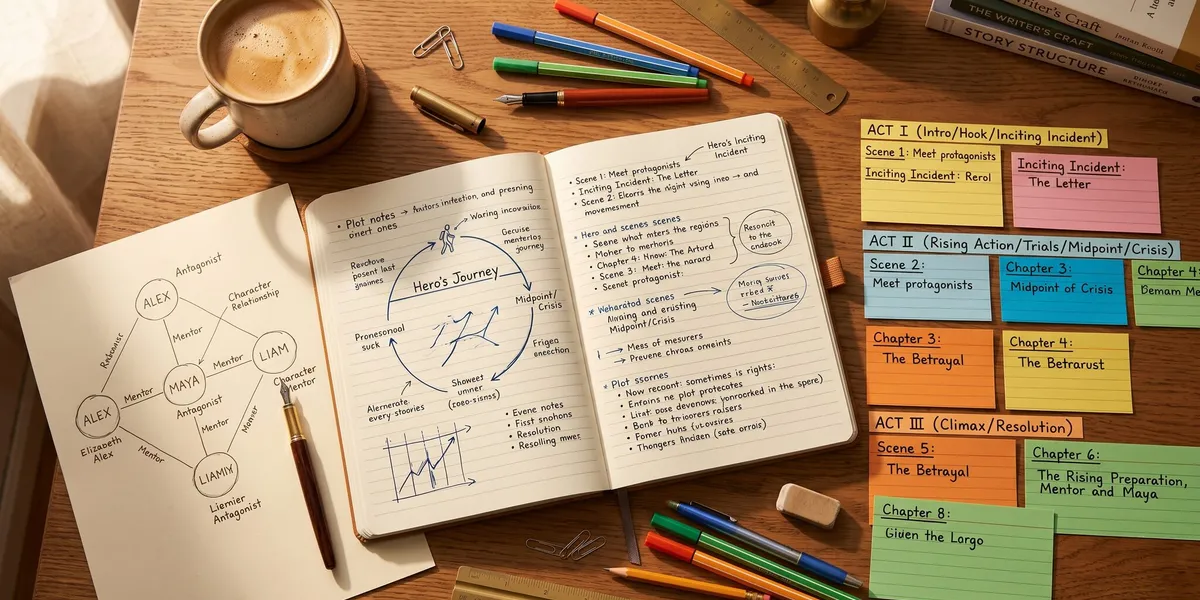
You can plan an entire novel — premise, characters, plot, scenes, and world — using seven free templates you copy right now and start filling in today.
In this guide, you’ll find:
- Seven ready-to-use novel planning templates covering every stage from concept to scene tracking
- A complete story bible template to keep your world, characters, and timeline consistent
- The exact order to fill these templates so nothing falls through the cracks
- How AI tools can generate your planning documents in minutes instead of hours
Here are the templates.
Template 1: Novel Premise and Concept Worksheet
Every novel starts with a premise. This template forces you to crystallize your core idea before you invest months writing chapters that wander.
| Field | Your Answer |
|---|---|
| Working Title | |
| Genre | (Primary genre + subgenre, e.g., “Fantasy Romance / Romantasy”) |
| One-Sentence Premise | (Complete: “[Character] must [goal] before [deadline], but [obstacle] stands in the way.”) |
| Core Conflict | (Internal conflict + external conflict) |
| Theme | (What truth about human nature does this story explore?) |
| Comparable Titles | (2-3 published novels with similar appeal) |
| How Yours Differs | (Your unique angle or twist) |
| Target Word Count | (See average novel word counts by genre) |
| POV and Tense | (First person past, third person limited present, etc.) |
| Target Completion Date |
Fill every field before writing a single chapter. If you cannot complete the one-sentence premise, your concept needs more development. That single sentence becomes your compass for every plot decision you make from here.
The premise worksheet is where most abandoned novels could have been saved. According to Writer’s Digest, writers who define their premise and conflict before drafting are significantly more likely to finish their manuscripts.
Template 2: Character Profile Template
Flat characters kill novels faster than weak plots. This character profile template gives you a structured way to build protagonists, antagonists, and supporting cast members who feel real on the page.
Main Character Profile
| Field | Details |
|---|---|
| Full Name | |
| Age | |
| Physical Description | (3-4 distinguishing features, not a full portrait) |
| Occupation / Role | |
| Core Want | (What they chase through the story) |
| Core Need | (What they actually need — often different from want) |
| Fatal Flaw | (The weakness that creates internal conflict) |
| Ghost / Wound | (Past event that shaped their flaw) |
| Character Arc | (How they change from page 1 to the final chapter) |
| Voice / Speech Pattern | (Formal, sarcastic, rambling, clipped?) |
| Key Relationships | (List 2-3 characters and the dynamic) |
| Secret | (Something the reader learns later) |
Supporting Character Quick Sheet
For secondary characters, you do not need the full profile. Use this condensed version:
| Character Name | Role in Story | Want | Relationship to Protagonist | One Defining Trait |
|---|---|---|---|---|
Create a full profile for your protagonist, antagonist, and love interest (if applicable). Use the quick sheet for everyone else. You can always expand a supporting character’s profile later if they demand more page time.
For deeper techniques on making characters feel three-dimensional, see our guide on character development.
Template 3: Plot Structure Template (Three-Act Framework)
A novel planning template without plot structure is just a list of scenes with no direction. This template maps your story to the three-act structure — the framework behind most commercially successful novels.
| Beat | Your Novel | Target Word Count |
|---|---|---|
| ACT 1: SETUP (25%) | ||
| Opening Scene / Hook | (What grabs the reader on page 1?) | 1-2 chapters |
| Ordinary World | (Character’s life before the story begins) | 2-3 chapters |
| Inciting Incident | (The event that disrupts everything) | Chapter 3-4 |
| Debate / Refusal | (Character resists the call to action) | 1-2 chapters |
| First Plot Point / Break into Act 2 | (Character commits to the journey) | End of Act 1 |
| ACT 2: CONFRONTATION (50%) | ||
| Fun and Games / Rising Action | (Character explores the new situation) | 4-6 chapters |
| B-Story / Subplot | (Secondary plot that reinforces theme) | Weave throughout |
| Midpoint | (Major revelation or reversal — stakes escalate) | Center of book |
| Bad Guys Close In | (Obstacles intensify, allies falter) | 3-5 chapters |
| All Is Lost | (Character’s lowest point) | 1-2 chapters |
| Dark Night of the Soul | (Internal reckoning before the climax) | 1 chapter |
| ACT 3: RESOLUTION (25%) | ||
| Break into Act 3 | (Character discovers the solution) | 1 chapter |
| Climax | (Final confrontation — internal and external conflict collide) | 2-3 chapters |
| Resolution / Denouement | (New normal — how has the world changed?) | 1-2 chapters |
This template works for literary fiction, thrillers, romance, fantasy, and science fiction. If you prefer a different framework, try the Hero’s Journey (12 stages) or the Save the Cat beat sheet (15 beats).
You can see all seven popular outlining methods compared in our how to outline a novel guide.
Template 4: Scene Tracker Spreadsheet
Chapters tell you what happens. A scene tracker tells you why each scene exists and whether it earns its place in your manuscript.
| Scene # | Chapter | POV Character | Location | Scene Goal | Conflict | Outcome | Emotional Shift | Word Count | Status |
|---|---|---|---|---|---|---|---|---|---|
| 1 | 1 | (e.g., hopeful → anxious) | Draft | ||||||
| 2 | 1 | Draft | |||||||
| 3 | 2 | Draft | |||||||
| 4 | 2 | Draft | |||||||
| 5 | 3 | Draft |
How to Use This Template
Every scene needs three things to justify its existence:
- A goal — What does the POV character want in this scene?
- Conflict — What blocks them from getting it?
- An outcome — Do they succeed, fail, or get a mixed result?
If a scene has no conflict and no emotional shift, cut it or combine it with another scene. This is the fastest way to eliminate pacing problems before they become revision nightmares.
The “Emotional Shift” column is what separates adequate plotting from compelling storytelling. Track how your character’s emotional state changes within each scene, and you will naturally create the rising and falling tension that keeps readers turning pages.
Template 5: Story Bible Template
A story bible template is your single source of truth for every detail in your novel’s world. It prevents continuity errors — the character whose eyes change color in chapter twelve, the town that shifts from coastal to inland, the timeline that contradicts itself.
World Details
| Category | Details |
|---|---|
| Setting / Time Period | |
| Geography | (Key locations, distances, climate) |
| Political Structure | (Government, factions, power dynamics) |
| Economic System | (Currency, trade, class structure) |
| Technology Level | (What exists, what does not) |
| Magic System / Special Rules | (If applicable — rules, costs, limitations) |
| Cultural Norms | (Customs, taboos, social expectations) |
| Religion / Belief Systems | |
| History | (Key historical events that shape the present) |
| Languages / Dialects |
Timeline and Chronology
| Date / Day | Event | Characters Involved | Location | Notes |
|---|---|---|---|---|
Rules and Continuity Tracker
| Detail | First Mentioned | Chapter | Notes |
|---|---|---|---|
| (e.g., “Magic requires blood sacrifice”) | “The old woman drew the blade…” | Ch. 3 | Cannot contradict in Ch. 15 |
This template is essential for fantasy and science fiction writers doing heavy world building, but even contemporary fiction benefits from tracking character details, locations, and timeline consistency.
The story bible grows as you write. Start with the basics before drafting, then update it every time you introduce a new detail. Your future self — and your editor — will thank you.
Template 6: Subplot Tracker
Most novels need two to four subplots running alongside the main plot. This template keeps them organized so they do not crowd each other or disappear for a hundred pages.
| Subplot | Type | Characters | Starts (Ch.) | Midpoint Turn | Resolves (Ch.) | Connection to Main Plot |
|---|---|---|---|---|---|---|
| Romance / Love Interest | Relationship | |||||
| Mentor / Friendship | Relationship | |||||
| Internal Arc | Character growth | |||||
| Mystery / Secret | Plot-driven |
Subplot Rules
- Every subplot must connect to or mirror the main plot’s theme
- Introduce subplots in Act 1, complicate them at the midpoint, resolve them before or during the climax
- If a subplot can be removed without affecting the main story, it does not belong in the novel
A common mistake is launching a subplot and forgetting to resolve it. The “Resolves” column prevents orphaned storylines. Check it against your scene tracker to make sure every subplot gets its closing beat.
For more on how subplots weave into your story’s overall shape, see our guide on story structure.
Template 7: Revision Planning Checklist
Planning does not stop when the first draft is finished. This template gives you a structured revision process so you do not just read your manuscript and feel vaguely uneasy about it.
First Pass: Structural Edit
- Does the inciting incident happen within the first 15% of the manuscript?
- Does every chapter end with a reason to keep reading?
- Does the midpoint genuinely change the direction of the story?
- Is the “All Is Lost” moment truly the protagonist’s lowest point?
- Does the climax resolve both the internal and external conflict?
- Can any chapter be removed without breaking the story? (If yes, remove it.)
- Are subplots resolved before or during the climax?
Second Pass: Character Edit
- Does the protagonist have a clear arc from page 1 to the final page?
- Does the antagonist have understandable motivations?
- Does each supporting character serve a distinct purpose?
- Are character voices distinct enough to identify without dialogue tags?
- Check character flaws — does the protagonist’s flaw create real consequences?
Third Pass: Scene-Level Edit
- Does every scene have a goal, conflict, and outcome?
- Cut scenes where nothing changes emotionally or plot-wise
- Check pacing — are quiet scenes followed by tension? Does intensity build toward the climax?
- Verify continuity against your story bible
Fourth Pass: Line Edit
- Eliminate passive voice
- Cut adverbs that weaken strong verbs
- Check dialogue — does it sound like how people actually talk?
- Remove filter words (“she felt,” “he noticed,” “she realized”)
How to Use These Templates in Order
You do not need to fill all seven templates before writing. Here is the recommended sequence:
Before you write a single word:
- Premise Worksheet (Template 1) — 30 minutes
- Character Profiles (Template 2) — 1-2 hours for main cast
- Plot Structure (Template 3) — 1-2 hours
As you begin drafting: 4. Scene Tracker (Template 4) — update as you write each scene 5. Story Bible (Template 5) — add details as you create them
After the first draft: 6. Subplot Tracker (Template 6) — map what you actually wrote 7. Revision Checklist (Template 7) — systematic editing passes
This order balances planning with discovery. You know enough to start writing after templates 1-3, and templates 4-7 keep the drafting and revision process organized without front-loading weeks of planning before a single word hits the page.
Can AI Help You Fill These Templates Faster?
Yes — and dramatically so. AI novel planning tools can generate character profiles, plot structures, and scene breakdowns in minutes instead of hours. The key is using AI as a brainstorming partner, not a replacement for your creative decisions.
Our Pick — Chapter
Chapter generates complete novel outlines, character profiles, and scene-by-scene plans using AI — then helps you write each chapter with your voice and vision intact. Over 2,147 authors have used Chapter to create 5,000+ books.
Best for: Fiction writers who want AI-assisted planning and drafting in one tool Why we built it: Most writers abandon novels not because they lack talent, but because they lack structure. Chapter’s planning features fill these exact templates automatically, giving you a roadmap before you write your first chapter.
You can also explore other AI plot generators and book outline generators if you want to compare options.
Common Novel Planning Mistakes to Avoid
Even with the best templates, these five mistakes derail novel planning:
- Over-planning before writing. If you spend three months filling templates and zero months drafting, the templates are procrastination tools. Set a deadline to start writing, even if templates are incomplete.
- Treating templates as permanent contracts. Your plot will change during drafting. That is normal. Templates are guides, not handcuffs. Update them when the story evolves.
- Skipping the character wound. The “Ghost / Wound” field in Template 2 is where internal conflict lives. Without it, your character has no emotional engine driving the story.
- Ignoring the midpoint. Most sagging second acts happen because the midpoint does not genuinely raise the stakes or change the protagonist’s understanding. The midpoint is not a rest stop — it is a turning point.
- Writing a story bible after the fact. Start your story bible from day one. Retroactively documenting details after 60,000 words guarantees continuity errors.
How Long Does It Take to Plan a Novel?
Planning a novel takes one to four weeks depending on complexity and genre. A contemporary romance with two POV characters and a single timeline needs less planning than an epic fantasy with twelve characters, three continents, and a magic system.
Here is a realistic breakdown:
| Planning Stage | Time Estimate |
|---|---|
| Premise and concept | 1-3 hours |
| Character profiles | 2-5 hours |
| Plot structure | 3-8 hours |
| Scene tracker (initial) | 2-4 hours |
| Story bible (initial) | 2-6 hours |
| Total | 10-26 hours |
You do not need to finish all planning before you start writing. Most successful novelists plan the first act thoroughly, sketch the midpoint and climax, then discover the details during drafting.
The Snowflake Method popularized by Randy Ingermanson takes this approach — start with a one-sentence summary, expand to a paragraph, then to a page, building detail gradually rather than trying to plan everything upfront.
Do You Need All Seven Templates?
No. Use the templates that match your writing style:
- Plotters (you plan everything) — Use all seven templates in order
- Pantsers (you write by discovery) — Start with Template 1 (Premise) and Template 2 (Character Profile) only, then use Template 4 (Scene Tracker) and Template 5 (Story Bible) retroactively as you draft
- Plantsers (hybrid) — Use Templates 1-3 before writing, add the rest as needed
The goal is not to fill every cell in every table. The goal is to have enough structure that you never stare at a blank page wondering what happens next — while leaving enough room for creative discovery.
If you want a full comparison of outlining methods beyond templates, check our how to write a novel outline guide or our overview of how to write a novel from start to finish.
FAQ
What is a novel planning template?
A novel planning template is a structured worksheet or framework that helps you organize your story’s premise, characters, plot, scenes, and world details before and during drafting. These templates prevent plot holes, maintain continuity, and give you a roadmap so you can write with confidence instead of guessing what comes next.
What should a story bible include?
A story bible should include your novel’s world details, character profiles, timeline, continuity rules, and key terminology. It serves as a single reference document that prevents contradictions. Fantasy and sci-fi writers especially need story bibles to track magic systems, geography, and invented languages across hundreds of pages.
Is it better to outline or discover your novel?
Both approaches work — the best method is whichever one helps you finish the manuscript. Research from NaNoWriMo participants shows that both plotters and pantsers complete novels at similar rates. The key difference is where the work happens: plotters do more upfront planning, pantsers do more revision. Most published authors fall somewhere in between.
Can I use AI to plan my novel?
Yes — AI tools like Chapter can generate character profiles, plot outlines, and scene-by-scene breakdowns in minutes. The most effective approach is using AI to brainstorm options and fill template scaffolding, then making the creative decisions yourself. Over 5,000 books have been created using AI-assisted planning and writing workflows.
How detailed should my novel outline be?
Your outline should be detailed enough to prevent getting stuck, but loose enough to allow discovery. A good rule: outline each chapter with a 2-3 sentence summary covering the scene goal, main conflict, and emotional outcome. You can always add detail as you write. If your outline reads like a finished novel, you have gone too far.