A story arc template is a fill-in framework that maps a story’s major turning points from beginning to end. You answer seven structural questions, drop your scenes into the slots, and walk away with a plot that holds together.
This guide gives you the template, walks through each section with examples, and shows you how to adapt it to your genre and story type.
What a Story Arc Template Does
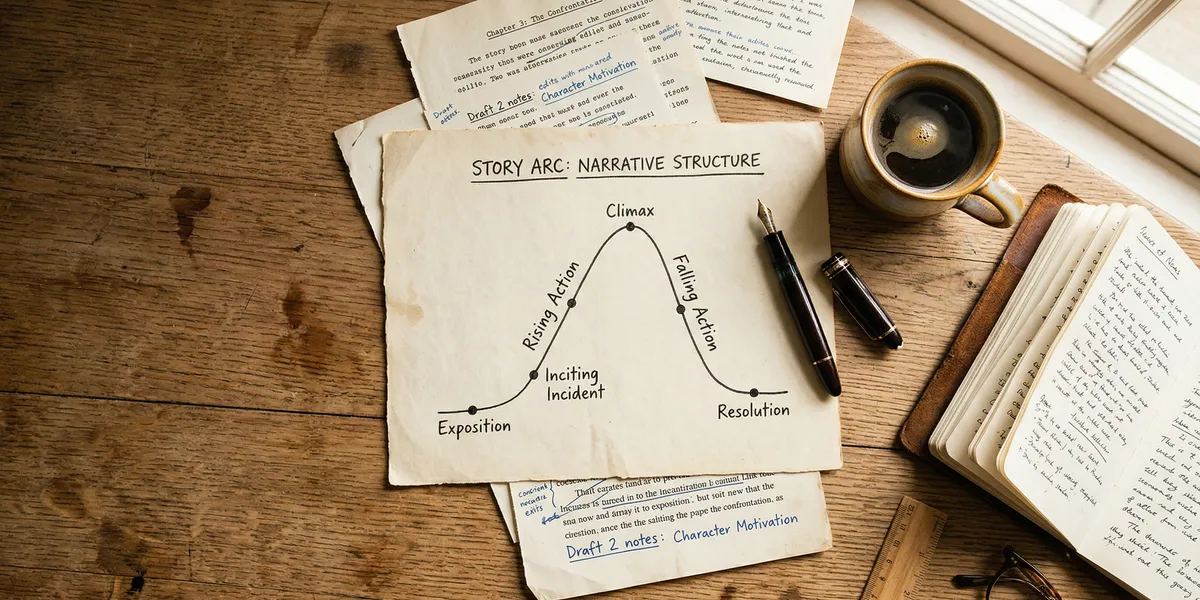
A story arc traces the emotional trajectory of your narrative — the shape of change your characters move through. A story arc template turns that abstract shape into a concrete planning tool.
Instead of staring at a blank outline, you fill in specific structural beats. Each beat has a job: establish the world, introduce the conflict, raise the stakes, hit the emotional peak, then land the ending.
Researchers at the University of Vermont’s Computational Story Lab analyzed over 1,700 English-language novels and identified six fundamental arc shapes that nearly every story follows. Whether your arc rises steadily (rags to riches) or falls and recovers (rebirth), the underlying structure still moves through the same core beats. A template captures those beats so you can fill them deliberately rather than hoping they emerge on their own.
The template below uses seven sections. It draws on the three-act structure as its backbone — setup, confrontation, resolution — but breaks those acts into the specific turning points that professional novelists and screenwriters rely on.
The 7-Section Story Arc Template
Here is the template at a glance. Each section gets its own deep dive below.
| # | Section | Purpose | Roughly Where |
|---|---|---|---|
| 1 | Status Quo | Show the character’s normal world | First 10-15% |
| 2 | Inciting Incident | Break the normal world with a problem or opportunity | 10-15% mark |
| 3 | Rising Action | Escalate conflict through obstacles and complications | 15-50% |
| 4 | Midpoint Shift | Change the game — new information, reversal, or commitment | ~50% mark |
| 5 | Crisis & Climax | Force the hardest choice and biggest confrontation | 75-90% |
| 6 | Falling Action | Show the immediate aftermath of the climax | 90-95% |
| 7 | Resolution | Settle the new normal and close the emotional loop | Final 5-10% |
These proportions are guidelines, not laws. A thriller might compress the status quo to two pages. A literary novel might spend 20% there. The sequence matters more than the exact percentages.
Step 1: Status Quo — Establish What’s Normal
The status quo shows readers who your character is before everything changes. It does three things:
- Introduces the protagonist — their personality, situation, and daily reality
- Establishes the world — the rules, setting, and atmosphere
- Plants the seed of dissatisfaction — a flaw, desire, or problem simmering beneath the surface
The status quo is not backstory. It is the opening scene or chapter that puts the reader into a specific moment in your character’s life. The best openings reveal character through action, not explanation.
Template fill-in:
My protagonist is [name], who lives in [setting/situation]. Their daily reality looks like [routine or circumstances]. On the surface, things seem [stable/tolerable/fine], but underneath, they [want/fear/lack something specific].
Example (fantasy): Kael is a palace cartographer in a kingdom that banned magic fifty years ago. He spends his days drawing coastlines he has never visited. On the surface, his life is stable and predictable. Underneath, he has been hiding his ability to see magical ley lines on every map he draws.
Example (romance): Nora runs a bookshop on a street being bought up by developers. Business is steady enough. But she has not let anyone close since her business partner — and best friend — walked away two years ago.
The status quo should make readers care about the character while making them feel that something must change. That change arrives in the next beat.
Step 2: Inciting Incident — Break the Normal World
The inciting incident is the event that shatters the status quo. It introduces the central conflict or opportunity that the rest of the story will revolve around.
A strong inciting incident has three qualities:
- It is external — something happens to or around the character, not just inside their head
- It demands a response — the character cannot simply ignore it and go back to normal
- It connects to the protagonist’s deeper need — the best inciting incidents poke directly at the flaw or desire you planted in Step 1
Template fill-in:
The normal world breaks when [specific event]. This forces my protagonist to [initial response], which sets them on the path toward [the story’s central question or goal].
Example (fantasy): A visiting diplomat collapses during a state dinner, and Kael sees ley-line poisoning spreading across the man’s skin — something no one else in the room can perceive. Kael now faces a choice: reveal his forbidden ability or let the man die.
Example (romance): The developer buying up Nora’s street turns out to be the younger brother of her former best friend. He walks into her bookshop with a lease proposal and a smile she does not trust.
The inciting incident typically lands between the 10% and 15% mark of your manuscript. Placing it earlier creates urgency. Placing it later risks losing the reader’s patience.
Step 3: Rising Action — Escalate Through Obstacles
Rising action is the longest section of your story. It covers everything between the inciting incident and the climax — a series of obstacles, complications, and small victories that raise the stakes with each scene.
Effective rising action follows a principle called progressive complication. Each obstacle should be harder than the last. Each failure should cost more. Each small win should create a new, bigger problem.
Plan three to five major complications in this section:
Template fill-in:
Complication 1: [First obstacle — protagonist tries the easy solution and fails] Complication 2: [Stakes rise — a new threat, ally, or piece of information changes the situation] Complication 3: [Things get personal — the conflict threatens something the protagonist values deeply] Complication 4 (optional): [False victory or devastating setback]
Example (fantasy):
- Complication 1: Kael secretly treats the diplomat but draws the attention of the king’s enforcer, who investigates anyone connected to magic.
- Complication 2: He discovers a network of hidden magic users in the city — and learns that the ley-line poisoning is spreading.
- Complication 3: The enforcer arrests Kael’s mentor, the only person who knew his secret, and threatens execution.
Each complication should serve double duty: advance the external plot and pressure the character’s internal arc. Kael’s obstacles are not just about survival — they force him to decide whether hiding his identity is worth other people’s lives.
Step 4: Midpoint Shift — Change the Game
The midpoint is the most underappreciated beat in story structure. It sits roughly halfway through the narrative and fundamentally changes the character’s relationship to the conflict.
The midpoint is not just “something happens in the middle.” It is a specific kind of shift:
- Reactive to proactive — the character stops running and starts fighting
- New information — a reveal that reframes everything the reader thought they knew
- Point of no return — the character commits to a path they cannot walk back from
Screenwriting instructor Syd Field identified the midpoint as one of the most important structural beats in storytelling, noting that it often divides Act 2 into two distinct halves with different dramatic energy.
Template fill-in:
At the midpoint, [event or revelation] changes the game. My protagonist shifts from [reactive stance] to [proactive stance]. The stakes become [higher/more personal/more urgent] because [reason].
Example (fantasy): Kael discovers that the ley-line poisoning is not natural — the kingdom’s own anti-magic barriers are decaying, and the decay will kill thousands within weeks. He stops hiding and begins actively seeking allies to break the barrier, knowing he will be hunted for it.
Example (romance): Nora and the developer have been working toward a compromise on the street’s future, and she realizes she has started trusting him — only to find documents proving he has been negotiating a demolition deal behind her back. She stops being cautious and goes on the offensive to save her shop and the neighborhood.
After the midpoint, the story accelerates. The character is now driving the action instead of reacting to it.
Step 5: Crisis and Climax — The Hardest Choice
The climax is the moment of highest tension and the turning point that determines the outcome of the story. But the climax only lands if it is preceded by a crisis — the impossible choice that strips the character to their core.
The crisis forces the protagonist to choose between two things they value. The best crises have no clean answer:
- Save yourself or save someone else
- Tell the truth and lose everything, or keep the lie and keep your life
- Achieve the goal at a moral cost, or abandon the goal and keep your integrity
Template fill-in:
Crisis: My protagonist must choose between [option A] and [option B]. Both have real costs. The choice reveals who they truly are.
Climax: They choose [their decision], and the final confrontation unfolds as [what happens]. The outcome is [result — victory, defeat, or bittersweet resolution].
Example (fantasy):
- Crisis: Kael can destroy the anti-magic barrier permanently (saving thousands but unleashing uncontrolled magic on a kingdom that fears it) or repair it temporarily (buying time but leaving the fundamental problem unsolved — and sentencing hidden magic users to continued persecution).
- Climax: He chooses to break the barrier. In the confrontation with the king’s enforcer, Kael uses his full power publicly for the first time, shattering the barrier and revealing magic to the entire kingdom.
The climax is the payoff of every setup, complication, and character beat that preceded it. If it feels weak, the problem is usually upstream — the stakes were not high enough, or the character’s internal journey was not developed enough to make the choice matter.
Step 6: Falling Action — Immediate Aftermath
Falling action covers the scenes immediately after the climax. The main conflict is resolved, but the emotional dust has not settled.
This section is short — often just a scene or two — but it serves critical functions:
- Process the climax — show the physical, emotional, and social consequences
- Tie up active subplots — resolve secondary storylines that were interrupted by the climax
- Begin the emotional transition — move the reader from peak intensity toward the quieter resolution
Template fill-in:
After the climax, the immediate consequences are [what changes]. My protagonist deals with [specific aftermath — injury, loss, revelation, new responsibility]. The secondary characters respond by [their reactions].
Example (fantasy): The barrier is gone. Magic begins returning visibly across the kingdom. The enforcer is defeated but not dead. Kael’s mentor is freed, but the political fallout is immediate — the king demands answers, and the kingdom divides between those who welcome magic’s return and those who fear it.
Do not rush the falling action. Readers need a few beats to process the climax before you close the story.
Step 7: Resolution — Settle the New Normal
The resolution shows the new status quo. It mirrors Step 1 — but everything has changed.
A strong resolution does three things:
- Closes the external plot — the central problem is solved (or acknowledged as unsolvable)
- Completes the character arc — the protagonist has changed in a way that is visible and specific
- Echoes the opening — a deliberate callback to the status quo shows how far the character has traveled
Template fill-in:
The new normal looks like [how things have changed]. My protagonist is now [how they’ve changed internally]. The final image or scene is [specific closing moment that echoes or contrasts the opening].
Example (fantasy): Kael is no longer hiding. He is appointed as the kingdom’s first magical cartographer, mapping ley lines openly. The final scene shows him drawing a map — the same activity from the opening — but now the ley lines glow on the page for everyone to see.
Example (romance): Nora’s bookshop is still standing. The development deal was restructured to preserve the historic street. She and the developer’s brother are cautiously building something new — a partnership that might become more. The final scene mirrors the opening: she is behind the counter, but this time the shop is full of people.
Adapting the Template by Genre
The seven sections work for any genre, but each genre emphasizes different beats:
| Genre | Emphasize | De-emphasize |
|---|---|---|
| Thriller/Suspense | Inciting incident, rising action, climax | Status quo (compress it) |
| Romance | Midpoint shift, crisis (the “black moment”) | Falling action |
| Literary Fiction | Status quo, internal midpoint shift | External climax (may be quiet) |
| Fantasy/Sci-Fi | Status quo (worldbuilding), rising action | Can have longer setup |
| Mystery | Inciting incident (the crime), rising action (investigation) | Resolution (often brief) |
The Hero’s Journey uses the same fundamental structure but adds mythic elements like the mentor, the threshold crossing, and the transformation. If you are writing epic fantasy or adventure stories, layering the Hero’s Journey on top of this template adds depth without changing the core beats.
Common Mistakes to Avoid
Starting with backstory instead of status quo. The status quo is a scene, not a history lesson. Drop readers into a moment. Weave background details in as the story moves.
Making the inciting incident too soft. If your protagonist can reasonably say “no thanks” and go back to their normal life, the inciting incident is not strong enough. It should make the old normal impossible.
Flat rising action. Every complication should be harder than the last. If your obstacles stay at the same difficulty level, the story flatlines. Each one should cost more, reveal more, or threaten more.
Skipping the midpoint shift. Many drafts sag in the middle because nothing fundamentally changes at the halfway mark. The midpoint is where you re-energize the story by changing the rules, the stakes, or the character’s approach.
Rushing the resolution. After spending chapters building to the climax, some writers wrap up in a paragraph. Give your resolution enough space to land. Readers invested time in these characters — they deserve to see how the dust settles.
Using a Story Arc Template With AI Writing Tools
A story arc template becomes even more powerful when paired with AI writing tools. Instead of feeding an AI a vague prompt, you give it the structural framework — and it generates scenes that fit within your planned arc.
Our Pick — Chapter
Chapter is built for authors who want to write full-length books with AI assistance. You can input your story arc template — character setups, turning points, climax beats — and Chapter generates chapters that follow your structural plan. It keeps your arc consistent across 50,000+ words, which is where most general-purpose AI tools fall apart.
Best for: Fiction and nonfiction authors writing full-length books Pricing: $97 one-time (nonfiction) | Varies (fiction) Why we built it: Plotting a story arc is one thing. Maintaining it across an entire manuscript is where most writers get stuck. Chapter keeps the structure visible throughout the drafting process.
FAQ
What is the difference between a story arc and a plot structure?
A story arc traces the emotional trajectory — how your character’s fortune rises and falls. Plot structure is the mechanical framework: where the exposition, turning points, and climax go. Two stories can share the same plot structure and have completely different arcs. The template in this guide bridges both — it gives you structural slots (plot) while tracking the emotional movement (arc).
Can I use this template for nonfiction?
Yes. Memoirs, narrative nonfiction, and even business books with case studies follow arc structures. The “character” becomes the subject (or the reader), and the “conflict” becomes the problem being solved. The seven sections adapt naturally — substitute “inciting incident” with “the problem the reader faces” and “climax” with “the breakthrough or transformation.”
How many story arcs should a novel have?
Most novels have one primary arc (the protagonist’s journey) and two to four secondary arcs (subplots, supporting characters). Each arc can use this template independently. The skill is in weaving them together so they peak and resolve at different moments, creating a layered reading experience. Your character arcs should intersect with the main story arc at key turning points.
What if my story does not fit this template?
Not every story follows a linear arc. Nonlinear narratives, epistolary novels, and experimental fiction may rearrange or subvert these beats. But even unconventional stories typically contain these seven elements — they just present them in a different order. Use the template as a diagnostic tool: if your draft feels off, check whether any of the seven beats are missing or underdeveloped.