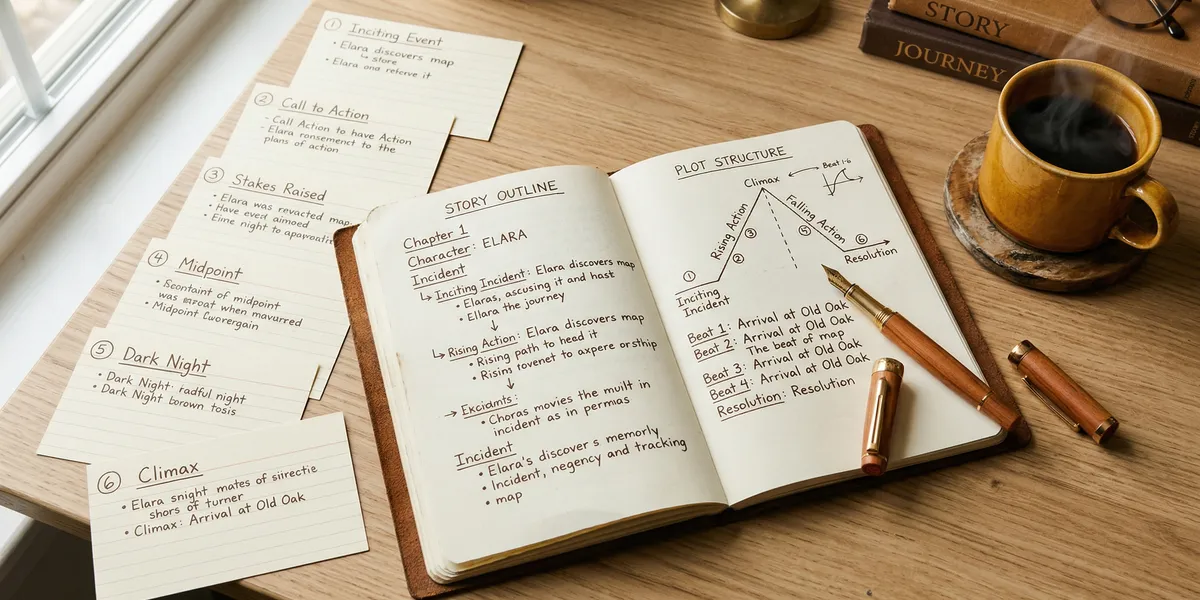
A story outline is a structured plan that maps your plot points, character arcs, and key scenes before you write a single page. Yes, you can build one — even if you have never outlined anything before.
This guide walks you through four proven outlining methods, shows you how to pick the right one for your project, and gives you a step-by-step process for creating an outline that actually holds your story together.
What a Story Outline Does
A story outline is not a rigid script you have to follow word for word. It is a roadmap. It shows you where the story starts, where the tension builds, where the big turning points land, and how everything resolves.
Without one, most writers hit a wall somewhere around the middle of their draft. The plot meanders, subplots tangle, and the ending feels forced. An outline prevents those problems before they start.
A strong story outline does four things:
- Prevents structural collapse. You catch plot holes and dead ends before you have written 40,000 words around them.
- Speeds up drafting. When you know what happens next, you spend your writing sessions producing pages instead of staring at a blank screen.
- Strengthens pacing. You can see whether your story drags in the middle or rushes through the climax before you commit to a full draft.
- Clarifies character motivation. Mapping your protagonist’s decisions against the plot structure exposes moments where their actions stop making sense.
Research from the University of Vermont’s Computational Story Lab found that stories follow a small number of core emotional arcs — all defined by structural turning points. An outline helps you build those arcs deliberately rather than by accident.
Choose Your Outlining Method
Not every writer thinks the same way, so not every outlining method works for everyone. Here are the four most proven approaches, along with who each one suits best.
The three-act structure
The three-act structure is the most widely used narrative framework in English-language fiction. It divides your story into three sections: setup, confrontation, and resolution.
Act One (roughly 25% of your story) introduces the world, the protagonist, and the central conflict. It ends with an inciting incident that pushes your protagonist out of their ordinary life and into the story’s main problem.
Act Two (roughly 50%) is the longest section. Your protagonist faces escalating obstacles, forms alliances, suffers setbacks, and reaches a midpoint that changes the stakes. The rising action builds tension steadily until the protagonist hits their lowest moment.
Act Three (roughly 25%) delivers the climax and resolution. The protagonist confronts the central conflict head-on, and the story closes out all remaining threads.
Best for: Writers who want a simple, proven framework. Works for nearly every genre — literary fiction, thriller, romance, sci-fi, memoir.
Example outline using three-act structure:
| Act | Story Beat | Your Story |
|---|---|---|
| Act 1 | Ordinary world | Who is the protagonist? What is their normal life? |
| Act 1 | Inciting incident | What event disrupts that life? |
| Act 1 | First plot point | What decision launches the protagonist into the conflict? |
| Act 2 | Rising action | What obstacles escalate the problem? |
| Act 2 | Midpoint | What revelation or event raises the stakes? |
| Act 2 | Crisis | What is the protagonist’s lowest moment? |
| Act 3 | Climax | How does the protagonist confront the central conflict? |
| Act 3 | Resolution | How does the story world settle after the climax? |
The hero’s journey
The hero’s journey is a 12-stage narrative pattern identified by mythologist Joseph Campbell in The Hero with a Thousand Faces (1949). Screenwriter Christopher Vogler later adapted it into a practical writing tool in The Writer’s Journey.
The framework follows a protagonist who leaves the familiar world, faces trials in an unknown realm, and returns transformed. It breaks into three broad phases:
- Departure — The hero receives a call to adventure, resists it, then crosses the threshold into the unfamiliar.
- Initiation — The hero faces tests, meets allies and enemies, survives an ordeal, and seizes a reward.
- Return — The hero brings the reward back to the ordinary world, changed by the experience.
Best for: Fantasy, sci-fi, adventure, and any story with a transformative character arc. George Lucas credited Campbell’s framework as the structural backbone of the original Star Wars trilogy.
Save the Cat beat sheet
The Save the Cat beat sheet, created by screenwriter Blake Snyder, breaks a story into 15 specific plot beats. While originally designed for screenplays, novelists have adopted it widely because it solves the biggest problem in storytelling: the sagging middle.
The 15 beats map onto the three-act structure but add granular checkpoints. Key beats include:
- Opening image — A snapshot of the protagonist’s life before the story changes it.
- Catalyst — The event that sets the story in motion (similar to the inciting incident).
- Midpoint — A false victory or false defeat that raises the stakes.
- All is lost — The protagonist’s lowest point.
- Finale — The protagonist uses everything they have learned to win (or lose).
Best for: Writers who want detailed guidance through the middle of their story. Particularly strong for commercial fiction, romance, and thrillers where pacing is everything.
The Snowflake Method
The Snowflake Method, created by physicist and novelist Randy Ingermanson, takes a different approach. Instead of starting with a full structure, you start small — a single sentence — and expand outward in ten progressive steps.
Here is the process in brief:
- Write a one-sentence summary of your story (25 words or fewer).
- Expand that sentence into a full paragraph with setup, three disasters, and resolution.
- Write a one-page summary for each major character — their storyline, motivation, and arc.
- Expand each paragraph sentence into a full paragraph, creating a one-page synopsis.
- Write a one-page description for each major character and a half-page for minor characters.
- Expand the one-page synopsis into a four-page synopsis.
- Expand character descriptions into full character charts.
- Use the four-page synopsis to create a scene list.
- Expand each scene into a full narrative description.
- Write the first draft.
Best for: Writers who get overwhelmed by blank outlines. The gradual expansion process builds complexity without requiring you to see the whole story at once. Also excellent for writers who have abandoned drafts because of plot holes — the method surfaces structural problems early.
How to Create a Story Outline Step by Step
Regardless of which method you prefer, the actual process of building an outline follows the same core steps. Here is how to do it.
Step 1: Start with the premise
Your premise is the foundation. Write it as a single sentence that includes three elements: a protagonist, a conflict, and the stakes.
Formula: [Character] must [goal] or else [consequence].
Examples:
- A retired detective must solve one last case before the real killer frames her daughter.
- A farm boy must destroy a corrupted ring before it destroys the world.
- A young chef must win a national competition to save her grandmother’s restaurant.
If you cannot state your premise in one sentence, your story is not focused enough yet. Tighten it before moving on.
Step 2: Define the protagonist’s arc
Your protagonist needs to change. The character arc — the internal transformation your protagonist undergoes — is the emotional spine of the outline. Without it, even a well-plotted story feels hollow.
Ask yourself:
- Who is the protagonist at the start? What do they believe, fear, or lack?
- Who are they at the end? What has changed inside them?
- What forces that change? The events in your outline should pressure the protagonist’s flaw or false belief until it breaks.
Map this arc alongside your plot beats. Every major turning point should push the protagonist closer to (or further from) their internal transformation.
Step 3: Identify the major plot beats
Every story needs a minimum set of structural turning points. Whatever outlining method you chose, make sure you have these:
- The hook — Something in the opening pages that makes the reader care enough to keep going.
- The inciting incident — The event that disrupts normal life and launches the story.
- The first major turning point — The protagonist commits to the central conflict. There is no going back.
- The midpoint — A revelation, reversal, or escalation that changes the stakes.
- The crisis — The protagonist’s lowest moment, where failure seems certain.
- The climax — The final confrontation with the central conflict.
- The resolution — The aftermath. How has the world changed? How has the protagonist changed?
Write one to three sentences for each beat. You are not writing prose — you are mapping the skeleton.
Step 4: Build out the scenes
Once you have your major beats, fill in the scenes between them. Each scene should do at least one of three things:
- Advance the plot
- Deepen a character
- Raise the stakes
If a scene does none of those, cut it from the outline. This is the stage where you can see pacing problems clearly. If you have twelve scenes between the inciting incident and the midpoint but only two between the midpoint and the climax, your story will drag in the middle and rush at the end.
A simple scene list works well:
| Scene # | What happens | POV character | Purpose |
|---|---|---|---|
| 1 | Elena arrives at the empty lab | Elena | Establish world, introduce protagonist |
| 2 | She discovers the encrypted message | Elena | Inciting incident |
| 3 | Flashback: her mentor’s last warning | Elena | Deepen backstory, raise stakes |
Step 5: Pressure-test the outline
Before you start drafting, run your outline through these checks:
- Motivation check. Does every major character decision make sense given what the character knows and wants at that point? Character motivation that does not track is the fastest way to lose a reader.
- Pacing check. Is the tension escalating from scene to scene? If two consecutive scenes have the same emotional temperature, something needs to change.
- Conflict check. Does every scene contain conflict — even if it is internal? Scenes without tension stall the story.
- Arc check. Does the protagonist’s internal journey progress alongside the external plot? If they transform only in the final chapter, the arc will feel unearned.
Fix structural problems now. Reworking an outline takes minutes. Reworking a 70,000-word draft takes months.
Story Outline Example
Here is a condensed three-act outline for an original story so you can see the process in action.
Premise: A burned-out journalist must expose a pharmaceutical cover-up before the company silences the only witness — her former mentor.
Act One:
- Scene 1: Maya Chen sits in her editor’s office, getting reassigned to the lifestyle desk after a fact-checking scandal. She is talented but reckless.
- Scene 2: Her former journalism professor, Dr. Asha Patel, calls with a tip about falsified drug trial data at Venn Pharmaceuticals.
- Scene 3: Maya hesitates (she swore off investigative work), but Asha reveals she is sick — the drug in question was prescribed to her.
Act Two:
- Scene 4: Maya begins digging. She finds redacted trial reports and a pattern of adverse reactions hidden from regulators.
- Scene 5: A junior researcher at Venn agrees to talk, then goes silent. Maya suspects intimidation.
- Scene 6 (Midpoint): Maya discovers Asha’s name was on the original trial — she was a paid consultant before she became a patient. The story is more complicated than she thought.
- Scene 7: Venn’s lawyers threaten legal action against Maya’s newspaper. Her editor pulls support.
- Scene 8 (Crisis): Asha collapses. Maya faces a choice: publish what she has (incomplete, risky) or drop it.
Act Three:
- Scene 9: Maya finds the junior researcher’s backup files. The evidence is undeniable.
- Scene 10 (Climax): She publishes independently, risking her career but saving the story.
- Scene 11 (Resolution): The FDA opens an investigation. Maya rebuilds her reputation on her own terms. Asha begins a new treatment.
Notice how the outline tracks both the external plot (the investigation) and the internal arc (Maya learning to be courageous and careful at the same time). That dual thread is what makes a story satisfying.
Common Mistakes to Avoid
- Outlining every detail. An outline is a map, not the territory. Leave room for discovery while drafting. If your outline reads like a finished manuscript, you have gone too far.
- Skipping the character arc. Plot without character change produces a story that feels like a sequence of events rather than a meaningful narrative.
- Ignoring the middle. Most outlines nail the opening and ending but leave the second act vague. The middle is where readers either stay hooked or bail. Give it the most attention.
- Treating the outline as permanent. Your outline will change as you draft. That is normal. The point is to start with a strong foundation, not to lock yourself into something you cannot adjust.
- Starting too late. Some writers draft 20,000 words, realize the story does not work, and then try to outline. Start with the outline. You will save weeks of revision.
Tools for Building Your Story Outline
You can outline with a notebook and pen, but software designed for writers makes it easier to rearrange scenes, track character threads, and spot structural gaps.
Our Pick — Chapter
Chapter.pub generates AI-powered story outlines that you can customize, rearrange, and expand into full chapters. It maps plot beats, character arcs, and scene sequences so you spend less time planning and more time writing.
Best for: Fiction and nonfiction writers who want to move from idea to structured outline fast. Why we built it: Because outlining is the step where most books die — and it does not have to be.
Other solid options include Scrivener for deep project management, Plottr for visual timeline-based outlining, and a simple spreadsheet if you prefer maximum flexibility.
FAQ
How long should a story outline be?
There is no fixed length. A short story outline might be half a page. A novel outline ranges from two pages (major beats only) to twenty-plus pages (scene-by-scene). Start with major beats and add detail only where you need it.
Should I outline if I am a pantser?
Even writers who prefer to discover the story as they draft benefit from a loose outline. Try writing just the premise, the midpoint, and the ending. Those three anchor points give you direction without constraining the process.
Can I change the outline while drafting?
Absolutely. The outline is a starting point, not a contract. Most writers revise their outline multiple times during the draft as characters develop and new possibilities emerge. The value is in having a foundation to deviate from, not in following it rigidly.
What is the difference between a story outline and a plot outline?
They overlap heavily. A story outline tends to include character arcs, themes, and emotional beats alongside the plot. A plot structure focuses specifically on the sequence of external events. In practice, you want both — the external events and the internal transformation.
Which outlining method is best for beginners?
The three-act structure is the simplest starting point. It gives you a clear beginning, middle, and end without requiring you to learn a detailed beat sheet. Once you are comfortable with that, you can layer in more specific frameworks like Save the Cat or the hero’s journey.