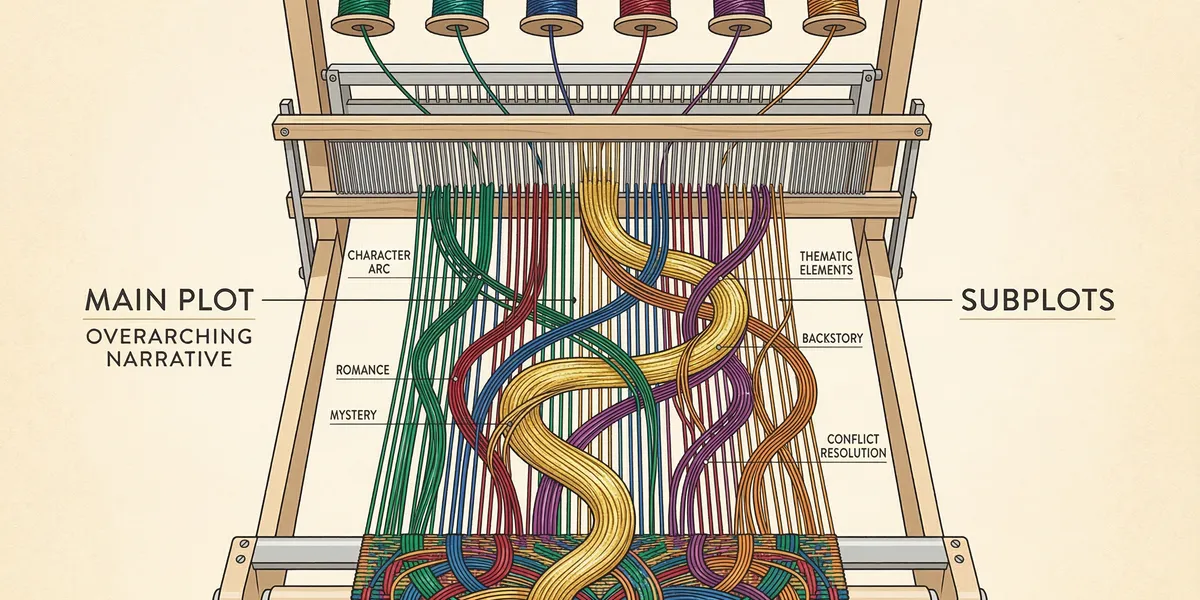
A subplot is a secondary storyline that runs alongside the main plot of a novel, adding depth, complexity, and texture to the story as a whole. If the main plot is the spine of your book, subplots are the ribs — structurally connected, individually shaped, and essential to giving the body its form.
What Is a Subplot
Every novel tells a primary story. The protagonist wants something, encounters obstacles, and either achieves that goal or doesn’t. That is the main plot. A subplot is a smaller, secondary narrative that runs in parallel. It has its own arc — a beginning, a middle, and a resolution — but it exists in service to the larger story.
Subplots give novels the layered feeling of real life, where multiple things are always happening at once. A detective chasing a killer is more compelling when she is also navigating a failing marriage. A young wizard fighting a dark lord resonates more deeply when his best friends are falling in love beside him.
The key distinction: a subplot supports and enriches the main plot. It never replaces it. The moment a secondary storyline demands more attention, more emotional investment, and more page time than the primary one, the structure of the novel starts to buckle.
Types of Subplots
Not all subplots serve the same purpose. Understanding the different types helps you choose which ones your novel actually needs.
Romantic Subplot
The most common type. Two characters develop a romantic relationship while the main plot unfolds around them. The romance creates emotional stakes that exist independently of the central conflict, giving readers someone to root for beyond the main storyline. Think of every action movie where the hero also falls in love — that is a romantic subplot doing its job.
Character Growth Subplot
A secondary character undergoes their own transformation across the story. This subplot tracks someone other than the protagonist learning, changing, or failing in ways that echo or contrast with the main character arc. It broadens the novel’s emotional range and gives the reader more to care about.
Mirror Subplot
Also called a foil subplot. This secondary storyline echoes the main plot’s theme but from a different angle. If the main plot explores the cost of ambition, a mirror subplot might show another character pursuing ambition through entirely different means — and reaching a different outcome. The contrast deepens the thematic argument of the novel without the author having to state it directly.
Complication Subplot
This type creates direct obstacles for the main plot. A character working to solve one problem finds that a separate situation keeps interfering. The complication subplot raises stakes and creates pacing variety by pulling the protagonist’s attention in multiple directions. It is a structural tool for building tension — the more plates the character has spinning, the more satisfying it is when some of them crash.
Famous Examples of Subplots
Pride and Prejudice
Jane Austen’s novel runs a masterful mirror subplot alongside the main story. The primary plot follows Elizabeth Bennet and Mr. Darcy — their mutual misjudgment, slow understanding, and eventual love. The subplot of Jane and Bingley mirrors that romance but with softer characters who lack Elizabeth and Darcy’s pride and prejudice. Jane and Bingley’s easier path highlights exactly how much Elizabeth and Darcy’s flaws complicate their own.
Harry Potter Series
J.K. Rowling layers multiple subplot types across the series. The Ron and Hermione romance is a slow-burn romantic subplot that develops across seven books. Neville Longbottom’s growth from timid, forgetful boy to someone who stands up to Voldemort is a character growth subplot that pays off spectacularly. Draco Malfoy’s arc in the later books functions as a mirror subplot — a young man shaped by family expectations, showing what Harry might have become under different circumstances.
A Game of Thrones
George R.R. Martin’s approach pushes subplots to their structural extreme. Multiple point-of-view characters each carry what feels like a main plot, but the story’s architecture reveals a hierarchy. The rising action of one storyline creates consequences that ripple into others. Daenerys’s journey across the Narrow Sea, the political machinations in King’s Landing, and the threat beyond the Wall all function as interwoven subplots that gradually converge. It is a masterclass in keeping many threads alive without losing the reader.
How Many Subplots Does a Novel Need
The answer depends on the scope of the story.
| Novel Type | Recommended Subplots | Why |
|---|---|---|
| Short novel (under 60K words) | 1-2 | Limited space means each subplot needs to earn its pages |
| Standard novel (60K-100K words) | 2-4 | Enough room for layered storytelling without overcrowding |
| Epic novel (100K+ words) | 5+ | Large casts and long arcs demand multiple threads to sustain momentum |
These are guidelines, not rules. A focused literary novel of 80,000 words might work beautifully with a single subplot. A sprawling fantasy of the same length might need five. The question is never “how many can I fit?” but “how many does this story need to feel complete?”
How to Weave Subplots Into Your Novel
Connect Every Subplot to the Main Theme
This is the single most important rule. A subplot that shares the novel’s thematic DNA will feel organic. A subplot that has nothing to do with the main theme will feel like a different book accidentally shuffled into yours.
If your novel is about forgiveness, your subplots should explore forgiveness — through different relationships, different stakes, different outcomes. The connections do not need to be obvious. They need to exist.
Introduce Subplots Early
Plant subplot seeds in the first quarter of the book. A subplot that appears halfway through the novel always feels bolted on, no matter how well written it is. Early introduction gives the reader time to invest in the secondary storyline and lets it develop at a natural pace alongside the main plot structure.
Resolve Subplots Before or During the Climax
Most subplots should reach their resolution shortly before the main climax or during it. This serves two purposes: it clears narrative space for the main story’s final push, and it creates a sense of convergence that makes the climax feel like the entire novel is arriving at its destination, not just one storyline.
A subplot that resolves after the main climax weakens the ending. The reader has already experienced the peak emotional moment. Anything that follows will feel like an appendix.
Use Subplots for Pacing
Subplots are powerful pacing tools. When the main plot reaches a moment of high tension, cutting to a subplot gives readers a beat to breathe — and builds suspense by delaying the resolution they are waiting for. When the main plot moves through a quieter stretch, a subplot can inject energy and urgency to keep pages turning.
The rhythm between main plot and subplot scenes creates the reading experience. Master that rhythm and the novel will feel effortlessly paced.
Subplot vs Main Plot
The distinction is straightforward in principle and tricky in practice.
The main plot carries the story’s central dramatic question. It receives the most page time, the highest stakes, and the most emotionally significant resolution. The protagonist’s primary goal lives here.
A subplot carries a secondary dramatic question. It receives less page time, lower (though still meaningful) stakes, and a resolution that supports or complicates the main plot’s resolution. Secondary characters or secondary goals live here.
The test: if you removed a storyline and the novel collapsed, it was the main plot. If you removed it and the novel still functioned but felt thinner, less rich, less satisfying — that was a subplot doing its job well.
Common Subplot Mistakes
Too many subplots. Every subplot costs attention. Readers have a finite capacity for tracking storylines. When a novel juggles more subplots than it can sustain, none of them develop enough to matter. Cut ruthlessly. Two well-developed subplots will always outperform five underdeveloped ones.
Subplot disconnected from theme. A romantic subplot in a thriller about government corruption can work — if the romance explores trust, loyalty, or betrayal in ways that mirror the main theme. If the romance exists solely because “thrillers need a love interest,” readers will feel it. Every subplot should answer the question: what does this add to the story’s central argument?
Forgetting to resolve a subplot. This is more common than most writers realize. A subplot introduced in Act I that simply vanishes by Act III creates a nagging sense of incompleteness for the reader. Track your subplots. Every one that begins must end — even if the ending is quiet or ambiguous.
Subplot more interesting than the main plot. When readers care more about the secondary storyline than the primary one, the novel has a structural problem. This usually signals that the main plot needs stronger stakes, a more compelling protagonist, or a more urgent dramatic question. The fix is rarely to weaken the subplot. It is to strengthen the main plot until it reclaims its rightful place at the center of the story.
Introducing subplots too late. A subplot that first appears in the second half of the novel never has enough room to breathe. It will feel rushed, its resolution forced. If a subplot matters enough to include, it matters enough to set up early.