Worldbuilding is the process of creating an imaginary world with its own geography, cultures, history, and rules — and you can do it whether you’re writing epic fantasy, sci-fi, or literary fiction set in a slightly altered version of Earth.
In this guide, you’ll learn:
- How to build your world’s physical landscape, climate, and borders
- The cultural layers that make fictional societies feel real — language, religion, class, politics
- How to create magic systems and technology that follow consistent rules
- The “iceberg method” for weaving worldbuilding into your story without overwhelming readers
Here’s everything you need to build a world worth getting lost in.
What Is Worldbuilding?
Worldbuilding is the craft of constructing an imaginary setting — its geography, history, cultures, power structures, and rules — so your story feels grounded in a living, breathing place. It goes far beyond picking a backdrop.
Think of it this way: your plot is what happens. Your characters are who it happens to. Your world is why any of it matters.
A prison escape means nothing if you don’t understand the regime that built the prison. A forbidden romance falls flat without the social rules that make it forbidden. Worldbuilding creates the pressure, the stakes, and the texture that turns a sequence of events into a story.
The term originated in speculative fiction — Tolkien’s Middle-earth is the classic example — but every genre uses worldbuilding. A contemporary thriller set in Wall Street still needs its own rules, hierarchies, and jargon. A memoir reshapes real places into narrative settings.
Types of Worldbuilding: Which Approach Fits Your Story?
Not every story needs the same depth of worldbuilding. Your approach depends on how far your setting departs from reality.
Primary World (Real-World Settings)
You set your story on Earth as we know it. The worldbuilding focuses on a specific time, place, and subculture — the unwritten rules of a 1920s speakeasy, the social dynamics of a modern high school, the daily rhythms of a fishing village.
Best for: Literary fiction, thrillers, romance, historical fiction, memoir.
Secondary World (Built From Scratch)
You create an entirely new world with its own continents, species, and physical laws. Nothing is inherited from reality unless you choose to include it.
Best for: Epic fantasy, far-future sci-fi, portal fantasy.
Hybrid World (Real World + Invented Elements)
You start with Earth but layer in invented elements — hidden magic, alternate history, advanced technology, supernatural creatures living among us.
Best for: Urban fantasy, dystopian fiction, science fiction, magical realism, superhero stories.
| Approach | Starting Point | Worldbuilding Effort | Examples |
|---|---|---|---|
| Primary | Real Earth | Low-Medium | The Great Gatsby, Gone Girl |
| Secondary | Nothing | High | Lord of the Rings, Dune |
| Hybrid | Earth + invented layers | Medium-High | Harry Potter, The Handmaid’s Tale |
Knowing your approach upfront saves you from building a 50-page atlas for a contemporary romance — or winging it in a story that needs deep infrastructure.
How to Build Your World’s Geography and Environment
Geography isn’t decoration. It shapes how your characters live, travel, trade, fight, and think.
Start With the Big Picture
Decide the physical scope of your story. You don’t need a whole planet if your plot unfolds in a single city. But you do need to understand what surrounds that city — where its water comes from, what it trades, and who lives beyond the walls.
Ask yourself:
- Terrain: Mountains, forests, deserts, oceans, islands? How does the landscape limit or enable movement?
- Climate: Is it tropical, arctic, temperate, or something alien? Climate drives agriculture, clothing, architecture, and daily life.
- Natural resources: What’s abundant? What’s scarce? Scarcity creates conflict. Abundance creates power.
- Natural hazards: Earthquakes, storms, volcanic activity, flooding? These shape where people settle and what they fear.
Draw a Map (Even a Rough One)
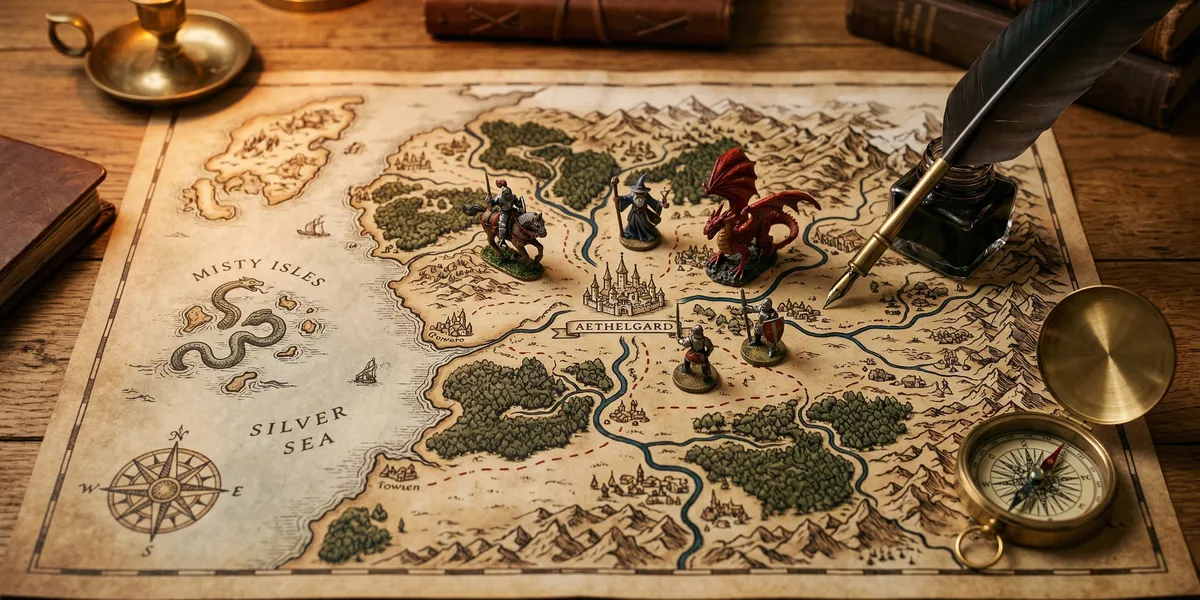
You don’t need artistic skill. A rough sketch helps you stay consistent with distances, travel times, and spatial relationships. If your character rides two days east to reach the coast, that coast better still be there in chapter 30.
Maps also reveal story opportunities. A mountain range between two kingdoms creates a natural border — and a natural point of conflict. A river running through a city creates rich neighborhoods on one side and poor ones on the other.
Let Geography Drive Culture
Real cultures develop in direct response to their environment. Desert peoples develop water-conservation rituals. Island cultures build their identity around the sea. Mountain communities become isolated and develop distinct traditions.
Your fictional cultures should follow the same logic. If your world has a region with year-round darkness, the people living there will have evolved customs, myths, and survival strategies you wouldn’t find in a sun-drenched tropical kingdom.
How to Create Cultures and Societies That Feel Real
Culture is where worldbuilding gets rich — and where lazy worldbuilding gets exposed. A world with one homogenous culture across an entire continent feels hollow. Here’s how to build depth.
Language and Communication
You don’t need to invent a full language (unless you’re Tolkien). But consider:
- Slang and idioms that reflect your world’s values. A seafaring culture might say “smooth sailing” where a mountain culture says “clear summit.”
- Naming conventions that feel consistent within a culture. If one character is named Aelindra, her brother probably isn’t named Dave.
- Literacy levels. Who can read? Who can’t? How does information travel?
Religion and Belief Systems
Religion in fiction isn’t just about gods. It’s about how belief shapes daily life, morality, law, and conflict.
Consider:
- Is there one dominant religion or many competing ones?
- Do the gods actually exist in your world, or is faith a matter of belief?
- How does religion interact with political power?
- What rituals mark birth, death, marriage, and coming of age?
Social Structure and Class
Every society has hierarchies. Your world needs to show who holds power and who doesn’t.
- Class systems: Are they rigid (caste-based) or fluid (merit-based)?
- Gender roles: Are they egalitarian, patriarchal, matriarchal, or something entirely different?
- Outsiders: How does the society treat immigrants, refugees, or people who don’t fit its norms?
The most interesting stories often come from characters who exist at the friction points of these systems.
Politics and Government
Government is just organized power — and power dynamics drive conflict.
Your world’s political structure could be:
- A monarchy (benevolent? corrupt? constitutional?)
- A democracy (functional? rigged? new and fragile?)
- A theocracy (led by clergy? by a living god?)
- Tribal councils, oligarchies, military juntas, or anarchist collectives
The key question isn’t which system — it’s who benefits and who suffers under it. That tension fuels story.
How to Build a Magic System or Technology Framework
If your world includes magic, advanced technology, or both, you need rules. Unlimited power is boring. Constraints create drama.
Hard Magic vs. Soft Magic
This framework, popularized by Brandon Sanderson, helps you decide how much your magic needs to be explained.
Hard magic has clear, defined rules. The reader understands what magic can and can’t do. This lets you use magic to solve problems without it feeling like a cheat.
Example: In Sanderson’s Mistborn, characters burn specific metals for specific powers. The limitations are precise.
Soft magic stays mysterious. The reader never fully understands how it works. This preserves a sense of wonder but means you can’t use magic as a convenient plot solution.
Example: Gandalf’s magic in Lord of the Rings. You never learn exactly what he can do.
Most stories fall somewhere on the spectrum between the two.
Three Rules for Consistent Magic
- Every power has a cost. Whether it’s physical exhaustion, rare materials, moral corruption, or shortened lifespan — magic without cost removes tension.
- Limitations matter more than abilities. What your magic can’t do is more interesting than what it can. Limitations force creative problem-solving.
- Magic should be woven into society. If healing magic exists, it changes medicine. If teleportation exists, it changes warfare. Don’t bolt magic onto a world that otherwise functions like medieval Europe.
Technology Follows the Same Logic
Sci-fi technology needs the same rigor. If faster-than-light travel exists, how does it affect trade, war, communication, and governance? If AI is sentient, what are its rights?
The best speculative technology isn’t about gadgets. It’s about how inventions reshape human behavior and social structures.
How to Develop Your World’s History
History gives your world weight. It explains why things are the way they are when your story begins.
The Iceberg Approach
You might develop 10 pages of timeline, but your reader only needs to see the tip. Include historical details only when they’re relevant to the current story.
A character mentioning “the war” in passing is more immersive than a three-paragraph info dump about the Treaty of Cardamoth signed in the Year of the Silver Moon.
Focus on Turning Points
You don’t need a complete chronicle. Focus on the 3-5 historical events that directly shape your story’s present:
- A founding event. How did this nation, city, or order begin?
- A great conflict. What war, disaster, or revolution scarred the collective memory?
- A recent shift. What changed in the last generation that your characters still feel?
These anchor points give characters something to reference, argue about, and live in the shadow of.
Let History Create Conflict
The best worldbuilding history isn’t neutral. It’s contested. Two cultures remember the same war differently. One group’s liberation is another group’s conquest. Your characters inherit these competing narratives — and that’s where story tension lives.
The Iceberg Method: How to Reveal Your World Without Info Dumps
This is where many writers stumble. You’ve built a rich world — now you want the reader to appreciate all of it. Resist that urge.
Show, Don’t Lecture
Instead of explaining your world’s currency system in a paragraph, show a character haggling at a market. Instead of describing the caste system, show a character being turned away from a door.
Every piece of worldbuilding should be delivered through:
- Character behavior — What they do (and don’t do) reveals social norms.
- Dialogue — How characters speak reveals education, region, and class.
- Conflict — Rules become visible when someone breaks them.
- Objects and details — A character’s clothing, food, and tools say more than a page of exposition.
The First Chapter Rule
Your first chapter should orient the reader in your world without stopping the story to explain it. The reader should understand:
- Where they are (roughly)
- What’s normal here
- What’s at stake
They don’t need to understand the full political landscape, the complete magic system, or 500 years of history. Trust your reader. Reveal layers gradually.
Common Info Dump Traps to Avoid
- The “As you know, Bob” dialogue — Characters explaining things they both already know, purely for the reader’s benefit.
- The prologue history lesson — Starting with pages of backstory before the actual story begins.
- The travelogue pause — Stopping the plot to describe a city in exhaustive detail.
- The footnote spiral — Explaining every unfamiliar term the moment it appears.
Let the reader be a little confused for a few pages. Curiosity is more engaging than comprehension.
Worldbuilding for Different Genres
The depth and focus of your worldbuilding shifts dramatically by genre.
Fantasy Worldbuilding
Fantasy demands the most visible worldbuilding. You’re asking readers to accept an entirely new reality. Focus on magic systems, cultural depth, and geography. Fantasy writing prompts can help you stress-test your world by exploring it from unexpected angles.
Science Fiction Worldbuilding
Sci-fi worldbuilding centers on technology and its consequences. One speculative change (AI, space travel, genetic engineering) ripples through every aspect of society. The key question: “If this technology existed, what would change?”
Historical Fiction Worldbuilding
You’re worldbuilding a real place — but at a time your reader hasn’t lived in. Research is your foundation. Get the details right (clothing, food, social norms, speech patterns), then use worldbuilding techniques to make the past feel as vivid as any fantasy realm.
Literary Fiction Worldbuilding
Even realistic fiction benefits from conscious worldbuilding. The unwritten rules of a small Southern town, the social dynamics of a tech startup, the rhythms of a failing marriage — these are all worlds with their own internal logic.
How AI Can Help You Worldbuild Faster
AI tools have transformed the worldbuilding process. Instead of spending months on pre-writing development, you can use AI to generate, test, and refine your world in days.
Our Pick — Chapter
Chapter’s AI writing assistant helps you build entire worlds through guided conversation. Describe your vision, and Chapter generates detailed settings, cultures, histories, and magic systems — then helps you weave them into your manuscript.
Best for: Fiction and nonfiction authors who want AI-assisted worldbuilding integrated into their writing workflow Pricing: $97 one-time (nonfiction) | Varies (fiction) Why we built it: Over 2,147 authors have used Chapter to create 5,000+ books — many of them in genres where deep worldbuilding is essential.
AI is especially useful for:
- Generating cultural details — Ask AI to develop naming conventions, religious practices, or social customs based on your world’s geography and history.
- Stress-testing consistency — Feed your world’s rules to AI and ask it to find contradictions or plot holes.
- Creating history timelines — Generate 500 years of history in minutes, then edit down to what matters.
- Developing secondary characters — AI can flesh out characters shaped by your world’s specific cultures and class systems.
Check out our full list of AI worldbuilding tools to find the right fit for your workflow.
Worldbuilding Checklist: Everything You Need to Define
Use this as a starting point — not every story needs every element.
Physical World
- Geography and terrain
- Climate and weather patterns
- Flora and fauna
- Natural resources and scarcity
- Map (even a rough sketch)
Culture and Society
- Language(s) and communication
- Religion and belief systems
- Social hierarchy and class structure
- Gender roles and family structure
- Art, music, and entertainment
- Food and cuisine
- Clothing and fashion
Power and Systems
- Government and political structure
- Legal system and laws
- Military and defense
- Economy and trade
- Magic system or technology framework
History and Context
- Founding myths or origin stories
- Major historical conflicts
- Recent events shaping the present
- Relationships between nations or groups
Common Worldbuilding Mistakes to Avoid
Building too much before writing. Worldbuilding is seductive. You can spend years developing a world and never write the story. Set a limit — build what you need for the first draft, then expand as the story demands.
Creating monocultures. A planet-sized world with one language, one religion, and one government isn’t realistic. Real worlds are messy, diverse, and contradictory. Even small regions have subcultures.
Forgetting the senses. Worldbuilding isn’t just visual. What does your world smell like? What does the food taste like? What sounds fill the streets at night? Sensory details create immersion faster than geography lessons.
Making your world too convenient for the plot. If a mountain range appears only when you need to slow your characters down, readers notice. Build your world first, then let the plot navigate its constraints.
Neglecting the ordinary. Not everything in your world needs to be exotic. Characters still eat breakfast, complain about weather, and have boring Tuesdays. The mundane makes the extraordinary stand out.
How Long Does Worldbuilding Take?
Worldbuilding takes anywhere from a few days to several months, depending on your genre, your story’s scope, and your approach. A contemporary thriller might need a week of location research. An epic fantasy series with multiple continents could require months of development.
Here’s a practical framework:
- Light worldbuilding (1-2 weeks): Real-world settings, urban fantasy with limited invented elements, single-location stories.
- Medium worldbuilding (2-6 weeks): Secondary world fantasy with a focused scope, sci-fi set in one star system, alternate history.
- Deep worldbuilding (1-3+ months): Multi-book epic fantasy, hard sci-fi with complex technology, stories spanning multiple cultures and centuries.
The key: don’t let worldbuilding become procrastination. Build enough to start writing, then develop the rest alongside your draft.
Can You Worldbuild as You Write?
Yes — and many successful authors prefer this approach. It’s called “discovery worldbuilding” or building your world alongside your narrative.
The advantage is efficiency. You only develop what the story actually needs. The risk is inconsistency — you might contradict yourself between chapters.
A practical middle ground: build the foundational layers (geography, basic power structures, magic rules) before you start, then discover the cultural details, history, and specifics as you draft. Keep a running worldbuilding document to track decisions as you make them.
Do Readers Actually Care About Worldbuilding?
Readers care about worldbuilding the way moviegoers care about set design — they notice when it’s bad, and they feel immersed when it’s good. But they came for the story.
The best worldbuilding is invisible. Your reader should feel like they’ve visited your world, not like they’ve studied it. If someone finishes your book and says “the world felt so real,” you’ve succeeded — even if they can’t name your continent’s major exports.
Character development and plot structure still drive the story. Worldbuilding is the stage they perform on.
FAQ
What Is Worldbuilding in Simple Terms?
Worldbuilding is the process of creating the setting, rules, and background of a fictional world for a story. It includes designing the geography, cultures, history, and systems (like magic or technology) that make your story’s world feel real and consistent. Every fiction writer does worldbuilding — whether they’re creating a new planet or describing a real neighborhood.
What Are the 5 Elements of Worldbuilding?
The five core elements of worldbuilding are geography (the physical world), culture (languages, religions, customs), history (past events shaping the present), power structures (government, economy, military), and rules (magic systems, technology, or natural laws unique to your world). You don’t need all five at equal depth — let your story’s needs guide which elements to develop most.
Is Worldbuilding Only for Fantasy and Sci-Fi?
No — worldbuilding applies to every genre of fiction. Historical fiction requires researching and recreating a past world. Contemporary fiction builds the social world of its characters — workplace dynamics, family structures, community norms. Even memoir involves worldbuilding, because you’re translating a real place and time into a narrative experience. Fantasy and sci-fi just make the process more visible.
What’s the Difference Between Worldbuilding and Setting?
Setting is where and when your story takes place — a specific location at a specific time. Worldbuilding is the complete construction of your story’s reality, including the setting plus all the systems, history, and cultural context that exist beyond the scenes you show. Think of setting as one room in a house, and worldbuilding as the whole neighborhood.
How Do You Organize Your Worldbuilding Notes?
The most effective way to organize worldbuilding notes is with a layered wiki-style document — start with broad categories (geography, culture, politics, history, magic) and add detail within each as needed. Tools like Notion, World Anvil, or even a simple folder of documents work well. The key is searchability — when you need to check a detail mid-draft, you should find it in under 30 seconds.