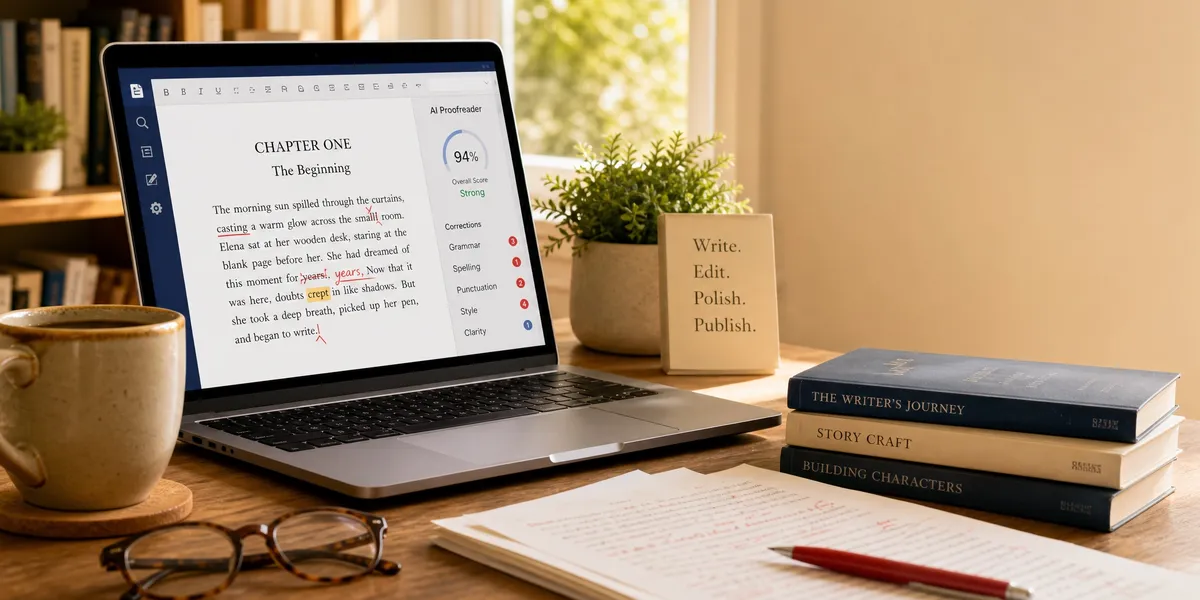
An AI proofreader for books scans your full manuscript for typos, grammar mistakes, punctuation errors, and inconsistencies — catching problems that your eyes skip after the twentieth read-through. The best ones handle book-length documents without losing context between chapters.
In this guide, you’ll learn:
- How AI proofreading actually works on book-length manuscripts
- The 4-step workflow for proofreading your book with AI
- Which AI proofreading tools handle books (not just blog posts)
- Where AI proofreading falls short — and how to fill the gaps
Here’s how to proofread your book with AI, step by step.
What Is an AI Proofreader for Books?
AI proofreader for books — software that uses artificial intelligence to scan your manuscript for spelling errors, grammar mistakes, punctuation issues, and formatting inconsistencies before publication. Unlike general writing tools, a book-level proofreader maintains context across chapters, tracks character names, and flags style drift that accumulates over 60,000+ words.
Traditional proofreading is the final stage of editing — it happens after developmental editing and copy editing. You’re not restructuring chapters or rewriting paragraphs. You’re hunting for the small errors that survived every previous round.
AI makes this faster and more consistent. A human proofreader charges $500 to $1,500 for an 80,000-word manuscript and takes one to two weeks. An AI proofreader finishes in minutes and catches mechanical errors at a rate that matches or exceeds human accuracy.
But AI proofreading isn’t a magic button. It works best as part of a structured workflow — and knowing how to set that workflow up is what separates a clean manuscript from one that still has embarrassing typos on page three.
How Does AI Proofreading Work on a Full Manuscript?
AI proofreading for a full manuscript works by analyzing your text against trained language models that understand grammar rules, spelling conventions, and stylistic patterns. The AI processes your manuscript in sections while maintaining a “context bridge” that carries information — character names, terminology, tense choices — from one chapter to the next.
Here’s what sets book-level AI proofreading apart from running a spell checker:
- Cross-chapter consistency. The AI remembers that you spelled your character’s name “Katerina” in chapter one and flags “Katarina” in chapter fourteen.
- Tense tracking. If you write in past tense throughout but slip into present tense during an action scene, the AI catches the shift.
- Style drift detection. Books written over months develop inconsistencies — sentence length patterns change, formality levels shift, and vocabulary choices evolve. AI flags these drifts.
- Dialogue tag accuracy. The AI checks that dialogue punctuation follows consistent rules throughout your manuscript.
Standard grammar checkers like your browser’s built-in spell check weren’t designed for this. They process each paragraph in isolation, which means they miss the manuscript-level patterns that make proofreading a book fundamentally different from proofreading an email.
Step 1: Finish All Other Editing First
AI proofreading is the last step before publication. Running a proofreader on a manuscript that still needs structural work wastes time — every rewrite introduces new errors.
Complete these stages first:
- Developmental editing — structure, pacing, plot holes, character arcs
- Copy editing — grammar, clarity, sentence-level improvements
- Line editing — prose style, rhythm, word choice
Only after your manuscript is structurally sound and stylistically polished should you bring in the proofreader. Think of it like painting a house — you don’t paint walls that are about to be torn down.
If you used AI to write your manuscript, run through the 5-pass editing method before proofreading. AI-generated text has specific patterns (filler words, hedging phrases, repetitive structures) that need addressing at the editing stage, not the proofreading stage.
Step 2: Choose the Right AI Proofreading Tool
Not every AI writing tool handles book-length manuscripts. Most grammar checkers max out at a few thousand words or lose context when processing long documents. Here are the tools that actually work for full books.
Our Pick — Chapter
Chapter includes a built-in AI editing and proofreading workflow that processes your entire manuscript as a unified document. Because you write and edit inside the same platform, the AI already understands your book’s structure, voice, and terminology — no uploading or reformatting required.
Best for: Authors who write and edit their books in one platform Pricing: $97 one time, 2 books included (fiction or nonfiction), 30-day money-back guarantee Why we built it: Proofreading shouldn’t require exporting your manuscript to three different tools
ProWritingAid
ProWritingAid processes book-length manuscripts and generates over 25 reports covering grammar, style, readability, and consistency. Its Scrivener integration makes it a strong choice if you draft in Scrivener.
Best for: Authors who want detailed style reports alongside proofreading Pricing: Free (limited) to $30/month Strength: Manuscript-wide consistency checking and overused word reports
Grammarly
Grammarly catches grammar, spelling, and punctuation errors with high accuracy. The Premium plan adds style suggestions and tone detection. It works well for chapter-by-chapter proofreading but doesn’t process full manuscripts as a single document.
Best for: Quick grammar and punctuation fixes on individual chapters Pricing: Free (basic) to $30/month (Premium) Limitation: No manuscript-level context — processes each document independently
ProofreaderPro.ai
ProofreaderPro.ai is designed specifically for academic and long-form documents. It accepts .docx, .pdf, and .txt files, tracks citations, and maintains terminology consistency across long documents.
Best for: Academic books, dissertations, and research-heavy nonfiction Pricing: Pay-per-document model Strength: Citation preservation and academic style conventions
LanguageTool
LanguageTool is an open-source grammar checker that supports over 30 languages. It’s a strong free option for multilingual authors or those writing in languages other than English.
Best for: Non-English manuscripts and multilingual authors Pricing: Free (basic) to $7/month (Premium) Strength: Multilingual support and privacy-focused (can run locally)
Step 3: Run a Structured Proofreading Pass
Don’t just paste your manuscript into a tool and accept every suggestion. A structured proofreading pass catches more errors and prevents the AI from introducing new problems.
Pass 1: Spelling and typos
Run the AI proofreader on your full manuscript (or chapter by chapter if the tool requires it). Accept obvious spelling fixes. Flag anything the AI marks as an error that’s actually intentional — dialect spelling, invented words, character-specific language.
Add these intentional exceptions to the tool’s custom dictionary so they don’t get flagged again.
Pass 2: Grammar and punctuation
Review grammar suggestions one at a time. AI proofreaders often flag grammatically “incorrect” constructions that are intentional in fiction — sentence fragments for emphasis, comma splices in stream-of-consciousness narration, starting sentences with conjunctions.
Accept suggestions for:
- Subject-verb agreement errors
- Missing or extra commas in non-dialogue text
- Incorrect apostrophes and possessives
- Semicolon and colon misuse
Reject suggestions that would flatten your prose style. The AI doesn’t know you used that fragment on purpose.
Pass 3: Consistency check
This is where AI proofreading shines brightest. Search your manuscript for:
- Name spelling variations — the AI should flag these, but also do a manual search for your main character names
- Number formatting — did you spell out “thirty” in chapter two but write “30” in chapter eight?
- Hyphenation patterns — “self-published” vs. “self published” vs. “selfpublished”
- Capitalization rules — is it “the King” or “the king”? Pick one and enforce it
- Timeline errors — if a character says it’s Tuesday but two scenes ago it was Friday with no days passing, the AI might catch this
Pass 4: Read-aloud review
After the AI pass, use text-to-speech to listen to your manuscript. Your ears catch problems your eyes skip — awkward phrasing, accidental word repetitions (“he had had”), missing words, and rhythm issues that AI proofreaders don’t flag.
Most word processors include text-to-speech. You can also use your operating system’s built-in accessibility features. Listen at 1.25x speed to save time without losing comprehension.
Step 4: Run a Final Human Review
AI proofreading catches mechanical errors with impressive accuracy. But it misses things that require human judgment:
- Factual accuracy. AI won’t verify that the historical date you cited is correct or that the street name you mentioned actually exists in Chicago.
- Contextual appropriateness. A word might be spelled correctly and grammatically proper but wrong for the context (“he waived to the crowd”).
- Homophones in context. “Their,” “there,” and “they’re” trip up even good AI tools when the surrounding context is ambiguous.
- Cultural sensitivity. AI doesn’t flag terminology that might be outdated or offensive in specific cultural contexts.
- Formatting edge cases. Em dashes vs. en dashes, ellipsis formatting, and scene break markers often need human eyes.
For self-published authors on a budget, recruit a beta reader with a sharp eye for typos. For authors investing in quality, hire a human proofreader for a final pass after the AI has handled the bulk of mechanical errors. This hybrid approach — AI first, human second — cuts your proofreading costs by 50-70% while maintaining professional quality.
What Does an AI Proofreader Catch vs. Miss?
Here’s an honest breakdown of what AI proofreaders handle well and where they struggle:
| Error Type | AI Catches It? | Notes |
|---|---|---|
| Spelling errors | Yes | Near-perfect accuracy on standard words |
| Grammar mistakes | Yes | Strong on common rules, weaker on complex constructions |
| Punctuation errors | Yes | Especially commas, apostrophes, periods |
| Consistency issues | Mostly | Cross-chapter consistency is tool-dependent |
| Homophones | Sometimes | Context-dependent — “affect” vs. “effect” is improving |
| Style drift | Partially | Better tools flag shifts in formality and sentence patterns |
| Factual errors | No | AI doesn’t fact-check your claims |
| Contextual word choice | Rarely | ”Waived” vs. “waved” in context is still hard |
| Tone appropriateness | No | Can’t judge if a joke lands or a scene feels tone-deaf |
The takeaway: AI proofreading is excellent for the mechanical layer of error detection. It’s not a replacement for editorial judgment. Use it to eliminate the 80% of errors that are purely mechanical, then apply human review for the remaining 20% that require context and taste.
How Much Does AI Proofreading Cost vs. Human Proofreading?
The cost difference between AI and human proofreading is significant — and it’s the main reason authors are adopting AI tools for this stage of editing.
| Option | Cost (80,000-word manuscript) | Turnaround | Accuracy |
|---|---|---|---|
| AI proofreader (free tier) | $0 | Minutes | Good for basics |
| AI proofreader (premium) | $10-30/month | Minutes | Strong |
| Chapter (built-in) | $97 one-time (includes writing + editing) | Minutes | Strong |
| Freelance proofreader | $500-1,500 | 1-2 weeks | Excellent |
| AI + human hybrid | $100-500 | 2-5 days | Best overall |
The hybrid approach delivers the best results per dollar. Let AI handle the mechanical sweep, then hire a human proofreader at a reduced rate — many proofreaders offer discounts when the manuscript has already been through an AI pass because they know the workload is lighter.
Over 2,147 authors have used Chapter to write and edit their books, and the platform’s built-in editing tools handle proofreading as part of the writing workflow — no extra subscription or export step required.
Common Mistakes When Using AI to Proofread Your Book
These are the pitfalls that trip up authors who are new to AI proofreading:
-
Accepting every suggestion blindly. AI doesn’t understand your creative intent. It will try to “fix” intentional sentence fragments, dialectal spelling, and stylistic punctuation choices. Review each suggestion individually.
-
Proofreading before editing is done. If you’re still rewriting chapters, running a proofreader is wasted effort. Every revision introduces new errors. Proofread only when the manuscript is otherwise final.
-
Using a blog-level tool for a book-length manuscript. Tools designed for 1,000-word documents lose context in 80,000-word manuscripts. Choose a tool that processes book-length content — or at minimum, run it chapter by chapter while tracking consistency manually.
-
Skipping the read-aloud pass. AI catches what’s wrong on the page. It doesn’t catch what sounds wrong to the ear. Text-to-speech review is the single most effective proofreading technique that authors skip.
-
Treating AI proofreading as the only quality check. AI proofreading is a layer, not the whole system. The authors who publish clean manuscripts combine AI proofreading with at least one human review — whether that’s a professional proofreader, a sharp beta reader, or their own fresh-eyes pass after a one-week break.
Can AI Proofread Fiction and Nonfiction Equally Well?
AI proofreads nonfiction more reliably than fiction because nonfiction follows more predictable grammar and style conventions. Fiction introduces intentional rule-breaking that AI tools struggle to distinguish from actual errors.
Nonfiction strengths:
- Consistent terminology enforcement across chapters
- Citation and reference formatting
- Number and date consistency
- Technical term spelling
- Style guide compliance (Chicago Manual, AP, etc.)
Fiction challenges:
- Dialogue written in dialect or non-standard English gets flagged as errors
- Intentional sentence fragments for pacing are marked as grammar mistakes
- Stream-of-consciousness prose generates dozens of false positives
- Made-up words (fantasy names, sci-fi terminology) need manual dictionary additions
- Character voice inconsistencies that are intentional (different characters speak differently) look like style drift to the AI
The workaround for fiction: Before running the AI proofreader, add all character names, invented terms, and intentional dialect words to the tool’s custom dictionary. This eliminates most false positives and lets you focus on real errors.
For AI-generated fiction, proofreading is even more important. AI drafts tend to produce clean grammar but repetitive word choices and subtle inconsistencies that accumulate across chapters. The AI revision process should handle structural issues before proofreading begins.
How Long Does It Take to Proofread a Book With AI?
Proofreading a book with AI takes 2 to 6 hours total, compared to 15-30 hours for manual proofreading. The AI processing itself takes minutes — the time is in reviewing suggestions, making decisions, and running the read-aloud pass.
Here’s a realistic timeline for an 80,000-word manuscript:
- AI processing: 5-15 minutes (tool-dependent)
- Reviewing spelling/typo suggestions: 30-60 minutes
- Reviewing grammar suggestions: 45-90 minutes
- Consistency checking: 30-60 minutes
- Read-aloud review: 60-120 minutes (at 1.25x speed)
- Final human review: 30-60 minutes
You’ll move faster with each book as you learn your own error patterns and build up your custom dictionary. Your third manuscript will take half the proofreading time of your first.
Should You Still Hire a Human Proofreader?
Whether you should hire a human proofreader after AI proofreading depends on your publishing goals and budget.
Skip the human proofreader if:
- You’re publishing a low-cost ebook and want to minimize expenses
- You’ve run AI proofreading plus a thorough read-aloud pass
- You have a detail-oriented beta reader who can catch what the AI missed
- Your manuscript is nonfiction with straightforward prose
Hire a human proofreader if:
- You’re investing in print publication (typos in print are permanent)
- Your book is literary fiction with complex stylistic choices
- You’re submitting to agents or traditional publishers
- The book is a professional credential (business book, academic work)
- You can afford $500-1,500 and want the cleanest possible manuscript
The most cost-effective approach for self-published authors is the hybrid method: AI proofreading reduces the manuscript’s error count by 80-90%, then a human proofreader handles the remaining contextual and judgment-based errors at a reduced rate.
AI Proofreading Checklist Before You Publish
Before you call your manuscript done, run through this checklist:
- All editing stages complete — developmental, copy, and line editing finished
- Custom dictionary built — character names, invented terms, and intentional non-standard spellings added
- AI proofreading pass done — spelling, grammar, and punctuation reviewed
- Consistency check complete — names, numbers, hyphenation, capitalization verified across all chapters
- Read-aloud review done — full manuscript listened to via text-to-speech
- Human review complete — at least one fresh pair of eyes has reviewed the manuscript
- Formatting check — em dashes, ellipses, scene breaks, and chapter headings consistent
- Front and back matter proofread — title page, copyright page, dedication, acknowledgments, and about the author section checked separately (these are often forgotten)
FAQ
What is the best AI proofreader for books?
The best AI proofreader for books is one that processes full manuscripts while maintaining cross-chapter context. Chapter handles proofreading within its writing platform. ProWritingAid offers the deepest style reports. Grammarly excels at grammar accuracy for chapter-by-chapter work.
Can AI replace a human proofreader?
AI can replace a human proofreader for mechanical error detection — spelling, grammar, and punctuation. It cannot replace human judgment for contextual word choice, factual accuracy, and cultural sensitivity. The most effective approach combines AI proofreading with human review.
How accurate is AI proofreading for book manuscripts?
AI proofreading catches 85-95% of mechanical errors in book manuscripts, including spelling, grammar, and punctuation mistakes. Accuracy drops for contextual errors, homophones, and intentional style choices in fiction. Running a structured 4-pass workflow improves overall accuracy significantly.
Is AI proofreading good enough for self-publishing?
AI proofreading is good enough for self-publishing when combined with a read-aloud review and at least one human check. Over 2,147 authors have published books through Chapter using AI-assisted workflows. The key is treating AI proofreading as one layer in a multi-step quality process, not the only step.
How much does it cost to proofread a book with AI?
AI proofreading costs range from $0 (free tools) to $30/month (premium subscriptions) for the software. Chapter includes proofreading in its $97 one-time price. Compare this to $500-$1,500 for a freelance human proofreader on an 80,000-word manuscript.