You own the rights to your audiobook — but only if you understand what those rights are and how to protect them before signing any deal.
In this guide, you’ll learn:
- What audiobook rights actually are and why they matter
- How exclusive vs. non-exclusive licensing affects your income
- What royalty rates you should expect from every major platform
- How to retain your rights whether you self-publish or go traditional
Here’s everything you need to know about audiobook rights in 2026.
What Are Audiobook Rights?
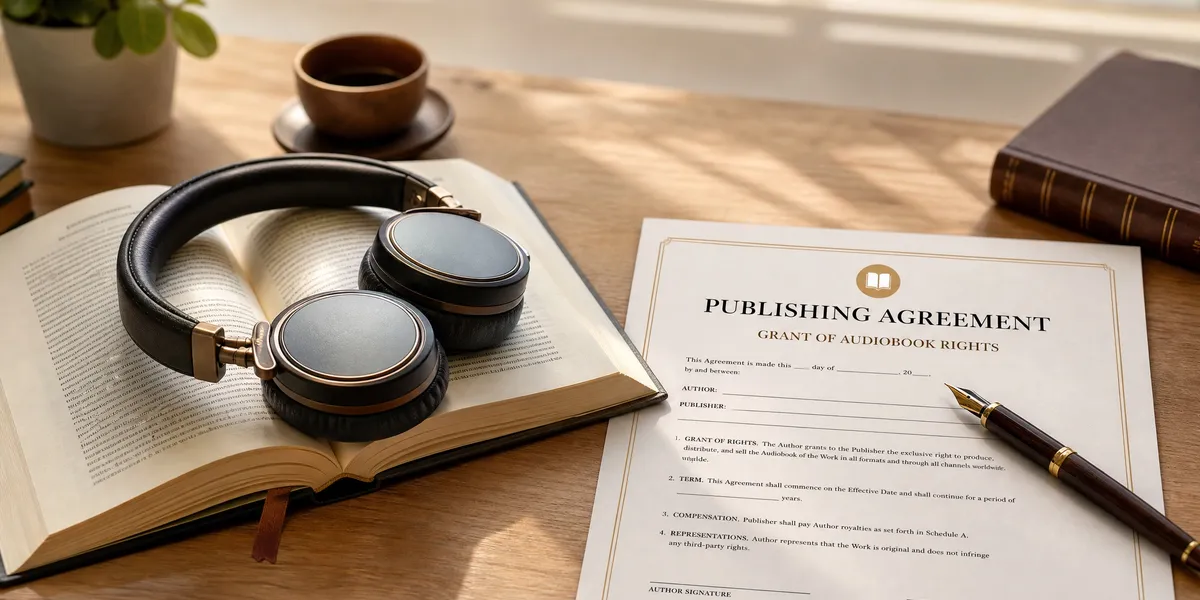
Audiobook rights are the legal permissions that control who can produce, distribute, and sell an audio version of your written work. They’re a subset of your broader copyright — separate from your print rights, ebook rights, film rights, and foreign translation rights.
When you write a book, you automatically own all subsidiary rights, including audio. No one can turn your book into an audiobook without your permission.
The confusion starts when you sign contracts. Traditional publishing deals, distribution agreements, and production contracts all touch your audiobook rights differently. Some ask for a license. Others ask for full ownership transfer. The difference between those two things determines whether you control your audiobook’s future — or someone else does.
Why Audiobook Rights Matter More Than Ever
The audiobook market has grown every year for over a decade. The Audio Publishers Association reports that US audiobook revenue now exceeds $2 billion annually, and global growth is even faster.
That growth means your audiobook rights are increasingly valuable. A book that earns $500 per month in ebook royalties might earn another $300-$800 per month as an audiobook — if you retain the rights and publish it yourself.
Here’s why this matters for you:
- Audiobook listeners are a separate audience. Many never read print or ebooks. You’re reaching people who consume books during commutes, workouts, and chores.
- Royalty rates vary wildly by deal type. You could earn 25% or 70%+ on the same audiobook depending on how you structure your rights.
- Rights are hard to get back. Some contracts lock you in for 7 years. Others lock you in for the life of the copyright. Choose wrong, and you’re stuck.
If you’re self-publishing, you start with full control. The key is not giving it away carelessly.
How Audiobook Rights Work in Traditional Publishing
When you sign a traditional publishing deal, the publisher typically asks for a bundle of rights. Audiobook rights may or may not be included in that bundle.
What Publishers Usually Want
Most traditional contracts include a “subsidiary rights” clause. This covers:
- Print rights (hardcover, paperback, large print)
- Ebook rights
- Audiobook rights
- Foreign translation rights
- Film/TV adaptation rights
The publisher may exercise these rights directly (producing the audiobook in-house) or license them to a third party (like an audiobook publisher) and split the proceeds with you.
What You Should Negotiate
If you have any negotiating leverage, consider these moves:
- Carve out audiobook rights entirely. Keep them and produce the audiobook yourself. This gives you full control and higher royalties.
- Set a “use it or lose it” clause. If the publisher doesn’t produce an audiobook within 12-18 months, the audio rights revert to you.
- Negotiate the split. If the publisher licenses your audiobook rights to a third party, push for a 50/50 split (or better) instead of the standard 75/25 publisher-favored split.
- Add a reversion clause. When the audiobook goes out of print or falls below a sales threshold, the rights come back to you.
The Authors Alliance recommends reviewing every subsidiary rights clause carefully and negotiating to retain any rights the publisher won’t actively exploit.
How Audiobook Rights Work for Self-Published Authors
If you self-publish your book, you retain all rights by default. No publisher owns a piece of your audio rights unless you specifically grant them.
But you still make rights decisions when you choose a distribution platform. Every audiobook distributor requires some form of license agreement — and the terms vary dramatically.
You’re Licensing, Not Selling
When you upload your audiobook to ACX, Findaway Voices (now part of Spotify), or any other platform, you’re granting them a license to distribute your audiobook. You’re not selling your copyright.
The critical distinction: a license can expire or be revoked. A copyright transfer is permanent.
Every distribution agreement specifies:
- Territory — Where the audiobook can be sold (worldwide, specific countries)
- Duration — How long the agreement lasts
- Exclusivity — Whether you can distribute the same audiobook elsewhere
- Royalty rate — What percentage you earn per sale or listen
Understanding these four terms is the foundation of protecting your audiobook rights.
Exclusive vs. Non-Exclusive Audiobook Distribution
This is the single biggest decision you’ll make with your audiobook rights. Exclusive deals offer higher royalty rates on one platform. Non-exclusive deals let you sell everywhere but at lower per-platform rates.
Exclusive Distribution
What it means: You grant one platform the sole right to distribute your audiobook. No other retailer, library, or streaming service can carry it.
ACX exclusive terms (2026):
- Royalty rate: 40% of net revenue
- Lock-in period: 7 years from release date
- Distribution: Audible, Amazon, and iTunes only
- Price control: None — Audible sets your audiobook’s price
The 40% rate sounds good until you realize you’re locked out of Apple Books, Google Play, Spotify, Kobo, libraries, and every other audiobook retailer for seven years. For context, that 7-year term is unusually long in publishing — most book contracts include reversion clauses that activate far sooner.
Non-Exclusive Distribution
What it means: You can distribute your audiobook through multiple platforms simultaneously. Each platform gets a non-exclusive license.
Typical non-exclusive terms:
| Platform | Royalty Rate | Distribution Reach |
|---|---|---|
| ACX (non-exclusive) | 25% | Audible, Amazon, iTunes |
| Findaway Voices | 50-80% | 40+ retailers including libraries |
| Authors Republic | 50-70% | 50+ retailers |
| PublishDrive | 50-70% | Multiple retailers |
| Direct (Apple Books) | 40-50% | Apple ecosystem |
| Google Play Books | 52% | Google ecosystem |
Going non-exclusive — often called going wide — means lower royalties per platform but access to far more listeners across more retailers.
Which Should You Choose?
Choose exclusive if:
- Your genre performs exceptionally well on Audible (romance, thriller, sci-fi)
- You’re doing a royalty-share deal with a narrator (only available through ACX exclusive)
- You don’t plan to actively market on other platforms
Choose non-exclusive if:
- You want to reach library listeners (a massive and growing audience)
- You’re already publishing wide with your ebook
- You don’t want a 7-year lock-in on your audiobook rights
- You want to set your own price
Most indie authors in 2026 are moving toward non-exclusive distribution. The rise of ACX alternatives and aggregators like Findaway Voices has made wide distribution easier than ever.
Audiobook Royalty Rates by Platform
Your royalty rate depends on your distribution model, your contract terms, and how the listener purchases your audiobook. Here’s the current landscape.
Per-Sale Royalties
When a listener buys your audiobook outright:
| Platform | Exclusive Rate | Non-Exclusive Rate |
|---|---|---|
| ACX / Audible | 40% | 25% |
| Findaway Voices | N/A | 50-80% |
| Authors Republic | N/A | 50-70% |
| Apple Books (direct) | N/A | 40-50% |
| Google Play (direct) | N/A | 52% |
Subscription/Streaming Royalties
Many listeners now access audiobooks through subscription services like Audible Plus, Spotify, and library apps. Royalties from streaming are calculated differently — typically from a pool model based on listening time rather than per-unit sales.
Audible is moving toward a streaming-style model where subscriber behavior, listening patterns, and engagement determine how the revenue pool gets divided. This shift mirrors what happened with Kindle Unlimited in the ebook world.
For a deeper breakdown of what you’ll earn, check out our audiobook pricing guide and book royalties calculator.
How to Protect Your Audiobook Rights
Whether you’re traditionally published or self-published, these strategies help you retain control of your audio rights.
1. Read Every Contract Before Signing
This sounds obvious, but many authors sign distribution agreements without reading the fine print. Pay attention to:
- Term length. 7 years is the ACX standard. Some contracts are shorter (1-3 years). Shorter is better for you.
- Auto-renewal clauses. Does the contract renew automatically? What’s the opt-out window?
- Rights granted. Are you granting “worldwide digital audio distribution rights” or something broader?
- Termination conditions. Can you pull your audiobook if you’re unhappy? What are the penalties?
2. Keep Audio Rights Separate From Print/Ebook
If you’re negotiating a publishing deal, push to keep audiobook rights carved out from the main contract. This lets you produce and distribute the audiobook independently for higher royalties.
3. Register Your Copyright
Your book copyright is automatic upon creation, but registration with the U.S. Copyright Office provides additional legal protections. Audiobooks are registered as “Sound Recordings” — a separate category from the underlying literary work. You may want to register both.
4. Use Work-for-Hire Agreements With Narrators
If you hire a narrator, make sure the contract specifies that the narration is a “work made for hire.” This means you own the audio recording outright — not just a license to use it. Without this clause, the narrator may retain rights to their performance.
The same applies to AI narration. When you use an AI narration service, check whether the terms of service grant you full ownership of the generated audio or just a usage license.
5. Track Your Rights and Agreements
Keep a simple spreadsheet tracking:
- Which rights you’ve granted to which platforms
- Contract start and end dates
- Royalty rates and payment schedules
- Reversion triggers and termination windows
When you have multiple books across multiple platforms, this becomes essential for managing your audiobook production costs and revenue streams.
AI Narration and Audiobook Rights in 2026
AI-narrated audiobooks are now accepted on most major platforms, but the rights landscape is still evolving. Here’s what you need to know.
Your Copyright Is Unaffected
Whether a human narrator or an AI voice reads your book, your underlying copyright remains the same. The story is yours. The words are yours. The audio format doesn’t change that.
Platform Acceptance
Most platforms now accept AI-narrated audiobooks:
- ACX: Accepts AI narration (must be disclosed)
- Google Play Books: Has its own AI narration program
- Findaway Voices: Accepts AI narration from most providers
- Apple Books: Accepts with disclosure
- Spotify: Accepts via distributors
If you’re considering AI narration, our guide on how to create an audiobook with AI walks through the full process.
Rights Considerations for AI Audio
When using AI narration services, check these terms:
- Output ownership. Do you own the generated audio file? Most services say yes, but read the fine print.
- Commercial rights. Can you sell the AI-generated audiobook commercially? Most platforms now allow this.
- Voice licensing. If you use a cloned or licensed voice, are there restrictions on distribution or territory?
- Platform-specific rules. Some platforms require you to disclose AI narration. Others may restrict promotional features for AI-narrated titles.
Common Mistakes Authors Make With Audiobook Rights
Avoid these pitfalls that cost authors money and control:
- Signing exclusive deals without understanding the term length. A 7-year exclusive contract with ACX means you can’t go wide until 2033 if you sign today.
- Giving away audio rights in a traditional deal and forgetting about them. If your publisher isn’t producing an audiobook, you’re losing money on a dormant right.
- Not including work-for-hire language in narrator contracts. Without it, the narrator may have a claim to the audio recording.
- Ignoring reversion clauses. Always negotiate a path to get your rights back if the other party isn’t actively exploiting them.
- Assuming all platforms have the same terms. Royalty rates range from 25% to 80% depending on the platform and deal type. Compare before committing.
Should You Sell or License Your Audiobook Rights?
License — almost always. Selling (transferring) your audiobook rights means permanently giving up control. Licensing means granting temporary, defined permission.
When you license your audiobook rights, you keep ownership and can renegotiate terms when the contract expires. When you sell or transfer rights, they’re gone unless the buyer agrees to sell them back.
The only scenario where selling makes sense is a large upfront rights deal — the kind you’d negotiate with a literary agent for a six-figure audiobook advance. For most indie authors, licensing through distribution platforms is the better path.
If you’re weighing self-publishing vs. traditional publishing overall, your audiobook rights strategy should be part of that decision.
How Do Audiobook Rights Differ From Ebook or Print Rights?
Audiobook rights are a separate subsidiary right from your print and ebook rights. Owning print rights doesn’t automatically give someone audiobook rights, and vice versa.
The key differences:
- Audiobook rights involve a performance. A narrator (human or AI) creates a derivative work based on your text. The recording itself has its own copyright layer.
- Distribution channels are different. Audiobooks sell through Audible, Apple Books, Google Play, Spotify, and library systems — not Amazon’s Kindle store or bookstores.
- Pricing models differ. Audiobooks are sold per-unit, through credits, or via subscription streaming. Each model affects your royalties differently.
- Contract terms are often longer. Audiobook distribution agreements frequently have 3-7 year terms, while ebook distribution can often be terminated more quickly.
You can grant your ebook rights to one party, your audiobook rights to another, and your film rights to a third. Each is an independent negotiation.
Can You Get Your Audiobook Rights Back?
Yes — but the process depends on your contract.
For self-published audiobooks on ACX: You must wait until your 7-year exclusive term expires (or your non-exclusive agreement term ends). ACX does not allow early termination except in specific circumstances.
For traditionally published audiobooks: Look for the reversion clause in your contract. Common triggers include:
- The audiobook going “out of print” (though digital books rarely go out of print)
- Sales falling below a specified threshold
- The publisher failing to produce an audiobook within a set timeframe
- The contract term expiring
The Authors Alliance publishes a detailed guide on rights reversion that covers the legal process for reclaiming subsidiary rights, including audio.
If your rights are stuck in a contract you regret, consult a publishing attorney. The cost of legal advice is worth it when the alternative is seven years of lost audiobook income.
FAQ
What does “audiobook rights” mean?
Audiobook rights refer to the legal permissions controlling who can produce, distribute, and sell an audio version of a written work. As the author, you automatically own these rights unless you transfer or license them to a publisher or distributor through a contract.
Can I keep my audiobook rights if I sign with a publisher?
Yes, you can negotiate to retain audiobook rights in a traditional publishing contract. Ask to carve out audio from the subsidiary rights clause. If the publisher insists on including them, add a “use it or lose it” reversion clause so the rights return to you if no audiobook is produced within 12-18 months.
What is the difference between exclusive and non-exclusive audiobook rights?
Exclusive audiobook rights grant one platform sole distribution access — ACX offers 40% royalties but locks you in for 7 years. Non-exclusive rights let you distribute across multiple platforms simultaneously at lower per-platform rates (25-80%), giving you broader reach and more control.
How much do audiobook royalties pay?
Audiobook royalties range from 25% to 80% depending on your distribution model. ACX exclusive pays 40%, ACX non-exclusive pays 25%, and aggregators like Findaway Voices pay 50-80%. Direct uploads to Apple Books and Google Play typically earn 40-52% of net revenue.
Do I need a separate copyright for my audiobook?
Your underlying book copyright protects the text automatically. However, the audio recording itself qualifies as a “Sound Recording” — a separate copyright category. Registering both with the U.S. Copyright Office provides stronger legal protection if you ever need to enforce your rights.