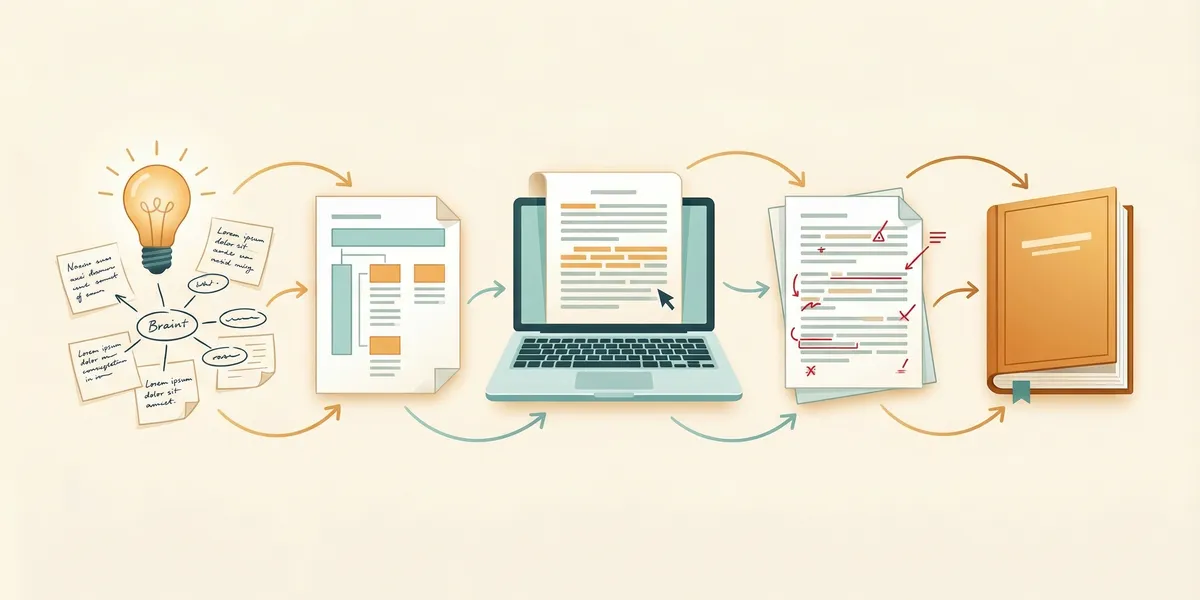
The writing process is a repeatable set of steps that takes you from a raw idea to a polished, finished piece. Whether you’re writing a novel, a memoir, or a business book, the same core stages apply. According to Purdue University’s Online Writing Lab, the process typically involves prewriting, drafting, revising, and editing — though most experienced writers treat these stages as recursive rather than strictly linear.
This guide breaks the writing process into seven practical steps you can follow from first spark to finished manuscript.
1. Prewriting: generate and organize your ideas
Prewriting is everything you do before writing actual sentences. It is the most overlooked step in the writing process, and skipping it is the fastest way to stall out at chapter three.
Start by clarifying two things: what you want to say and who you’re saying it to. A memoir about growing up in rural Appalachia needs different framing than a business book about scaling a startup.
Prewriting techniques that work:
- Freewriting. Set a timer for 15 minutes and write without stopping. Don’t judge, correct, or organize. The goal is volume, not quality.
- Mind mapping. Put your central topic in the middle of a page and branch out with related ideas, subtopics, and questions your reader might have.
- The question method. Write down every question your reader would need answered by the end of your book. Group them into clusters — those clusters become your chapters.
- Research gathering. Collect quotes, data, anecdotes, and references. Nonfiction writers should do this early. Fiction writers often research setting, time period, and subject expertise at this stage.
The University of Kansas Writing Center emphasizes that prewriting should take a significant portion of your total writing time. Rushing through it leads to structural problems that are painful to fix later.
2. Outlining: build your book’s structure
An outline transforms scattered ideas into a roadmap. Some writers use detailed chapter-by-chapter outlines. Others prefer a loose list of major beats. Either approach works — what matters is that you have a structure before you start drafting.
For nonfiction books:
Organize your outline around the reader’s transformation. What do they know at the start? What should they know or be able to do by the end? Each chapter moves them one step along that path.
A typical nonfiction book outline follows this pattern:
- Hook the reader and establish the problem
- Build foundational concepts
- Deliver the core framework or method
- Address objections and edge cases
- Provide next steps and a clear conclusion
For fiction:
Structure varies by genre, but most novels follow a three-act structure or a variation of the hero’s journey. Map out your major plot points: the inciting incident, the midpoint shift, the climax, and the resolution.
Your outline doesn’t need to be rigid. Think of it as a GPS route — you can take detours, but you always know where you’re headed.
3. Drafting: write the first version
Drafting is where most people get stuck, and the reason is almost always the same: they try to write and edit simultaneously. These are separate stages of the writing process, and mixing them kills momentum.
The first draft has one job — to exist. It doesn’t need to be good. It needs to be complete.
Practical drafting strategies:
- Set a daily word count. Research from the National Novel Writing Month (NaNoWriMo) community shows that 1,000 to 2,000 words per day is sustainable for most writers. At that pace, a 60,000-word book takes 30 to 60 days.
- Write in order or out of order. Some writers draft chronologically. Others write whichever scene or chapter excites them most. Both approaches produce finished manuscripts.
- Use placeholders. Can’t find the right word? Type [TK] and move on. Need to verify a fact? Mark it [CHECK] and keep going. Stopping to research mid-sentence is a productivity trap.
- Protect your writing time. Treat your writing session like a meeting you can’t cancel. Close your browser tabs. Put your phone in another room.
The question of how long it takes to write a book depends entirely on how consistently you show up to the draft.
Our Pick — Chapter
Chapter helps you move from outline to complete draft faster. The platform’s AI-assisted writing tools generate chapter drafts based on your outline and voice, which you then refine and expand. Over 2,147 authors have used Chapter to produce more than 5,000 books.
Best for: Authors who want to accelerate the drafting phase without losing their voice Pricing: $97 one-time (nonfiction) Why we built it: Because the drafting stage is where most books die — and having a system that keeps you moving eliminates the blank-page problem.
4. Revising: reshape and strengthen your work
Revising is not the same as editing. Revision addresses the big picture: structure, argument flow, character development, pacing, and whether each chapter earns its place.
According to MIT’s Writing and Communication Center, revision is where good writing actually happens. The first draft captures your ideas. Revision shapes them into something a reader wants to finish.
What to look for during revision:
- Structure. Does the book flow logically? Are there sections that repeat or contradict earlier ones?
- Pacing. Are there chapters that drag? Sections where you lose momentum? Cut or compress them.
- Clarity. Would a reader who knows nothing about your topic follow every argument? Read each chapter as if you’ve never seen it before.
- Stakes. In fiction, does the tension rise throughout? In nonfiction, does each chapter deliver clear value?
A practical approach: read your entire manuscript in one or two sittings (print it out if possible). Take notes on what feels slow, confusing, or unnecessary. Then make structural changes before moving to sentence-level edits.
Most published authors revise their manuscript at least two or three times before it goes to an editor. Don’t expect one revision pass to be enough.
5. Editing: polish at the sentence level
Once the structure is solid, shift to line-level editing. This is where you refine word choice, fix awkward phrasing, tighten paragraphs, and ensure every sentence pulls its weight.
The three levels of editing:
| Edit type | What it covers | When to do it |
|---|---|---|
| Developmental editing | Structure, argument, narrative arc | After first draft |
| Line editing | Sentence flow, word choice, tone | After revision |
| Copyediting and proofreading | Grammar, spelling, punctuation, consistency | Final pass before publishing |
Self-editing tips that professional writers use:
- Read aloud. Your ear catches problems your eye skips. Awkward rhythm, repeated words, and unclear sentences become obvious when spoken.
- Cut 10%. Most first drafts are at least 10% too long. Challenge every adverb, every qualifying phrase, and every sentence that restates what you just said.
- Search for your crutch words. Every writer overuses certain words. Common offenders: “just,” “really,” “very,” “actually,” “that.” Find yours with your word processor’s search function and eliminate the unnecessary ones.
- Check your transitions. Each paragraph should connect to the next. Each chapter should set up the one that follows.
Even with thorough self-editing, hire a professional editor before publishing. The Editorial Freelancers Association maintains a directory of vetted professionals and publishes industry-standard rates.
6. Getting feedback: test your work with readers
No writer can fully evaluate their own work. You’ve been too close to it for too long. External feedback reveals blind spots you literally cannot see.
Types of feedback and when to seek each:
- Beta readers. Recruit three to five people from your target audience. Give them specific questions: Where did you lose interest? What confused you? What would you cut? Read more in our guide to beta readers.
- Writing groups or critique partners. Fellow writers catch craft issues — weak dialogue, inconsistent point of view, unclear show-don’t-tell execution — that casual readers might feel but can’t name.
- Professional editors. A developmental editor provides the most thorough structural feedback. Budget for this if your book is for commercial publication.
How to use feedback effectively:
Not all feedback is equal. Look for patterns. If three out of five beta readers found chapter four confusing, chapter four needs work. If one reader didn’t like your protagonist’s name, that’s personal preference.
Resist the urge to explain or defend your choices when receiving feedback. If a reader didn’t understand something, the text didn’t communicate it clearly enough — regardless of what you intended.
7. Publishing: deliver your finished work
The writing process doesn’t end when the last word is edited. Publishing is the final step, and it requires its own set of decisions.
Your two main paths:
Traditional publishing involves querying literary agents, receiving a book deal, and working with a publishing house. The process is slow (18 to 24 months from deal to bookshelf) but provides advance payments, professional production, and bookstore distribution. Learn more in our self-publishing vs. traditional publishing comparison.
Self-publishing gives you full control over timeline, pricing, and creative decisions. Platforms like Amazon KDP make it possible to publish within weeks of finishing your manuscript. The trade-off is that you handle marketing, cover design, and distribution yourself — or hire professionals for each.
Before you publish, complete these steps:
- Professional cover design (readers absolutely judge books by covers)
- Interior formatting for print and ebook
- ISBN registration if publishing outside Amazon exclusivity
- A book launch plan including pre-orders, email list outreach, and launch-week promotions
The writing process is recursive. Even at the publishing stage, you may discover sections that need revision. That’s normal and expected.
Common mistakes to avoid
- Editing while drafting. These are separate steps for a reason. Draft first, edit later. Mixing them guarantees slow progress and frustration.
- Skipping the outline. Even a loose one. Writers who “just start writing” frequently hit a wall around the 20,000-word mark because they never established where the book was going.
- Waiting for inspiration. Professional writers don’t wait to feel inspired. They write on schedule. Inspiration follows effort, not the other way around.
- Revising too early. Don’t start revising until the full draft is complete. Polishing chapter one while chapters ten through fifteen don’t exist is procrastination disguised as productivity.
- Ignoring feedback. If you never show your work to another person before publishing, you’re guessing about whether it works. Get external eyes on it.
FAQ
What are the 5 steps of the writing process?
The traditional five-step model includes prewriting, drafting, revising, editing, and publishing. This framework is taught in most composition courses, though professional writers often add outlining and feedback as distinct stages, expanding the process to seven steps.
Is the writing process linear?
No. The writing process is recursive, meaning you’ll cycle back through earlier stages as your work develops. You might return to prewriting after a draft reveals a structural gap, or revise sections while editing if you discover a logic problem. The stages provide a framework, not a rigid sequence.
How long does the writing process take for a book?
Timelines vary widely. A focused nonfiction book can be drafted in 30 to 90 days. A complex novel may take six months to a year. The total process from initial idea through published book typically ranges from three months to two years, depending on the writer’s schedule, the project’s complexity, and whether they’re self-publishing or pursuing a traditional deal.
How is the writing process different for fiction vs. nonfiction?
The core stages are identical. The main differences show up in prewriting (fiction emphasizes character and plot development, nonfiction emphasizes research and audience analysis) and in outlining (fiction outlines follow narrative structure, nonfiction outlines follow logical argument). The drafting, revising, editing, and publishing stages work the same way for both.
Can AI help with the writing process?
Yes. AI tools can assist at every stage — from brainstorming and outlining to drafting and editing. The key is using AI as an accelerator rather than a replacement. Tools like Chapter are designed specifically for book-length projects, helping authors generate drafts from their outlines while maintaining their unique voice and perspective.